








Background and Context
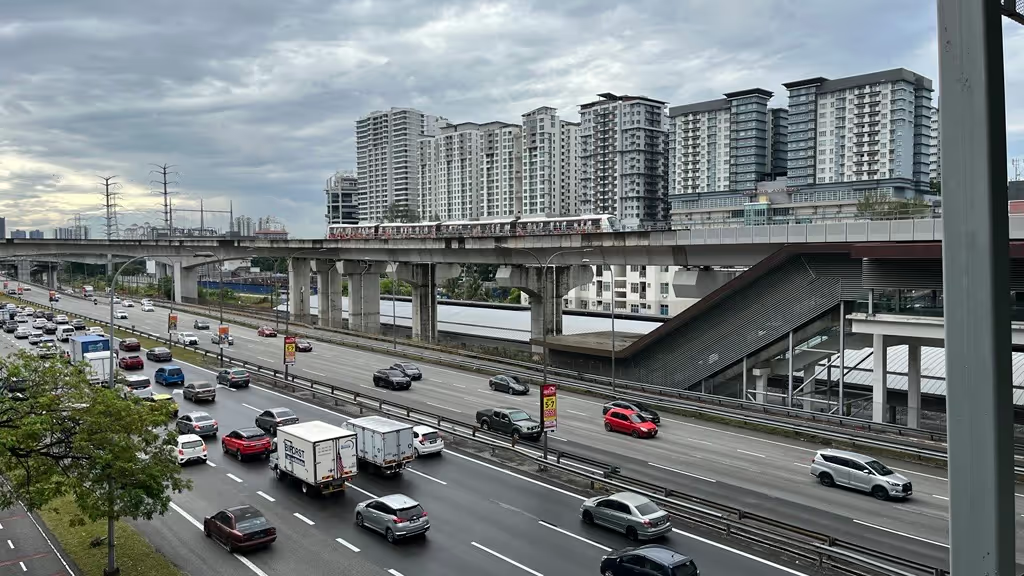
Phase 1 of the Greater Kuala Lumpur Mobilities (GKLMOB) study is a multi-method research programme examining how people experience public transport in their daily lives. Phase 1 brings together qualitative interviews, operational performance analysis, and spatial assessment to understand why ridership growth remains uneven despite significant public investment in transport infrastructure.
This study encompasses two discussion papers, one working paper, and three policy briefs as outlined below:
Discussion Papers
Discussion Paper: Assessing Bus Performance in Greater Kuala Lumpur
Technical & Supporting Research
Working Paper: The Anatomy of Bus Stops
Discussion Paper 1 - Greater Kuala Lumpur's Public Transportation and its Viability: A Qualitative Study
- Despite significant government investment in public transport infrastructure, ridership growth in Malaysia remains uneven. This suggests that expanding public transport infrastructure alone does not guarantee that services can meet the commuters’ standards and needs.
- This paper adopts a qualitative, phenomenological approach to centre the lived experiences of choice riders. By surfacing these lived experiences, personal standards and decision-making process, we seek to uncover the behavioural factors and subjective preferences that influence commuters’ travel mode choice.
- We conducted 34 semi-structured interviews with choice riders across urban and sub-urban areas. This allows us to better understand how choice riders interpret service quality and negotiate trade-offs in choosing public transport over private vehicles.
- Our findings show that public transport in Greater Kuala Lumpur is perceived as working well enough to use, yet fragile enough to be set aside. Commuters’ perceptions are shaped by three set of experiences: commuting journey experience, reliability of the operating services, and social and environmental conditions.
Discussion Paper 2 - Assessing Bus Performance in Greater Kuala Lumpur
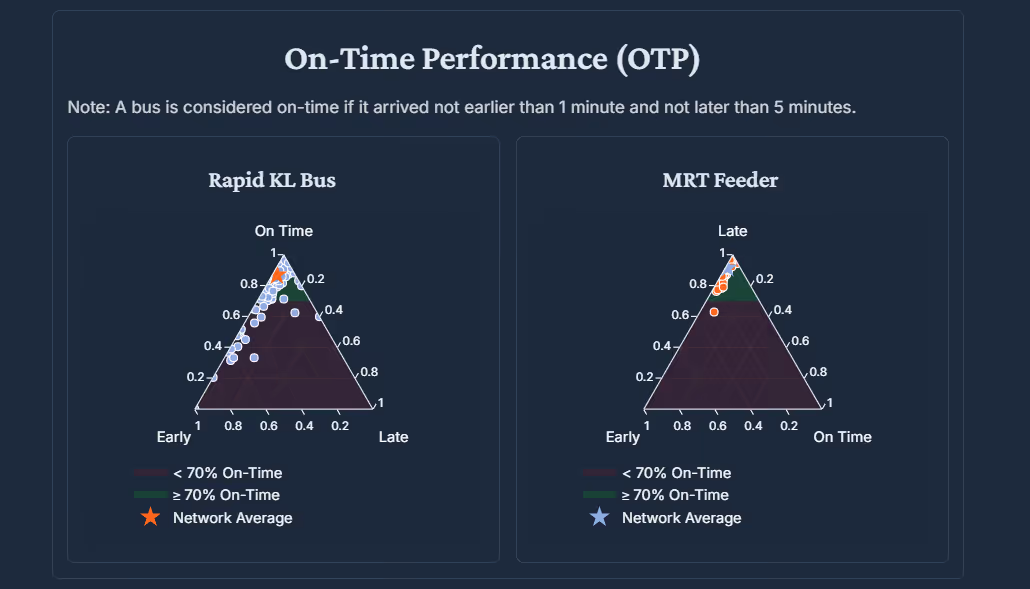
- Bus reliability in Greater Kuala Lumpur remains uneven, contributing to commuter distrust in bus services. Using high-frequency GTFS static and real-time data, we show that while many routes achieve acceptable punctuality scores on average, a non-trivial subset of Rapid KL bus routes exhibit large and unpredictable deviations. These deviations undermine commuters’ ability to plan daily travel and erode confidence in busses as a dependable mode of transport.
- We develop a Bus Performance Index (BPI) that integrates punctuality with the severity of service deviations. By combining on-time performance with a normalized measure of deviation magnitude, the BPI distinguishes between routes that are occasionally late, and those that fail severely when they happen to be late. This allows the index to more closely reflect commuter experience.
- MRT Feeder services consistently outperform Rapid KL bus routes both in reliability and predictability. Across the study period, MRT Feeder routes record higher BPI scores, tighter performance distributions, and near-zero collapse rates. In contrast, while the specific Rapid KL bus routes with very low scores vary from day to day and week to week, the proportion of such low-performing routes remain relatively stable over time. This pattern points to a systemic reliability issue embedded in the network.
- Meaningful near-term improvements in reliability can be achieved through targeted operational reforms, even within existing infrastructural constraints. The results point to practical interventions such as timetable recalibration using real-time data, improving real-time passenger information, and bus control strategies such as conditional transit signal priority. These measures directly address reliability failures that commuters experience today, while also strengthening the effectiveness and resilience of future infrastructural investments when capacity expansion becomes necessary.
Working Paper - The Anatomy of Bus Stops
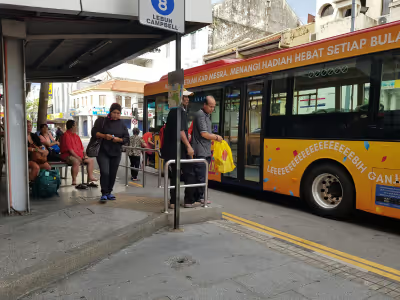
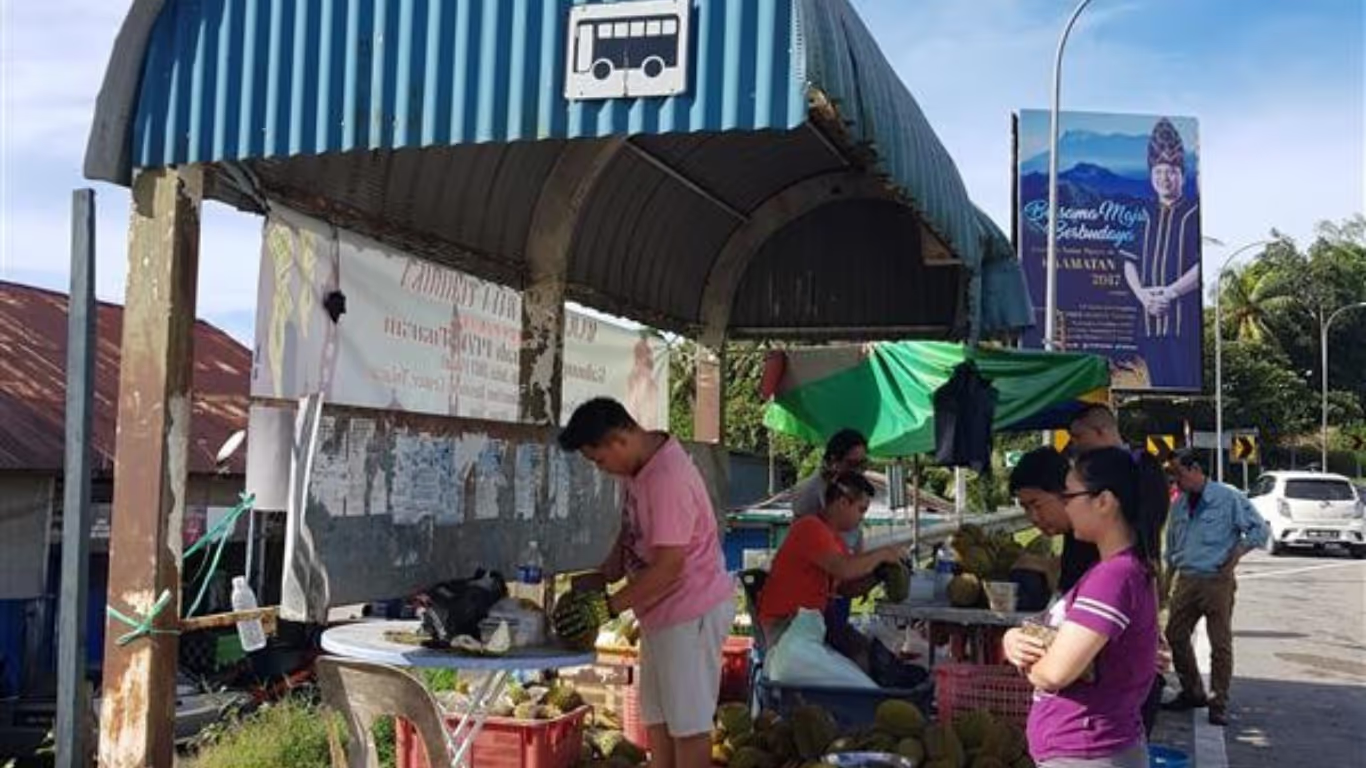
- Bus stop infrastructure across Greater KL is structurally inadequate. A computer vision assessment of more than 5,000 bus stop images shows that most stops lack essential amenities such as shelters, benches, lighting, and clear signage. These deficiencies are widespread, with little to no moderate-high quality bus stop amenities distributed across geographical clusters.
- Amenity gaps meaningfully affect perceived waiting time, safety and the decision to use public transport. Evidence from the literature suggests that poor waiting environments increase perceived wait durations on the part of the rider. This reduces feelings of safety, and discourage use, particularly among groups that are more sensitive to how safety and comfort is experienced.
- Two policy interventions offer immediate improvements. A national bus stop design standard would establish minimum requirements for safety, accessibility and comfort, guiding bus stop upgrades across jurisdictions. Real-time arrival information systems, through countdown displays reduce uncertainty and significantly improve perceived waiting time even when bus frequency remains unchanged.
Policy Briefs - From Findings to Action
Alongside the discussion papers, a series of policy briefs has been released to translate Phase 1 findings into actionable recommendations. The briefs focus on practical levers that can strengthen public transport use in the near term, while complementing longer-term infrastructure planning.
Policy Briefs
Policy Brief 1: Waiting Without Knowing: How Information Gaps Undermine Trust in Public Transport
Policy Brief 2: When Buses Are Almost Reliable: Why Inconsistency Matters More Than Average Performance
Policy Brief 3: Closing the First- and Last-Mile Gap in Greater Kuala Lumpur
The three policy briefs and their related recommendations are summarised as follows:
Policy Brief 1 - Waiting Without Knowing: How Information Gaps Undermine Trust in Public Transport
When service frequency is high, commuters can often arrive at a stop without consulting real-time information. However, when services are in low frequency, as is the case in our bus services, the quality of information provided is important because it becomes the primary buffer against uncertainty and frustration. Inadequate information therefore amplifies perceived delays and undermines trust in the bus services.
To strengthen information as a buffer against uncertainty, we recommend the following:
- Provide stop-level scheduled arrival times alongside real-time ETAs of the next two busses
- Revise scheduled headways using observed operating conditions
- Introduce personalized and proactive information features
- Disseminate real-time information through multiple channels, including at high-ridership bus stops
Policy Brief 2 - When Busses are Almost Reliable: Why Inconsistency Matters More than Average Performance
The probability of missing the bus is a great source of anxiety. If commuters miss the bus, the consequence would be an additional 20 to 40 minutes wait for the next bus to arrive. Faced with this risk, the rational response is therefore either to arrive excessively early or to use other modes of travel. Either responses undermine public transport ridership. To reduce this risk and restore confidence in bus services, we recommend the following:
- Keep busses from leaving early at every stop
- Align timetables with real conditions or to add busses
- Reduce intersection delay where it hurts reliability the most
- Protect busses during peak periods with enforceable bus lanes
Policy Brief 3 - Closing the First-and-Last Mile Gap in Greater Kuala Lumpur
Improving first-and-last mile access in Greater KL requires recognizing that commuters face different constraints depending on where they live. In urban areas, walking can be dangerous or uncomfortable. While in peri-urban areas, distances to stations are often too long for walking and feeder services tend to be less frequent or less reliable. To address these diverse conditions, we recommend the following:
- Make walking safe, continuous and predictable in urban areas
- Reduce the impact of distance and coordination burdens in peri-urban areas
- Deploy targeted community-scale service in low-density clusters
Open Data and Reproducible Research
At Khazanah Research Institute (KRI), we believe that data comes alive when it is seen and understood. Through clear, compelling, and interactive data visualisations, we turn complex research findings into stories that are accessible, relatable, and actionable. Our visualisations highlight the patterns, trends, and human dimensions behind Malaysia’s most pressing economic, social, and structural challenges, helping policymakers, communities, and the public make informed decisions that strengthen families, uplift communities, and drive inclusive national progress. We would like to share our code and datasets to contribute to these efforts.
GitHub Repositories
Interactive Data & Visual Stories
1. Bus Performance Data Dashboard
2. Data Scrollytelling: How Bus Services Work in Practice
3. Open Dataset (Public Use)
The Greater Kuala Lumpur Mobilities research project is led by Gregory Ho, Senior Research Associate, with research assistance from Kelvin Ling Shyan Seng and Shukri Mohamed Khairi at the Khazanah Research Institute (KRI), and advised by Dr. Suraya Ismail, Director of Research at KRI. All Phase 1 research outputs, including the discussion papers and policy briefs, are available for download at: www.KRInstitute.org.
Media Release
1. Press Release (English)
2. Siaran Media (Bahasa Malaysia)