







Discussion Papers
Dec 30, 2025
6
Minutes read

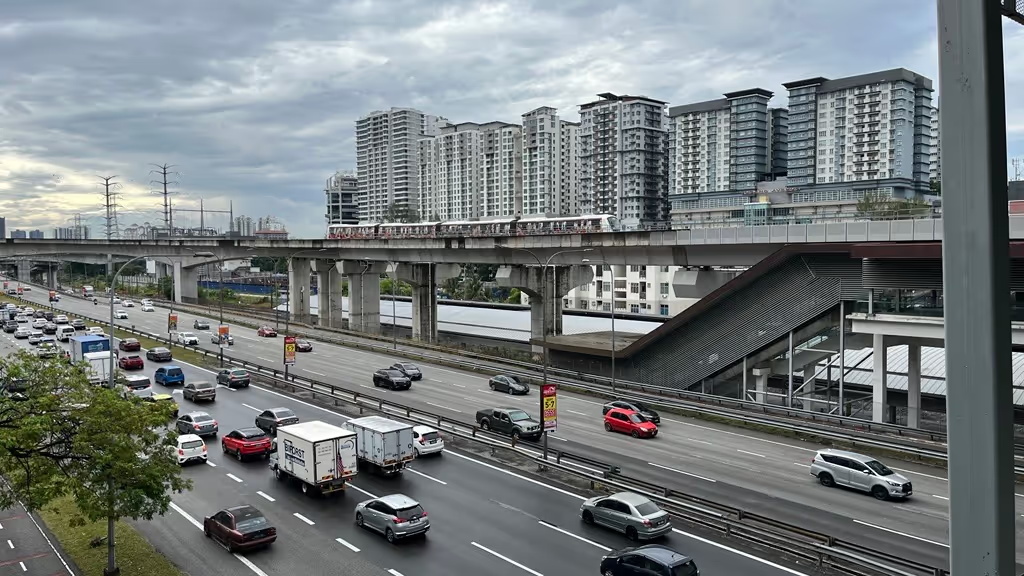
Greater Kuala Lumpur’s Public Transportation and its Viability: A Qualitative Study

Key Takeaways
Data Sets Overview
  • Commuters perceive public transport as functional enough to use but fragile enough to abandon. Their perceptions are shaped by three clusters of experiences: the commuting journey, the reliability of operating services, and social or environmental conditions.
  • In their commuting journey experience, respondents prioritize comfort and safety throughout the trip, value the ability to manage their own time, and find mental relief in not having to drive.
  • The reliability of operating services strongly influences mode choice. Commuters compare services by their reliability, accessibility (including first- and last-mile considerations), and how interchanges or station layouts affect trip smoothness.
  • Social and environmental conditions shape comfort levels along the journey. Weather conditions amplify discomfort, while encounters in public transport spaces also influence how commuters evaluate the overall experience.
  • People are keen to use public transport, but there are key critical factors (e.g. reliability, comfort and safety, travel time, transfers and accessibility) that we have identified as friction points. These have the potential to encourage or to impede them from continuing to use public transport.

greater-kuala-lumpurs-public-transportation-and-its-viability-a-qualitative-study
Discussion Papers
Peer-reviewed publications designed to share emerging research or early analysis on key issues. Discussion Papers aim to invite feedback, encourage dialogue, and inspire further study or collaboration.
Disclaimer
As we transition to a digital-first communication and continue building our knowledge hub, publications released before October 2025 are preserved in their original format. Publications released from October 2025 onward adopt a new, digitally friendly format for easier online reading. The official versions of earlier publications, including their original language and formatting, remain available in the downloadable PDF.

Summary

• Despite significant government investment in public transport infrastructure, ridership growth in Malaysia remains uneven. This suggests that expanding public transport infrastructure alone does not guarantee that services can meet the commuters’ standards and needs.

• This paper adopts a qualitative, phenomenological approach to centre the lived experiences of choice riders. By surfacing these lived experiences, personal standards and decision-making process, we seek to uncover the behavioural factors and subjective preferences that influence commuters’ travel mode choice.

• We conducted 34 semi-structured interviews with choice riders across urban and sub-urban areas. This allows us to better understand how choice riders interpret service quality and negotiate trade-offs in choosing public transport over private vehicles.

• Our findings show that public transport in Greater Kuala Lumpur is perceived as working well enough to use, yet fragile enough to be set aside. Commuters’ perceptions are shaped by three set of experiences: commuting journey experience, reliability of the operating services, and social and environmental conditions.


Read Full Publication

Article highlight

featured report

Conclusion

Attributes
Footnotes
References
Photography Credit

Related to this Publication

No results found for this selection
You can  try another search to see more

Want more stories like these in your inbox?

Stay ahead with KRI, sign up for research updates, events, and more

Thanks for subscribing. Your first KRI newsletter will arrive soon—filled with fresh insights and research you can trust.

Oops! Something went wrong while submitting the form.
Follow Us On Our Socials