







Introduction and Context
Public discourse on Greater Kuala Lumpur (GKL)’s busses usually focus on the reliability issues. One dimension of reliability has to do with early departures. A rational commuter would like to arrive at the bus stop just a few minutes before the bus arrives.
For these commuters, an early departure means a missed bus. And, on many routes, the consequence would be an additional 20-to-40-minutes wait for the next bus to arrive. Faced with this risk, the rational response is therefore to arrive excessively early, which would waste the commuter’s time, or to abandon the system altogether in favour of a different mode of travel. Either response supresses ridership.
Early departures are especially damaging in low frequency networks like Greater KL’s. In high frequency systems, missing a bus is inconvenient, but recoverable. In Greater KL’s context, headways can be long and uneven. A single early departure could derail an entire trip. Behavioural research shows that when predictability collapses, perceived waiting time increases sharply even if the actual delay is modest.
Looking into the problem: Departure Non-Compliance and Schedule Variance
This diagnosis is supported by evidence from KRI’s Bus Performance Index (BPI) . Our recent discussion paper shows that (1) System wide on-time performance (OTP, -1 to +5min) for Rapid KL busses hovers between 68-72%, compared to 90-92% for MRT Feeder services. More importantly, Early departures (departures more than 1min ahead of schedule) occur in approximately 12% of trips, disproportionally affecting low-frequency routes operating on major corridors. At least 18% of routes register a Bus Performance Index of Zero (BPI = 0) on any day in any given month.
Qualitative interviews reinforce these findings:
“For bus, I think maximum 5 minutes [late from schedule]. Anything more, might as well just take another bus.” (R23)
“Certain public transport macam bus berbayar [Rapid KL] tu, dia tak beat the allegation. Memang dia lambat.” (R21)
Taken together, these findings point to a clear conclusion. Improving bus reliability in Greater KL is not only a question of adding bus capacity. It requires restoring control over departures, and stabilising services. The sections that follow outline a set of targeted control strategies that can achieve this without large capital expenditure.
Policy Recommendations – Four interventions can restore predictability
Improving bus reliability in Greater KL requires targeted operational reforms that stabilize departures, align schedules with real conditions, and protect buses at points of recurrent delay. Four interventions stand out:
Policy Recommendation 1: Keep busses from leaving early at every stop
This is the most simple and impactful step. A schedule is only meaningful if busses follow their appointed schedule, and do not depart before their stated time.
Operators should introduce holding control not only at terminals, but at intermediate stops where early departures commonly occur. Using real-time data, dispatchers should monitor scheduled departure adherence and be given clear authority to correct deviations immediately. If a bus is three minutes early at a downstream stop, the driver should be instructed to wait until the scheduled departure time, if road conditions allow for this.
From a commuter’s perspective, this closes the single most painful gap in the system: the fear that the bus may already be gone even when they arrive early or on-time. When early departures are prevented, the timetable becomes a reliable reference point again.
Policy Recommendation 2: Align timetable with real conditions or to add busses
On many routes, scheduled run-times do not reflect actual travel durations. Analysis of the GTFS real-time data shows that actual headways and travel times often exceed what is scheduled.
Operators should use observed real-time data to identify consistent slow-zones, defined by location or time of day, and adjust dwell allowances accordingly. This allows schedules to reflect real operating patterns, so that busses can depart each stop on time rather than accumulating delays downstream.
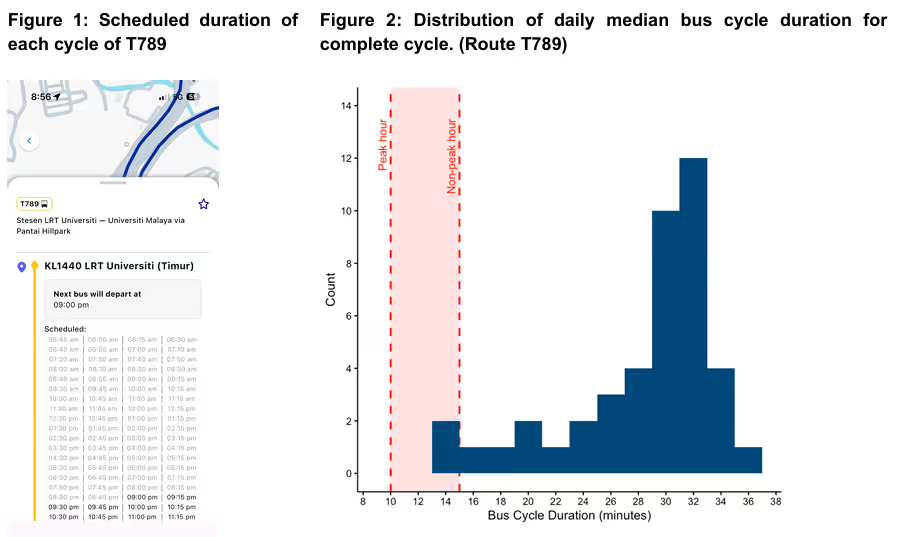
For example, while the published timetable for Route T789 indicates an average headway of 10 minutes, observed data suggests that actual headways are closer to 30 minutes. Persisting with unrealistic schedules widens the gap between expectation and reality. Revising schedules to match observed conditions improves predictability, even if nominal frequency is temporarily reduced.
Schedule alignment should be treated as an iterative process. As operating conditions improve, frequencies can be increased.
Policy Recommendation 3: Reduce intersection delay where it hurts reliability the most
Analysis of BPI and route-level performance identifies specific chokepoints where busses lose disproportionate amounts of time at signalised junctions. Examples include T788 (Stesen LRT Universiti ~ Mid Valley), DS01 (AM) (Stesen LRT Ampang ~ KLCC via AKLEH) and T603 (Stesen LRT Puchong Prima ~ Taman Mas Sepang),
In these locations, congestion routinely overwhelms signal cycles, causing busses to lose time even when lights turn green. Conditional Transit Signal Priority (TSP) can help stabilise travel time by granting busses a few additional seconds of green only when they are running behind schedule.
When deployed selectively, conditional TSP improves reliability without materially disrupting general traffic flow. International experience shows that targeted intersection management reduces variability on congested corridors and supports timetable adherence.
Policy Recommendation 4: Protect busses during peak periods with enforceable bus lanes
Peak-hour bus lanes are effective when they are time-specific, clearly marked, enforceable by cameras and paired with public communication.
We recommend introducing time-of-day bus lanes along critical corridors such as KLG3A (Taman Sri Andalas ~ Bandar Klang), SA02 (Hentian Bandar Seksyen 14 ~ Stesen KTM Batu Tiga) and 300 (Hab Pandan Indah ~ Lebuh Ampang). Enforcement should be paired with signage and public awareness campaigns that communicate the purpose and hours of operation.
International experience shows that digitally enforced peak-hour bus lanes can substantially improve bus speeds by up to 36% in enforced routes when applied selectively. By giving preferential treatment to busses during periods of peak stress, these lanes help prevent timetable collapse and support consistent operations.
Managing the transition
These reforms are not costless. Holding busses may feel counterintuitive to commuters watching a stationary vehicle. TSP and bus lanes may draw resistance from drivers. Drivers and dispatches may face new operational expectations.
However, these risks are manageable when agencies communicate transparently, provide clear before-and-after evidence, and support frontline staff with training and incentives. In the short-term there will be fewer missed busses, smoother transfers and lower stress levels on the part of the commuter. In the medium term, improved control supports better integration with real-time information systems. In the longer term, confidence in bus timetables can be restored.
Conclusion
Public transport succeeds when people can depend on it. Not occasionally, but for everyday use. The strategies outlined in this brief are neither new nor glamorous. They do not require massive capital expenditure, as the building blocks for these are already available. What is missing is a clear and consistent execution sequence. Rebuilding trust in Greater KL’s bus system begins with protecting the timetable.
.jpg)