







Discussion Papers
May 28, 2026
6
Minutes read

The Geoeconomics of Food Dependencies in Malaysia/Southeast Asia

Authors
Christopher Choong Weng Wai
Teoh Ai Ni
Teoh Ai Ni
Nik Syafiah Anis Nik Sharifulden
Adam Manaf Mohamed Firouz
Dania Arissa Muhamad Zaharin
Key Takeaways
Data Sets Overview

This discussion paper examines Malaysia and Southeast Asia’s food security through the lens of structural food dependencies, rather than treating the looming crisis as a mere short-term spillover from supply disruptions linked to the war in Iran. It situates these dependencies within wider geopolitical and geoeconomic pressures, particularly the ongoing rivalry between the United States and China.

The paper focuses on eight key food commodities to map how dependency operates across the region. While intra-regional trade has provided some buffer against over-reliance on major powers, market concentration remains high and regional trade remains limited. Thailand and Vietnam demonstrate that higher self-sufficiency ratios can coexist with regional food exports, including to Malaysia. However, the war in Iran also exposes deeper agricultural input dependency, especially through fertiliser, feed and fuel supply chains.

Beyond this, the paper argues that strengthening domestic production should not be conflated with food isolationism/nationalism. Instead, it highlights the idea of cooperative self-reliance, where food self-sufficiency is supported by regional trade, coordination and shared crisis mechanisms. Although responses in Southeast Asia remain largely nationally driven, ASEAN-level mechanisms can be better utilised to align national actions with broader regional food security goals.

the-geoeconomics-of-food-dependencies-in-malaysia-southeast-asia
Discussion Papers
Peer-reviewed publications designed to share emerging research or early analysis on key issues. Discussion Papers aim to invite feedback, encourage dialogue, and inspire further study or collaboration.
Disclaimer
As we transition to a digital-first communication and continue building our knowledge hub, publications released before October 2025 are preserved in their original format. Publications released from October 2025 onward adopt a new, digitally friendly format for easier online reading. The official versions of earlier publications, including their original language and formatting, remain available in the downloadable PDF.
  • The looming food crisis confronting Malaysia/Southeast Asia cannot be merely understood as spillover effects from supply-side disruptions arising from the war in Iran. Instead, it must be approached as structural food dependencies exacerbated by broader geopolitical and geoeconomic disruptions. This is the main contention of the discussion paper.
  • Drawing on a slightly longer historical arc (than the war in Iran), food dependencies in the region are situated within ongoing contestations between the United States (US) and China-a key geoeconomic rivalry at the current historical conjuncture. Shifting dynamics between the US, China and Southeast Asia shape the forms and levels of food dependency in the region, and the war in Iran shows how these dependencies manifest as vulnerabilities that can be exploited in the context of great power competition.
  • Breaking from these dependencies requires boosting domestic production, but this should not be conflated with food isolationism/nationalism-cooperation still matters. Our empirical mapping of eight food commodities not only helps to unravel the structures of food dependencies in Southeast Asia but also shows that food self-sufficiency can be pursued in tandem with regional trade and cooperation. Thailand and Vietnam have high self-sufficiency ratios in a broad range of food commodities and play a key role as food exporters in the region, including to Malaysia.  
  • While intra-regional food trade has provided a buffer against over-reliance on major powers, the war in Iran makes visible agricultural input dependency, whereby input disruptions can cascade rapidly through domestic production systems and chokepoints amplify these cascading disruptions. Feed production remains concentrated in Argentina and Brazil, while fertiliser supply is tied to geopolitically sensitive or resource-dependent regions, with potash imports unavoidable for all four countries.
  • Given the temporary buffers of intra-regional food trade and trade rerouting of exports from the Gulf, there is currently no apparent impact on consumer food prices. However, agricultural input dependency suggests that the impact on consumer food prices would be transmitted via the fertiliser-feed-food channel in the coming months. An imminent price increase is indicated by producer prices, notably at the early stage of processing and for perennial crops with more regular fertiliser applications.
  • Responses in the region thus far have been nationally driven rather than regionally coordinated. The preference for national over regional mechanisms reflects a form of ASEAN regionalism that has prioritised national policy flexibility over centralised/pooled authority. Such flexible regionalism can be a model for cooperative self-reliance, where self-sufficiency is grounded in regional cooperation rather than food isolationism/nationalism. This is where ASEAN-level mechanisms can be more fully utilised to coordinate national actions that can contribute collectively to regional food security.

Read Full Publication

Article highlight

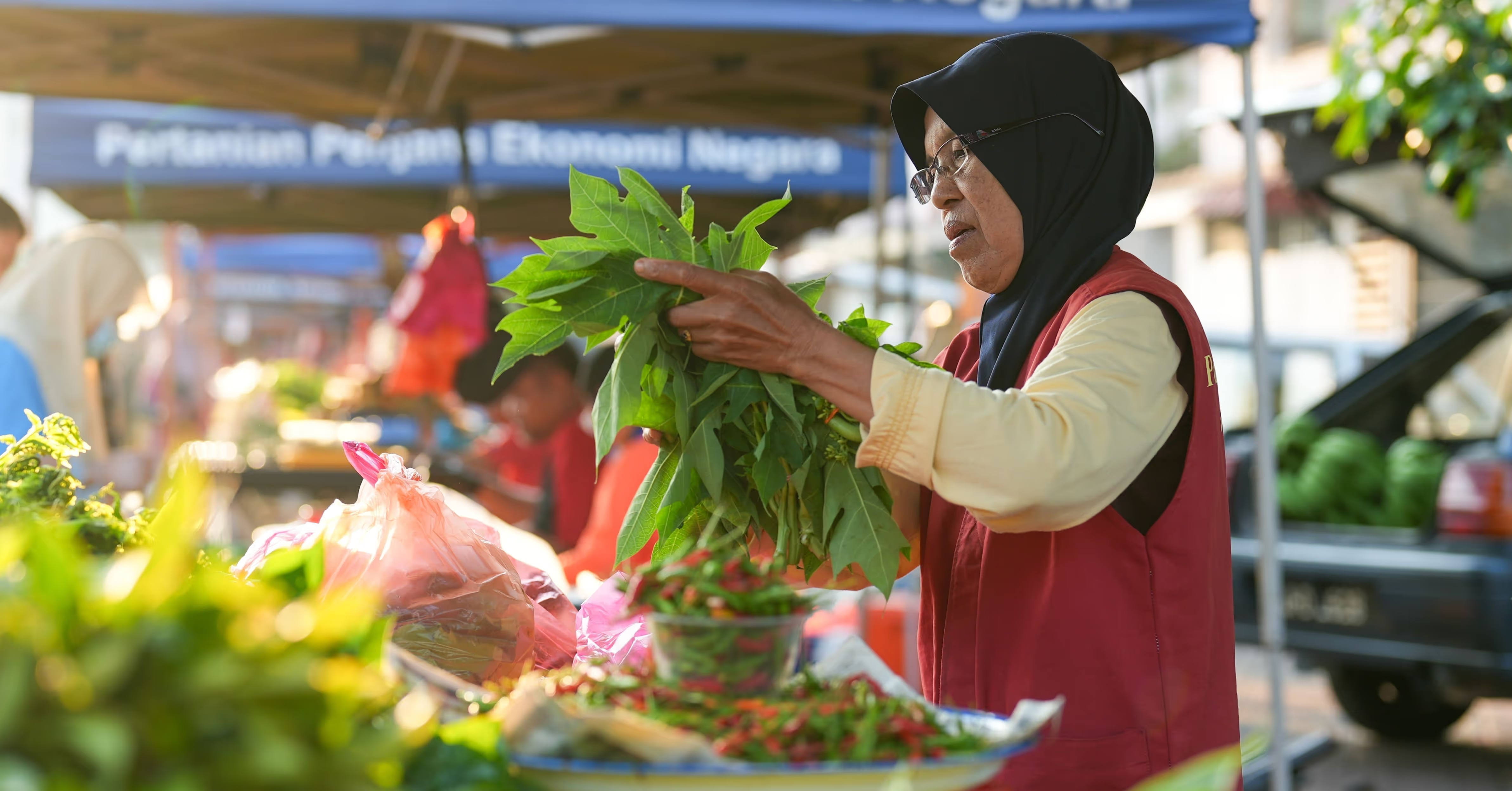
The shift toward sustainable and localized food systems is not only an environmental necessity but also an economic opportunity for communities.

featured report

Conclusion

Download Resources
Files
Datasets
Attributes
Footnotes
References
Photography Credit

Related to this Publication

No results found for this selection
You can  try another search to see more

Want more stories like these in your inbox?

Stay ahead with KRI, sign up for research updates, events, and more

Thanks for subscribing. Your first KRI newsletter will arrive soon—filled with fresh insights and research you can trust.

Oops! Something went wrong while submitting the form.
Follow Us On Our Socials