

Publications
Explore KRI research products to deepen your understanding of local, national, and global challenges. Our experts offer evidence-based analysis and innovative policy solutions that inform decision-making and drive positive change.
Featured KRI Publication
KRI shares insightful commentaries on current topics to encourage discussion, but these do not represent KRI's official views.
Thank you! Your submission has been received!
Oops! Something went wrong while submitting the form.
Book
Policy Briefs
Views
Data Sets
Data Visualisations
Reports
Discussion Papers
Working Papers
Views
Mar 2, 2026
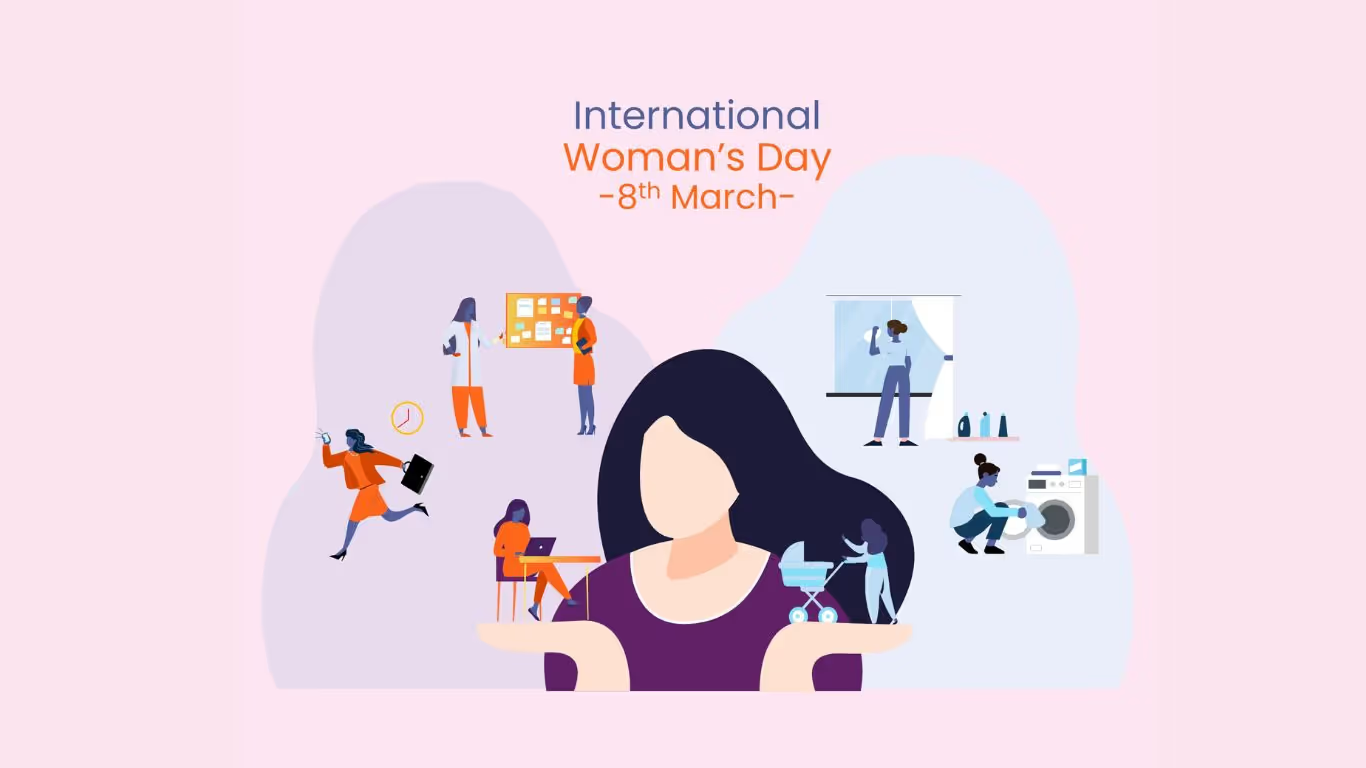
When do Men Care? Insights on Care, Crisis and Masculinities during COVID-19
This article examines whether the COVID-19 pandemic led to lasting changes in men’s participation in unpaid care. While men’s involvement increased during the pandemic, the shift was largely temporary, with women continuing to bear the majority of care responsibilities. The findings highlight the need for gender-inclusive care policies that promote men’s continuous involvement in care.

OP-ED
Mar 2, 2026
When do Men Care? Insights on Care, Crisis and Masculinities during COVID-19
This article examines whether the COVID-19 pandemic led to lasting changes in men’s participation in unpaid care. While men’s involvement increased during the pandemic, the shift was largely temporary, with women continuing to bear the majority of care responsibilities. The findings highlight the need for gender-inclusive care policies that promote men’s continuous involvement in care.

Views
Feb 26, 2026
The Iceberg of Everyday Digital Identity
Digital identity is increasingly common for people to access public services, financial systems and everyday digital interactions. It is often linked to quicker processes, greater convenience and more efficient service delivery. At the same time, everyday experiences with digital identity can differ. While many interactions go smoothly, some users encounter issues such as authentication problems or difficulty recovering access. These moments may not always show up in headline results, but they influence how people perceive digital systems over time. The Iceberg of Everyday Digital Identity looks at how both visible benefits and less apparent experiences shape trust and long-term usability. Some users can resolve problems quickly, while others may encounter repeated barriers that affect their engagement with digital services. Paying attention to these daily experiences can help support digital identity systems that stay practical, inclusive and reliable for everyone.

OP-ED
Feb 26, 2026
The Iceberg of Everyday Digital Identity
Digital identity is increasingly common for people to access public services, financial systems and everyday digital interactions. It is often linked to quicker processes, greater convenience and more efficient service delivery. At the same time, everyday experiences with digital identity can differ. While many interactions go smoothly, some users encounter issues such as authentication problems or difficulty recovering access. These moments may not always show up in headline results, but they influence how people perceive digital systems over time. The Iceberg of Everyday Digital Identity looks at how both visible benefits and less apparent experiences shape trust and long-term usability. Some users can resolve problems quickly, while others may encounter repeated barriers that affect their engagement with digital services. Paying attention to these daily experiences can help support digital identity systems that stay practical, inclusive and reliable for everyone.
.jpg)
Discussion Papers
Jan 28, 2026
Assessing and Optimising MyDigital ID
Launched in 2023, MyDigital ID enables Malaysians to access multiple government and selected private digital services using a single verified login. As a Single Sign On (SSO) platform, it simplifies access, reduces repeated verification and supports more efficient delivery of digital services. These practical benefits make authentication a sensible and appropriate starting point for a national digital identity initiative. International experience shows that many digital identity systems begin with authentication and develop gradually over time. In several countries, SSO has served as a foundation on which additional capabilities were introduced after governance arrangements, safeguards and public confidence were well established. In this respect, MyDigital ID’s current focus does not limit future options. Rather, it provides immediate value while preserving flexibility for future policy choices that align with national priorities. This research finds that MyDigital ID is progressing positively as a secure and reliable authentication platform within Malaysia’s broader digitalisation agenda. Its technical design aligns with recognised security standards, while its role as a verification layer that relies on authoritative government databases supports both system integrity and privacy protection. As adoption increases and integration expands, continued attention to governance clarity, accessibility and long-term planning can further strengthen public understanding and confidence in the system. Viewed in this way, MyDigital ID can be understood as a public digital asset that delivers immediate service improvements while remaining adaptable to future needs. A measured and phased approach allows benefits to be realised today, while ensuring that policy choices remain aligned with institutional readiness and public expectations.
.jpg)
OP-ED
Jan 28, 2026
Assessing and Optimising MyDigital ID
Launched in 2023, MyDigital ID enables Malaysians to access multiple government and selected private digital services using a single verified login. As a Single Sign On (SSO) platform, it simplifies access, reduces repeated verification and supports more efficient delivery of digital services. These practical benefits make authentication a sensible and appropriate starting point for a national digital identity initiative. International experience shows that many digital identity systems begin with authentication and develop gradually over time. In several countries, SSO has served as a foundation on which additional capabilities were introduced after governance arrangements, safeguards and public confidence were well established. In this respect, MyDigital ID’s current focus does not limit future options. Rather, it provides immediate value while preserving flexibility for future policy choices that align with national priorities. This research finds that MyDigital ID is progressing positively as a secure and reliable authentication platform within Malaysia’s broader digitalisation agenda. Its technical design aligns with recognised security standards, while its role as a verification layer that relies on authoritative government databases supports both system integrity and privacy protection. As adoption increases and integration expands, continued attention to governance clarity, accessibility and long-term planning can further strengthen public understanding and confidence in the system. Viewed in this way, MyDigital ID can be understood as a public digital asset that delivers immediate service improvements while remaining adaptable to future needs. A measured and phased approach allows benefits to be realised today, while ensuring that policy choices remain aligned with institutional readiness and public expectations.
.png)
Views
Jan 9, 2026
Regional Insights on the Care Economy: Childcare
Despite the declining fertility rate seen worldwide and in Malaysia, the issue of childcare still remains, particularly since family structures are becoming more independent units. With many parents chasing economic opportunities and lacking community support to raise children, childcare services are in demand. This article will briefly explore how countries such as Indonesia, Singapore and Vietnam are moving to improving the quality and accessibility of childcare services to allow for comparison with Malaysia’s own initiatives and provide lessons on the way forward.
.png)
OP-ED
Jan 9, 2026
Regional Insights on the Care Economy: Childcare
Despite the declining fertility rate seen worldwide and in Malaysia, the issue of childcare still remains, particularly since family structures are becoming more independent units. With many parents chasing economic opportunities and lacking community support to raise children, childcare services are in demand. This article will briefly explore how countries such as Indonesia, Singapore and Vietnam are moving to improving the quality and accessibility of childcare services to allow for comparison with Malaysia’s own initiatives and provide lessons on the way forward.
.png)
Views
Jan 9, 2026
Regional Insights on the Care Economy: Aged Care
The burden of care is a rising issue faced not just by Malaysia but also across the globe. The increase in dependant populations in tandem with a shrinking working age group has led countries to rethink how the former population is taken care of while still balancing economic growth. This article will briefly explore how countries such as Indonesia, Singapore and Vietnam are moving to tackling the needs of their ageing nation in order to provide lessons for the establishment of Malaysia’s own Care Framework.
.png)
OP-ED
Jan 9, 2026
Regional Insights on the Care Economy: Aged Care
The burden of care is a rising issue faced not just by Malaysia but also across the globe. The increase in dependant populations in tandem with a shrinking working age group has led countries to rethink how the former population is taken care of while still balancing economic growth. This article will briefly explore how countries such as Indonesia, Singapore and Vietnam are moving to tackling the needs of their ageing nation in order to provide lessons for the establishment of Malaysia’s own Care Framework.
List of Publication
Thank you! Your submission has been received!
Oops! Something went wrong while submitting the form.
Book
Policy Briefs
Views
Data Sets
Data Visualisations
Reports
Discussion Papers
Working Papers
Digital Transformation
Demography
Digital Divide
Digital & Gig Economy
AI, Automation & Work
SME Tech Adoption
Digital Infrastructure & Access
Aquaculture
Agro-industrial Crops Management
Water, Waste & Resource
Energy Transition & Just Transition
Climate Change & Resilience
Food Systems & Smallholders
Housing Affordability & Rental Market
Infrastructure Access
Public Transport & Connectivity
Urban Planning & Governance
Housing Affordability
Financialisation & Indebtedness
Poverty & Social Mobility
Education
Health, Nutrition & Public Health
Ageing, Fertility & Demographics
Income, & Consumption
Society
Gender Inclusion
Social Protection
Care & Domestic Work
Wages & Gig Work
Labour Trends & Youth Employment
Taxation
Public Finance & Fiscal Reform
Regional Development
Productivity & Industrial Development
International Trade
Economic Growth & Structure
Eleanor Wikstrom
Dr Roza Hazli Zakaria
Stephanie Hsu
Tan Hui Hui
Kelvin Ling Shyan Seng
Khairin Ilaina Mohamed Amin
Govind Nirav Rao
C. Hari S. Shankar
Afifah Ahmad
Elisabeth Chan Wen Yi
Nurrdinan Serena Amer Sharaffudin
Nurhanina Zaharin
Dr Amirah 'Aisha Badrul Hisham
Nur Hannani Abd Ghafar
Tehleel Nazir
Yee Suet Ee
Balqis Athirah Azhar
Shukri Mohamed Khairi
Nurul Farhana Abdul Shukor
Aidil Farhan Jasrie Arman Sany
Amirah Syazwani Ahmad Junaidi
Dinie Joshry Shaqeel Prakash
Ts Dr Amirah Aisha Badrul Hisham
Professor Joseph Eugene Stiglitz
K. Kuhaneetha Bai
Nadia Malyanah Azman
Siti Maisarah Zainurin
Ndongo Samba Sylla
Malini Elango
Aqeel Khaldun
Belinda Liew Ai Ching
Muhammad Khairulamri Muhammad
Nicholas Khaw
Nur Zulaikha Atiqah Mohd Zahril
Dr Diana Abdul Wahab
Dr Umawathy Techanamurthy
Bryan Yeoh Quan Jin
Wan Manan Wan Muda
Alyssa Chua Lee-Yen
Goh Ming Jun
Mohan Mahadeva
Yap Chun Hao
Syafa Sakinah Mustaffa
Ammar Hanania Hazli Izma
Dr Yunus Yasin
Dato’ Amirul Feisal Wan Zahir
Professor Emeritus Dr Tham Siew Yean
Datuk Hisham Hamdan
Khazanah Research Institute
Tan Sri Nor Mohamed Yakcop
Tan Mei Yi
Emir Izat Abdul Rashid
Lim Han Hsuen
Ida Madieha Abdul Ghani Azmi
Musaddiq Adam Muhtar
Nur Adilah Hamid
Chakrin Utit
Bach Nguyen Luong
Zainab Ali Ahmad
Kusairi Mohd Noh
Rokiah Alavi
Ibrahim Kabiru Maji
Illisriyani Ismail
Intan Nadia Jalil
Abdulla Ibragimov
Siti Nooraznie Abdul Rahim
Fatimah Mohamed Arshad
Dr Mohd Yusof Saari
Pierre Sauvé
Tan Theng Theng
Charissa Lee Yi Zhen
Yap Gin Bee
Tan Kar Man
Junaidi Mansor
Alia Muhammad Radzi
Yeu-Mynn Yeung
Prof. Wan Abdul Manan Wan Muda
Tan Zhai Gen
Umi Maisarah Kamis
Shukri Mohamed Khairi
Wong Ee Kin
Dr Wan Khatina Wan Nawawi
Maia Hollins-Kirk
Grace Loh Wan Chi
Keelea Shaye Linsuau Soh
Hui San Chiam
Goh Hao Yi
Daniel Filippi
Azlin Natasha Mohd Ghazali
Balqis Athirah Azhar
Dr Sarena Che Omar
Aqeel Khaldun (University of St Andrews)
Aidil Iman Aidid
Nurul Farhana Abdul Shukor
Nur Thuraya Sazali
Yugendran Rajaendran
Putera Daniel Hakeem
Siti Aiysyah Tumin
Laventhen Sivashanmugam
Nithiyananthan Muthusamy
0
Results


Views
Dec 26, 2024
Affordable Housing or Affordable Debt?


OP-ED
Dec 26, 2024
Affordable Housing or Affordable Debt?
Financialisation & Indebtedness
Theebalakshmi Kunasekaran
Dec 26, 2024
Dec 26, 2024
Views


Views
Dec 24, 2024
Vaping: The Lesser Evil?


OP-ED
Dec 24, 2024
Vaping: The Lesser Evil?
Health, Nutrition & Public Health
Wan Amirah Wan Usamah
Dec 24, 2024
Dec 24, 2024
Views


Views
Dec 23, 2024
Abandoned Housing: An Unfinished Dream


OP-ED
Dec 23, 2024
Abandoned Housing: An Unfinished Dream
Housing Affordability & Rental Market
Theebalakshmi Kunasekaran
Dec 23, 2024
Dec 23, 2024
Views


Views
Dec 23, 2024
From Floods to Markets: Understanding the Ripple Effect of Weather Variability on Food Prices


OP-ED
Dec 23, 2024
From Floods to Markets: Understanding the Ripple Effect of Weather Variability on Food Prices
Climate Change & Resilience
Nik Syafiah Anis Nik Sharifulden
Dec 23, 2024
Dec 23, 2024
Views


Views
Dec 21, 2024
Rising Medical Premiums: Can It Be Cured?


OP-ED
Dec 21, 2024
Rising Medical Premiums: Can It Be Cured?
Health, Nutrition & Public Health
Ilyana Mukhriz
Dec 21, 2024
Dec 21, 2024
Views


Views
Dec 20, 2024
The EU’s Competitiveness Crisis and the Carbon Border Adjustment Mechanism


OP-ED
Dec 20, 2024
The EU’s Competitiveness Crisis and the Carbon Border Adjustment Mechanism
Climate Change & Resilience
Yin Shao Loong
Dec 20, 2024
Dec 20, 2024
Views

Views
Dec 20, 2024
Arteri Kota: Mencari Dana Alternatif Pengangkutan Awam Lembah Klang

OP-ED
Dec 20, 2024
Arteri Kota: Mencari Dana Alternatif Pengangkutan Awam Lembah Klang
Housing Affordability & Rental Market
Muhammad Nazhan Kamaruzuki
Dec 20, 2024
Dec 20, 2024
Views
_1.avif)
_1.avif)
Views
Dec 19, 2024
Reframing Narratives on Women and Development in Malaysia
_1.avif)
_1.avif)
OP-ED
Dec 19, 2024
Reframing Narratives on Women and Development in Malaysia
Economic Growth & Structure
Adam Manaf Mohamed Firouz
Dec 19, 2024
Dec 19, 2024
Views
%20(1).avif)
%20(1).avif)
Views
Dec 18, 2024
Rekod Kesihatan Digital Perlu Seiring Dengan Reformasi Dasar
%20(1).avif)
%20(1).avif)
OP-ED
Dec 18, 2024
Rekod Kesihatan Digital Perlu Seiring Dengan Reformasi Dasar
Digital Divide
SME Tech Adoption
Ilyana Mukhriz
Dec 18, 2024
Dec 18, 2024
Views

Quote Of The Day
Redevelopment should not be driven by profit alone. It must prioritize protecting existing residents and delivering long-term benefits to communities living there. Therefore, the adoption of urban renewal must be anchored to households, with a vision to improve the quality of life for households and neighbourhoods.

Views
July 22, 2025
Maintain or Demolish? Rethinking Urban Renewal Priorities
This article argues that urban renewal must prioritize maintenance over demolition. Not every old building needs to be demolished. Many can be preserved through proper building maintenance and thoughtful refurbishment.
featured report