



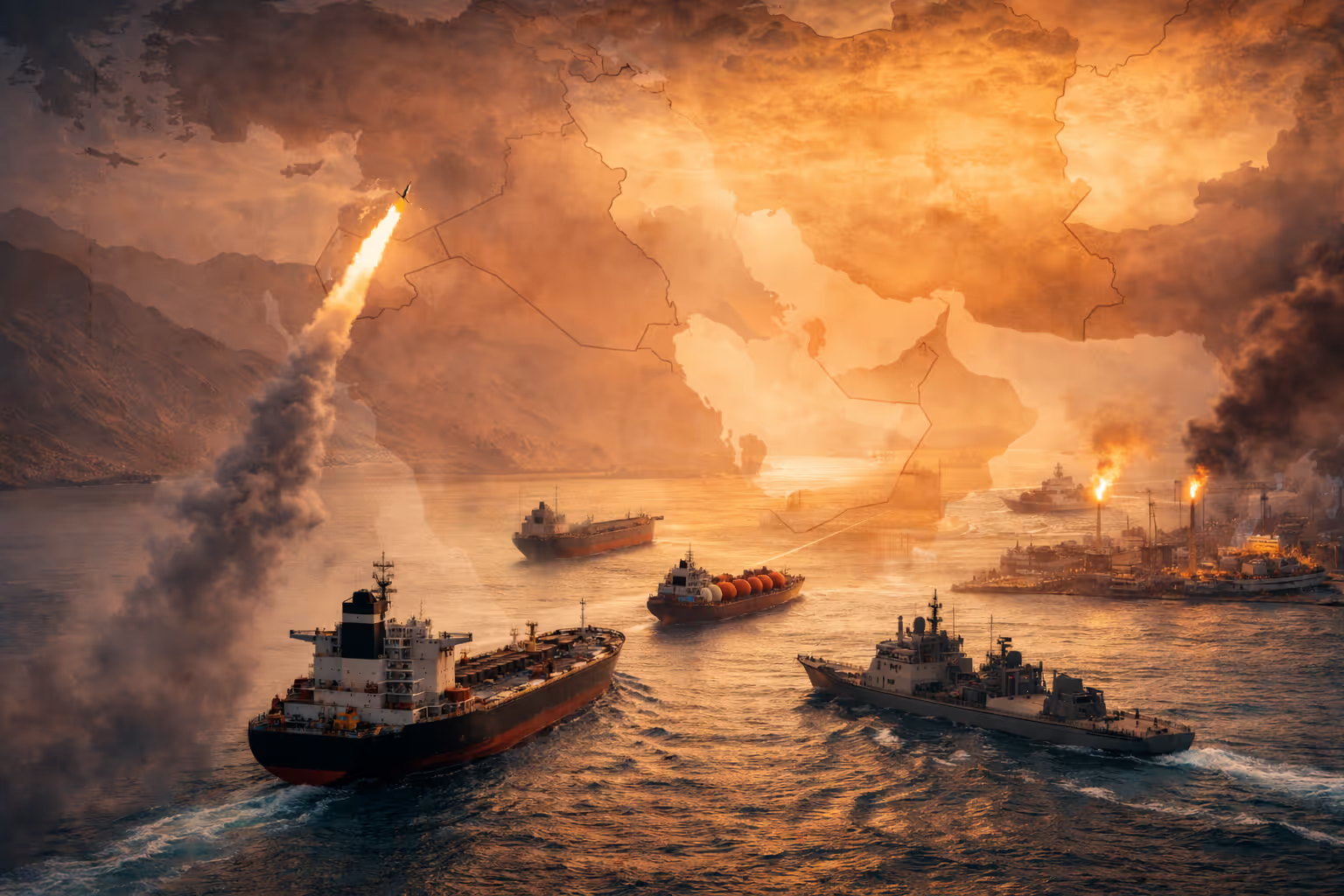






The US (Israel) unprovoked unilateral attack on Iran started on February 28, with missiles targeted at Iran’s leadership as well as other targets, including a primary school for girls. This happened while the US-Iran negotiations were ongoing, which was also the case when the US attacked Iran eight months ago. While the negotiations were presumably about nuclear weapons, the true objective of this war is unclear, but the US has killed the only person holding Iran back from developing nuclear weapons – Ayatollah Ali Khamenei, who issued an edict against it.
The rhetoric from Washington has shifted to “regime change” as the objective of this attack which ignorantly presumes that a “shock and awe” attack and murder of the Ayatollah will precipitate a popular uprising and therefore, regime change. This is not naiveté, it is foolhardiness to the extreme. Instead and as expected, the Iranians have rallied together behind the memory of a martyred leader and murdered young girls to retaliate against the two nuclear powers.
Iran has been true to its threat that it will attack all US bases in the region, something neither the Americans nor the Gulf states have taken seriously. An attack on Iran by the Americans was going to result in a regional response, as all the Gulf states host US military bases. In a hostile situation, these bases represent direct threats to Iran. This is what is happening now. The Iranian strategic posture is clear. The regional nature of this war has undermined the economic logic of the Gulf states as neutral safe havens, which is unlikely to return to what it was. The security blanket supposedly provided by the US is not true and it is in fact a liability. This war, once started, quickly became the regional conflict that it now is.
The Americans remain unclear about their end game, from deterring Iran from developing nuclear weapons to "regime change" and "unconditional surrender." The Israeli end game is however very clear: to use the Americans to destroy Iran the way Iraq, Syria and Libya have been destroyed. Israel continues to attack Lebanon and even Syria, and as if that were not enough, its bombardment of Gaza proceeds relentlessly. These actions by Israel should not surprise anyone. The Zionists have always been clear about their objectives right from the beginning. They have never been interested in co-existence with the Palestinians or any of Israel’s neighbors; it has always been about domination. It is part of their greater Israel project, a project that has the support of Christian Zionists in the US including in the Trump Administration itself. In Trump, Netanyahu found a US President willing to attack Iran, the missing piece in the Gulf.
Iran however has a population larger than Syria, Iraq and Libya combined. Its land mass is 1.65 million square kilometers. The Israeli objective of expansion and occupation of Palestine and parts of Lebanon has always been facilitated militarily and diplomatically by the US. The US led the destruction of Iraq under the false pretext that Iraq had “weapons of mass destruction” and Syria was turned into a battleground for a proxy war that exploited its internal sectarian divisions. An estimated 750,000 Iranians died in the Iran-Iraq war with the US supporting Iraq back then. What is the war the US is engaged in now? This is still unclear. One pertinent question, given that the majority of the US population is against this war, is: how many deaths can the US tolerate in this war? How much inflation can it tolerate? And to what end?
As it is, there is no end in sight but the possible trajectories include some ominous ones. Of course, the worst case scenario is the war escalates towards the use of nuclear weapons by either Israel or the US, which will invite the involvement of other nuclear powers. A Syria-like situation may be possible as an escalation towards this. All the stated objectives the Americans have used are not feasible. By their own admission, it will no longer be “a quick win” that takes several weeks. In the meantime, the economic consequences of this expanding war have begun to manifest themselves, with effects that are global in nature.
Crude oil and Liquefied Natural Gas (LNG) prices rose over 40% since the war started, with WTI crude oil prices closing above USD100/barrel. The price of coal has also risen over 25% during the same period. Some 20 million barrels of oil per day pass through the Straits of Hormuz, accounting for approximately 20% of global flows, and the Straits also handles about 20% of the world’s LNG flows. These flows have already been disrupted as insurers have cancelled war risk coverage. Some refineries in the Gulf areas have also been destroyed by the ongoing war. Saudi Arabia's largest domestic refinery has halted production and Qatar has halted its LNG production. Let's not forget that crude oil and LNG prices have the potential to go up even further. Beyond that, economies dependent on flows through the Gulf - such as India and much of East Asia - will be directly impacted as flows have halted. Major producers such as the US and Russia are the two big winners in the short term.
Increases in the price of oil, LNG and coal means the cost of electricity will also rise proportionately, which will have a pervasive impact on not just residential consumption but also on its varied industrial uses. Fertilizers- a major cost item for agriculture - will rise in prices. This will become an inflationary scenario with the potential to be highly inflationary, the likes of which have not been seen since the 1973/74 crisis. That crisis too involved Israel - the source of instability in the Middle East - when it attacked Egypt.
The world in 1974 was not as connected and financialized as the world today. One would expect the economic consequences of a spike in fuel prices today to be broader and deeper. It is also unclear when the supply side fuel and energy industries will return to normal. The world is therefore looking at a possible extended inflationary period as these dynamics unfold. The 1970s crisis saw a period of stagflation, where high inflation was accompanied by stagnant growth. Malaysia’s growth dipped in 1974/75 but recovered in 1976. However, the inflation in 1974 of 18% was the highest ever recorded. Looking at the current crisis, it is clear that the demand side will also contract globally as the result of these uncertainties which affect overall growth. The stagflation scenario is a possibility globally as well as domestically in Malaysia. This is something policymakers will have to grapple with.
There will be flight to safety on the asset side of the equation, where investors look to reallocate their existing holdings into assets that will preserve their values. But there are very limited options for safe stores of value today apart from gold. The short term will see a slight bump of the USD but this episode would only accelerate the structural trend of a weakening USD. The wealth effects of any decline in asset prices, in particular financial assets, will yield effects well beyond consumption on the real side of the economy. It is not clear how this will affect capital markets that have grown tremendously based on layers of debt instruments. It is not likely to be pretty when leverage meets asset deflation.
For Malaysia, apart from the specter of cost-push inflation which will happen, the state of government finances is also of concern. The BUDI scheme, while universal for Malaysians, has capped subsidies to 300 liters per citizen. This has resulted in savings compared to when subsidies were universal and uncapped, but its calculations were from when crude oil prices were around USD70/barrel. It is over USD100 now which cost billions more. A decision on this will have to be made soon, which will require a robust debate on the trade-offs in the use of fiscal resources. Similar conversations will have to take place in the power sector more broadly. These will be difficult conversations.
Ironically, the strengthened Ringgit has also had the effect of muting the effects of the increase in prices of crude and LNG as a producer. The Ringgit revenue will not be as high compared to when the Ringgit is weaker. At the same time, the fiscal side spends in Ringgit. It should also be noted that Malaysia has been a net importer of crude oil for a while now. Even before the signing of the Agreement on Reciprocal Trade (ART) with the US, Malaysia, a major LNG producer has become a net importer of LNG as well. There are severe limits on expecting more contributions from an international player such as Petronas during this period, which will force decisions on optimizing both revenue and expenditure on the fiscal end of things.
The uncertainties arising from this war and from the Trumpian policies on trade as well as the ongoing debate on the relevance of global multilateral institutions do not take away the logic of investments - both private and public investments - in preparation for what lies ahead, whatever that may be. The Malaysian economy closed last year robustly fueled by both trade and domestic consumption and investments. If we need to prop up the demand side, the economy needs to invest in new capacities and new capabilities to be better and more competitive. If there is a world still, we must be better. In the meantime, policymakers and the people need to prepare for challenging times ahead.