








Introduction
As discussed in Part I, street food plays an undeniably important role in the Malaysian diet, providing affordable and easily accessible meals while helping to preserve the country’s distinctive cultural heritage. Its importance spans across all income groups, from low-income to high-income households. For urban dwellers in particular, street food offers a practical alternative to cafés and restaurants, as it is generally more affordable and better suited to lifestyles characterised by long working hours, lengthy commutes and limited time for meal preparation at home.
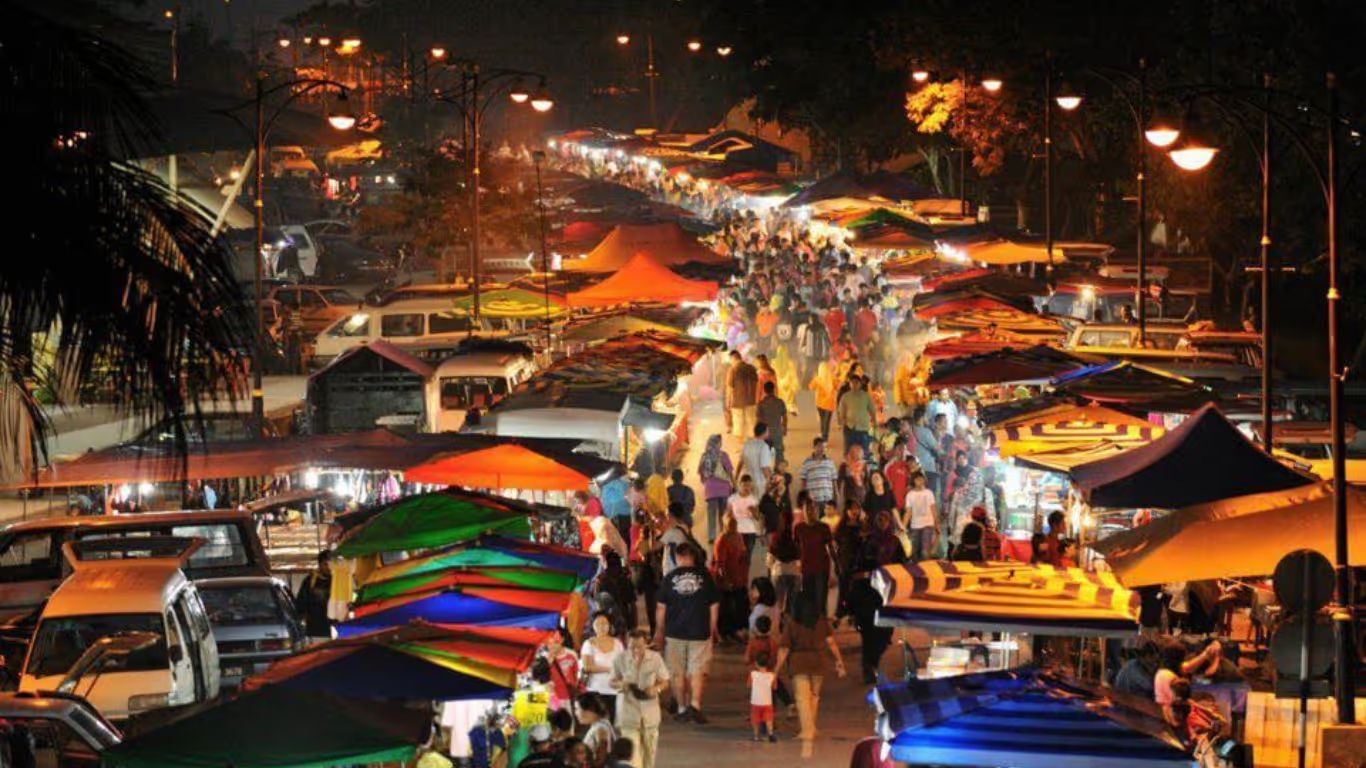
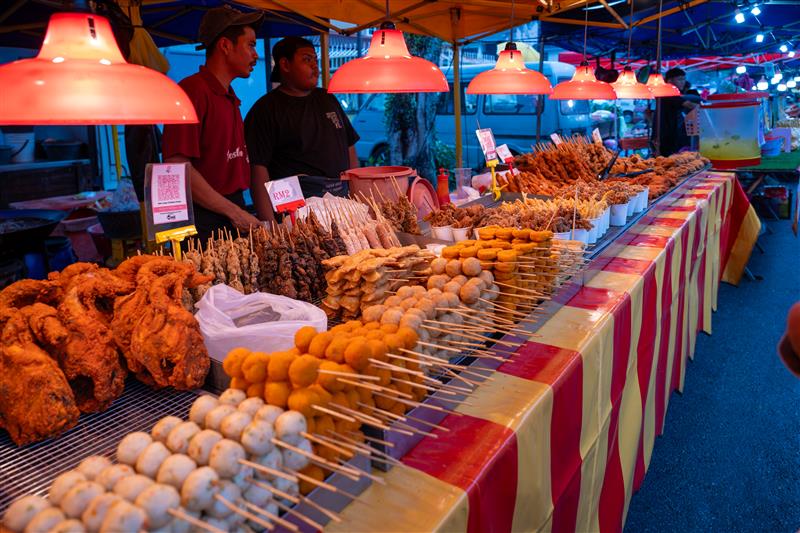
Street food is prepared and sold in a variety of settings, ranging from permanent stalls or kiosks to mobile carts and temporary setups at night markets or festive bazaars. Many vendors operate in open-air environments with limited access to clean water, refrigeration and proper waste disposal. These factors, combined with the need to prepare food quickly to meet consumer demand, create conditions that make it challenging for vendors to consistently maintain hygiene and safe food handling practices1.
Furthermore, the mobility and informal nature of many street food operations complicate oversight, as routine monitoring and enforcement of food safety standards are often difficult to carry out. Licensing requirements and regulations exist, but compliance may vary, particularly among temporary or seasonal vendors. These characteristics that make street food affordable and accessible, such as flexibility, convenience and proximity to consumers, also make it more difficult to apply food safety procedures consistently.
In Malaysia, several foodborne illnesses linked to street food have been documented. For example, in 2014, an outbreak of acute gastroenteritis in Terengganu affected 169 individuals and resulted in one death2. The outbreak was traced to fried rice sold at two street food stalls, contaminated by a food handler infected with Salmonella typhimurium3. Similarly, in 2012, around 25 students in Johor were affected by food poisoning after consuming nasi lemak and murtabak from a street food stall. The incident led to one 7-year-old student passing away after experiencing severe food poisoning4.
In this context, Part II of this paper focuses on the food safety challenges within Malaysia’s street food sector. It examines the risks arising from food handling practices and operating environments, reviews the regulatory frameworks in place and highlights gaps between regulatory requirements and everyday practices. The discussion aims to identify policy opportunities to enhance food safety while preserving the accessibility, affordability and cultural significance of street food.
Food Safety Risks Associated with Street Food
Food safety in Malaysia’s street food sector is influenced by a mix of environmental, operational and vendor-related factors. These challenges are closely tied to the informal nature of street food operations and the contexts in which food is prepared and sold. They can be broadly categorised into environmental and infrastructural conditions, food preparation, storage and display practices, vendor hygiene and knowledge-practice gaps, food packaging and food types.
Environmental and infrastructural conditions
Street food is commonly prepared and sold in open-air environments, often close to roads, traffic and densely populated areas. These settings expose food to environmental contaminants such as dust, vehicle exhaust and airborne pollutants. Poor waste management further contributes to unhygienic surroundings, as accumulated garbage attracts pests and creates unsanitary conditions that can compromise food safety.
Furthermore, another key challenge that could exacerbate food safety risks is the limited availability of basic infrastructure at many vending sites. Access to potable water, handwashing facilities, proper drainage, toilets and organised waste disposal systems is often insufficient or absent5. Where tap water is not readily available, vendors may obtain water from nearby premises, public facilities or bring it from home. In such cases, the same supply of water may be used throughout the day for cooking, cleaning and handwashing, raising concerns about its suitability and cleanliness6.
Food preparation, storage, and display
Preparation and storage methods introduce further food safety risks. Many street foods are prepared in bulk several hours before sale and held for long periods at ambient temperatures7. In Malaysia’s warm and humid climate, such conditions are conducive to the growth of foodborne pathogens, particularly when food is kept within the temperature range that supports bacterial multiplication. Cooked rice and noodles, for example, have been identified as common vehicles for Bacillus cereus when held at inappropriate temperatures8,9. In addition, cross-contamination may occur during preparation and storage. For instance, when raw and cooked foods are stored together or when shared utensils and containers are used for multiple food items10.
Furthermore, foods that are partially or fully cooked ahead of time and later reheated require sufficient time and temperature to reduce the risk of microbial survival. In practice, reheating is often inadequate, with food not being heated thoroughly enough or for long enough to eliminate harmful microorganisms, allowing pathogens that survived cooking or contaminated the food afterward to persist and multiply11.
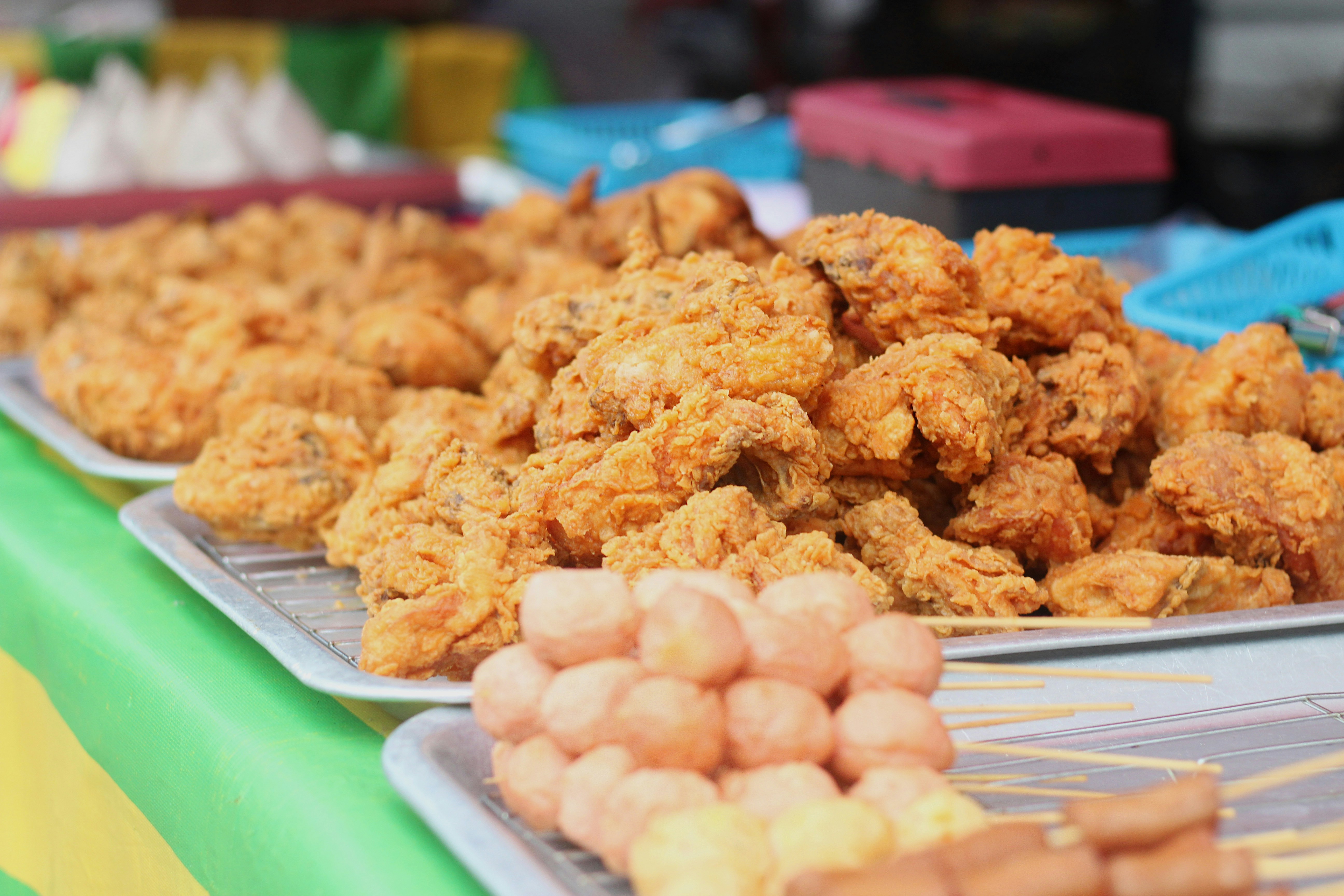
In terms of food display, risks are primarily related to exposure to the open-air environment. Foods are often kept uncovered during service, making them susceptible to dust, heat, and airborne pollutants from the environment.
Additionally, the repeated use of serving utensils or containers without thorough cleaning can increase the risk of contamination. Maintaining proper coverage and hygiene during display is therefore essential to preserve both the safety and quality of street food.
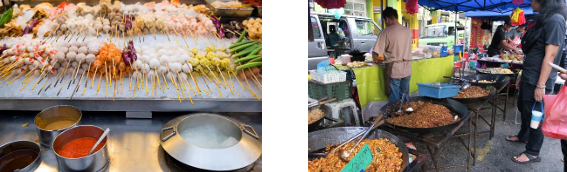
Notes: Examples of street food being exposed to the open-air environment
Vendor personal hygiene and knowledge-practice gaps
Vendor personal hygiene plays a critical role in street food safety, but lapses are common due to the informal nature of operations. Handwashing after handling money, raw ingredients or other tasks may not always be possible, and factors such as uncovered hair, unwashed aprons or working while unwell can increase the risk of food contamination.
The knowledge-practice gap, often assessed through KAP (Knowledge, Attitudes and Practices) studies, evaluates food handlers’ understanding of hygiene principles (knowledge), their beliefs about safe practices (attitudes), and their actual behaviors (practices). Studies have identified several factors influencing KAP among street food vendors, including education level, food safety training, vending environment and even cultural or racial context12. While many Malaysian street food vendors are aware of basic food safety measures, such as handwashing, proper reheating, and avoiding cross-contamination, their practices do not always align with this knowledge due to time pressures and limited facilities.
Food packaging
Food packaging represents another aspect of street food safety that can pose risks. In many street food operations, packaging materials are selected primarily for convenience and cost, which can introduce both physical and chemical hazards. The use of staples to seal food packaging, commonly seen in traditional foods such as tepung pelita, pulut udang and packed rice, poses a physical contamination risk if staples detach and are accidentally ingested, particularly by children and older adults13.

Note: Examples of food packaging secured with stapler
In addition, thin plastic bags and containers are widely used to package hot and oily foods due to their low cost and availability. Many plastics contain chemicals such as Bisphenol A (BPA) and phthalates, which may migrate into food when exposed to heat or oil. The hot and humid climate further increases the likelihood of chemical leaching14. Street food items such as laksa and bihun sup are commonly served while still steaming hot in thin plastic packaging, raising concerns about repeated exposure to chemical residues over time.
Food types and associated risks
Certain street foods are considered riskier than others, such as poultry, eggs, dairy products, and vegetables15. Such foods are more susceptible to contamination when they are not cooked to temperatures sufficient to destroy harmful microorganisms, or when they are held for extended periods without adequate temperature control16. Common foodborne pathogens associated with these foods include Salmonella spp., Staphylococcus aureus, Clostridium perfringens, Bacillus cereus, and Escherichia coli17. In Malaysia’s tropical climate, the warm ambient conditions further accelerate microbial growth. As a result, when high-risk foods are prepared, stored or sold without effective temperature management, they are more likely to act as vehicles for foodborne illness18.
Regulatory Framework Governing Street Food in Malaysia
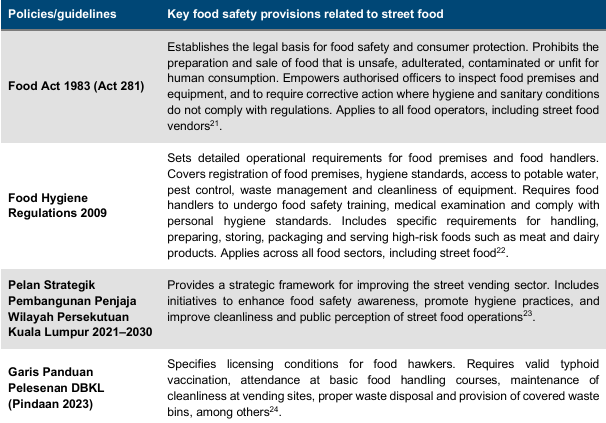
Malaysia’s food safety governance framework comprises national legislation, subsidiary regulations and local authority guidelines that collectively shape street food practices. At the national level, the Food Act 1983 (Act 281) establishes the legal foundation for food safety and consumer protection, empowering authorities to regulate hygiene standards, prohibit unsafe or adulterated food and oversee food labeling and sale19. Complementing this, the Food Hygiene
Regulations 2009 set out detailed operational requirements for food premises and handlers, covering hygiene practices, access to potable water, waste management, pest control and training for food handlers20.
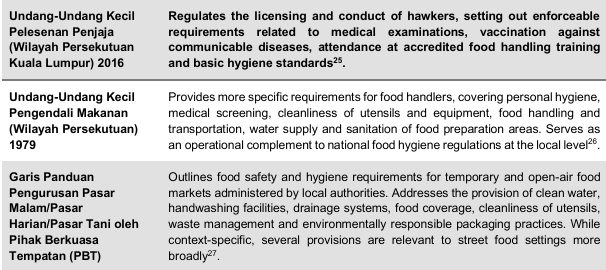
Apart from these overarching laws and regulations, food safety practices for street vendors are also shaped by a range of more targeted municipal and operational guidelines. In urbanised states such as Kuala Lumpur, local authorities specify licensing conditions for both mobile and static vendors, including requirements related to personal hygiene, food handling, cleanliness of vending areas and basic infrastructure. Table 1 summarises the key food safety–related requirements across national legislation and selected local authority guidelines relevant to street food operations.
Table 1: Key policies and guidelines relevant to street food safety in Malaysia
Gaps Between Regulation and Practice
Malaysia’s food safety framework for street food is relatively comprehensive, with clear standards covering hygiene, food handling, infrastructure and vendor conduct. However, the effectiveness of these regulations depends on consistent implementation and compliance at the ground level. In practice, gaps persist between formal requirements and everyday street food operations.
Infrastructure and environmental shortcomings. While regulations require access to potable water, handwashing facilities, adequate drainage and proper waste disposal, these provisions are not uniformly available across all vending locations, particularly in open-air or temporary settings. Limited access to such facilities constrains vendors’ ability to fully comply with prescribed hygiene practices, even when awareness exists.
Compliance with personal and operational hygiene is also uneven. Although guidelines specify the use of clean clothing, protective coverings, and hygienic food handling practices, adherence varies across vendors and vending contexts. Time pressures, space constraints and the absence of on-site facilities can hinder the consistent application of these measures during peak trading periods.
Finally, enforcement presents an ongoing challenge. The large number, mobility and informal nature of street food operations make routine monitoring difficult for local authorities. As a result, enforcement tends to be periodic rather than continuous, limiting the effectiveness of otherwise well-defined regulatory standards. Addressing these implementation gaps is therefore imperative to translating regulatory intent into improved food safety outcomes on the ground.
Conclusion
The food safety challenges in Malaysia’s street food sector reflect a clear disconnect: a comprehensive regulatory framework exists, yet everyday practice is constrained by infrastructural limitations, operational pressures and uneven enforcement. Bridging the gap between regulation and reality requires approaches that enable compliance rather than relying solely on oversight. Practical progress depends on creating conditions that make adherence feasible for vendors, supporting consistent hygiene and safe food handling without disrupting the flexibility and accessibility that define street food. By aligning regulatory expectations with operational realities, policymakers can strengthen public health protections while preserving the vibrant and dynamic character of Malaysia’s street food landscape.