


.jpg)




Introduction
Note: This article is an edited version of remarks made at the August 2026 KRI-UNDP roundtable on Malaysia’s development journey.
In reflecting on Malaysia’s development journey, I would like to make three points.
The first point is that an arbitrary income threshold should not be the key benchmark of a nation’s development or progress. While benchmarking is important, the quest to reach high-income nation status may be misguided as it has a singular focus on reaching a specific level of income per capita. In my opinion, income itself, not just income level, should not be the sole benchmark of development or wellbeing.
So what should? KRI’s ongoing research for the institute’s flagship State of Households report explores the multidimensional and complex nature of wellbeing and how different constraints act on households in their efforts to improve their wellbeing. A more holistic approach to wellbeing and its constraints may be preferred in assessments of development progress.
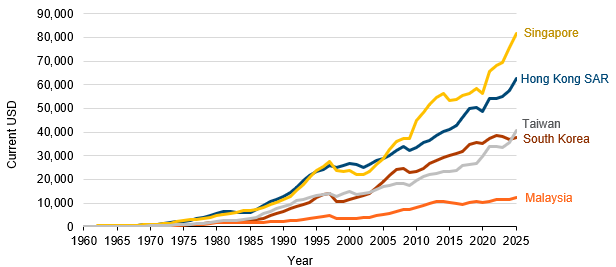
The second point is that I think we have to acknowledge that Malaysia has fallen behind relative to some of the Asian countries it used to be grouped with. In the 1970s, Malaysia’s economic development was comparable to the so-called Asian Tigers (Hong Kong, Singapore, South Korea and Taiwan). It is important to interrogate why our growth trajectory, while consistently positive, has slowed compared to nations we were previously considered on par with.
To do this, and this is the third point, we have to contend with non-market factors that affect development, specifically power, politics and institutions. The interplay of these decision-making and society-shaping factors have put the country on a path dependent journey that affects current and future outcomes.
I discuss these three points in more detail in this article.
Development benchmarks should not be limited to income measures
First, income thresholds should not be the sole benchmark of development or progress. One might argue that neither should income by itself. That line of reasoning was part of what motivated the approach to KRI’s forthcoming 2026 State of Households Report. We wanted to highlight the point that household wellbeing should be neither measured nor determined by income alone, although income is of course important.
In the report we focus on aspects of wellbeing typically prioritised in policy discussions, such as labour, education and health. However, we wanted to raise the idea that we should also be considering other aspects of wellbeing such as relational ties – family, community – and larger societal concerns such as public safety and climate change.
One of the findings of the report, relevant in a discussion of why we should not be focusing on any one aggregated metric, is that national statistics mask significant geographic inequalities.
As mentioned, while income shouldn’t be the key benchmark of development, it is hard to deny that it is a necessary but not sufficient means of improving wellbeing.
That is why it is a striking statistic that 144/166 districts (86.7%) in Malaysia have median household incomes below the national median of RM7,017 per month. That indicates just how skewed the income distribution is towards those remaining 22 districts, which are exactly where you would expect them to be, namely in the central Klang Valley agglomeration, industrial areas of Penang and southern Johor, and the oil rich regions of Sarawak and Terengganu.
This also suggests that these 22 districts are where development and its associated benefits cluster, and may explain why these districts are where almost 50% (46.2%) of Malaysian households are located. This corroborates the point in the concept note for the roundtable that there continue to be “pockets of low productivity, low income and limited economic opportunity within an increasingly high-income economy.”
In my opinion, proactive consideration of the redistribution of development and its benefits should be highly prioritised in development policy agendas.
Malaysia’s development journey warrants deeper interrogation
Second, I think we have to acknowledge that Malaysia’s path to progress has been slower than might be expected. Ironically, while not wanting to overly focus on national income, the most straightforward way to assess the country’s growth rate is by looking at gross national income (GNI) per capita in comparison to the Asian Tigers.
Trends from the 1960s to the present (as shown in Figure 1) show a clear divergence between Malaysia and the Asian Tigers starting in the 1980s and growing over time.
Figure 1: GNI per capita of Malaysia and the Asian Tigers, 1960–2025
In an attempt to de-centre arbitrary income threshold setting, I also consider the UNDP’s Human Development Index (HDI), which takes into account income using a standard of living measure, which is GNI per capita adjusted for purchasing power parity, education as measured by expected and mean years of schooling, and health as measured by life expectancy at birth.
As mentioned earlier, aggregate measures may mask detailed differences, and this is the case with composite indices as well. There may be some concerns around how informative such composite indices can be as they can mask differences between sub-composites, with policymakers preferring dashboards instead. Further discussion may also be warranted on how the HDI should be interpreted. Nonetheless, over the last twenty years, Malaysia has lagged behind the Asian Tigers on the HDI (as shown in Figure 2), although Malaysia outperformed the world average in 2023 (0.819 vs. 0.756)1.
Figure 2: HDI of Malaysia and the Asian Tigers, 2000–2023
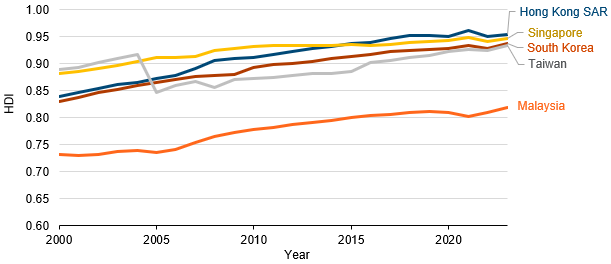
I think we should ask why this is the case. Admittedly there are contextual factors to consider when comparing development across countries. Among other things, higher rates of industrialisation, urbanisation and innovation all contribute to higher rates of development. Agglomeration, or the clustering, of economic activity and population density also affect development paths.
Nonetheless, Malaysia is not short on resources, investments or talent. Should we not be doing better? It is less a question of benchmarking and more a question of whether we are maximising our potential by effectively and responsibly managing our resources, be they natural, human or capital.
Development is influenced by power, politics and institutions
This brings me to my third point, which is the need to contend with non-market factors that affect development, specifically power, politics and institutions, in discussions on structural transformation.
Here I want to bring in three concepts which demonstrate how these factors affect development.
The first concept is cultural hegemony, a Gramscian idea that ruling elites maintain their positions of power, which tend to be self-interested rather than in the public interest, not by force or coercion, but by shaping people’s worldview of how things should work. This sometimes includes convincing people that they do not want things that are in their best interests, such as taxing wealth.
The second concept is institutionalism or how things get baked into social systems. At an individual level, we know this as “actions become habits, habits become character”. At a macro level, we might think of this as rules become norms, norms become culture.
The third concept is path dependency, something that we have been thinking about as we develop the 2026 State of Households report. Path dependency is the idea that once we start down a particular path, the longer we stay on it, the harder it becomes to change lanes, never mind change directions. Past decisions constrain future choices.
Let us take fuel subsidies as an example. Malaysia has been kept largely insulated from the shocks of the current West Asia crisis thanks to its fuel subsidies, which have been in place since the 1980s. In making an intervention to keep petrol prices low at that time, the government sent a message to the public that petrol prices should be low and a good government keeps prices low.
Over time, people expect petrol prices to be low, regardless of what is actually happening with the price of crude oil. They make decisions and behave accordingly, for example, in estimating business costs and setting prices or in purchasing private cars rather than demanding better public transportation.
Any attempt the government makes to adjust petrol prices to market rates is met with public resistance, even if that’s the reasonable thing to do to free up some fiscal space for other public spending. This may be an oversimplification, but it illustrates how power, politics and institutions have long lasting impacts on development.
Conclusion
In sum, development and wellbeing should not be measured by income alone. The question should not be simply whether Malaysia crosses a particular income threshold, but how improving national income also improves living standards and opportunities, especially in non-urban populated areas. Further consideration should be given to how to distribute development and its benefits across the country, which will also help relieve pressures faced by high-density cities.
Malaysia has made continuous and substantial progress over the years, but its relative position has weakened. Why this happened has to do with non-market forces such as power, politics and institutions. These should be taken into account when charting the next stage of Malaysia’s development journey.
%203.avif)