


.png)



Early Days of Education
Looking back on my primary school years, I was not considered intelligent. Reading was not easy for me: my eyes darted unpredictably across the page, and words seemed to scatter, stripping sentences of meaning. Through careful self-observation, I managed to come up with a rudimentary solution—placing two rulers across the page to obscure the rows above and below, thus forcing my attention onto a single line at a time. Though exhausting, this method gradually enabled me to read independently. Although I was never fully “cured” and do have sudden spouts of reading difficulties, I have learnt to adapt and optimize my journey thus far..
Years later, I discovered that my friend’s daughter in San Francisco had been formally diagnosed with dyslexia and was trained using a similar technique by her teacher. This parallel often makes me reflect on how many education systems fail to accommodate individual needs. I wonder how different my life might have been had I not stumbled upon my own solution at such a formative stage. I was fortunate; many were not.
No One-Size-Fits-All
In Greek mythology, Procrustes—a cruel blacksmith—forced travelers onto his iron bed, claiming it fits all. In reality, those who exceeded its length were severed, while those who fell short were stretched. The myth endures as a stark allegory of forced conformity, illustrating the destructive consequences of imposing rigid standards upon human diversity.
Procrustes was ultimately vanquished by the Greek hero Theseus, who employed the bandit’s own cruel method against him. Compelling Procrustes to recline upon his infamous bed and conform to its dimensions, Theseus brought about his death and made the road to Athens safe for travelers. This episode epitomizes the principle of poetic justice, demonstrating that those who construct arbitrary and oppressive standards for others are, in the end, undone by the very systems they devised for others.
The Paradox of Rigid Methodologies
The term “Procrustean bed” has become a metaphor for arbitrary standards that force diversity into conformity. For example, the Chicago School of Economics often claims that markets determine the best outcomes, while values such as trust, love, or mercy are sidelined because they cannot be priced for the market. However, the paradox, is striking: the very foundation of the monetary system depends upon trust, whether in the stability of currency, the reliability of institutions, or the credibility of contractual agreements. Yet trust itself is excluded from economic valuation precisely because it is neither measurable nor transferable. This exclusion illustrates the limitations of a purely market-driven perspective, which risks reducing complex human and social realities to what can be commodified, while overlooking the intangible but indispensable values that sustain economic and social life.
Another example of methodological limitation arises when the scientific method is applied indiscriminately. By design, the scientific method requires controlling all variables while manipulating only one, in order to observe its effect on a single responding variable. In this framework, only two variables are permitted to change, while all others must remain constant. Such control is feasible in laboratory settings—closed systems where conditions can be tightly regulated. This method has been immensely successful and underlie much of the technological advancement of today. However, it becomes very difficult to apply in open systems, such as the study of human behavior in real time, where variables are numerous, dynamic, and resistant to regulation. Consequently, attempts to apply the scientific method in these contexts often fail to achieve the rigor the method demands resulting in conclusions that are questionable.
The Tyranny of the Average
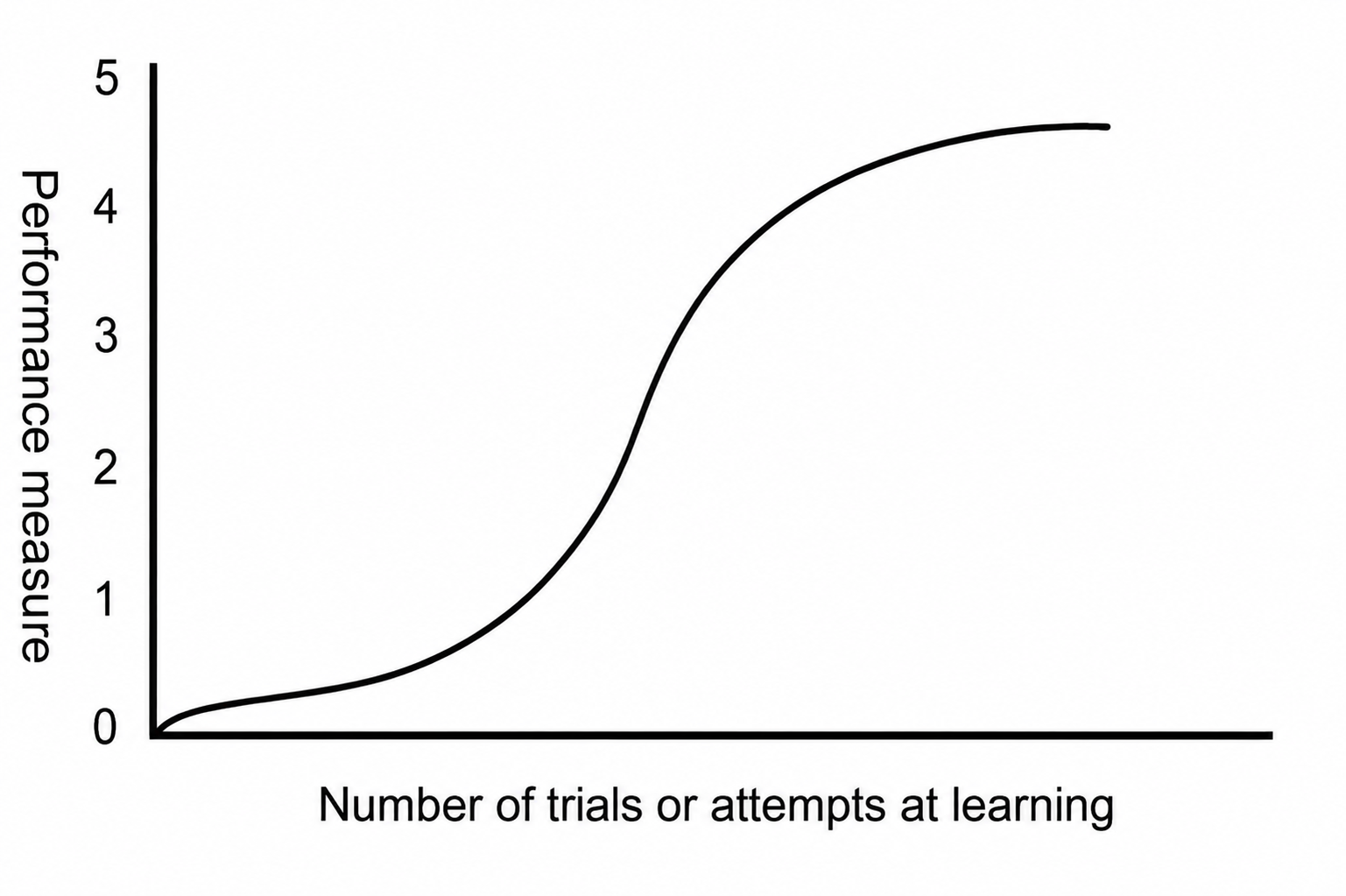
Learning is often depicted as a smooth “S-curve.” Yet my own experience—and that of many others—suggests otherwise. Individual learning unfolds in stages, marked by sudden breakthroughs and plateaus. The S-curve emerges only when patterns are averaged across groups. Unfortunately, many publications present it as if it reflects a single learner’s journey.
Psychologist Peter Molenaar warned against such overgeneralization in his 2004 Manifesto on Psychology as Idiographic Science. Oversimplification risks misinterpretation, leading to misguided diagnoses and interventions. Reflecting on this, we can see how easily individuality can be erased when averages are mistaken for individual lived experience.
Desire Paths: The Dehumanization of Planning
Desire paths—unplanned trails formed by repeated foot traffic—are often visible in jungles and hiking routes, where continuous walking erodes the ground and prevents vegetation from growing. Broadway in Manhattan, New York, began as such a path long before the city’s grid system was established, and it remains the only curved street in the borough.
These paths illustrate the tension between rigid planning, which prioritizes efficiency, and lived experience, which often unfolds in unpredictable ways. They remind me of a scene from Dead Poets Society, where a textbook attempted to measure the quality of poetry with graphs—an absurd effort to quantify the unquantifiable.
Desire paths symbolize the human tendency to carve our own way when life throws “curve balls” at us—random challenges that resist neat categorization or control.
Understanding Intelligence: IQ Versus Lived Experience
Intelligence is measured by taking an IQ exam. Most IQ exams include abstract reasoning components, which are designed to measure fluid intelligence which is the ability to solve novel problems without relying on prior knowledge. Psychologist Philip Akerman argues that intelligence is not only measured by the speed of abstract reasoning but by the cumulative depth of knowledge and lived experience. Knowledge builds upon itself, and that domain expertise is the most reliable predictor of performance and success. Akerman’s framework resonates with many especially those who do not fit predetermined molds: intelligence evolves into domain-specific expertise, shaped by education, career, and personal motivation. Persistence, personality, and interests matter just as much or more than raw ability.
The Way Forward
Democratic nations face a persistent dilemma: how to educate large populations efficiently and cost-effectively while simultaneously preserving individuality, a pursuit often perceived as resource-intensive. This tension may never be fully resolved, yet it demands vigilance and sustained effort, particularly as new technologies and pedagogical methods continue to emerge. Policymakers must resist the temptation of overgeneralization and the excessive reliance on statistical measures, recognizing that not everything of importance can be quantified, and that not everything quantified is necessarily important. A promising way forward lies in the development of diverse educational pathways and pedagogical approaches—such as the Feynman Technique or Project-Based Learning—which place the learner at the center of the educational process while maintaining affordability.
Looking back, schools of the past embodied both strengths and shortcomings. Despite challenges, they shaped us into who we are today. Different generations face different lived experiences. The world has changed, and younger generations face realities distinct from mine. Thus, any transformation needs to reshape education for contemporary life and surroundings.
Early assessment of learning challenges is also crucial. Conditions such as autism, ADHD, and dyslexia are likely more prevalent than assumed, yet remain hidden without deliberate screening. Recognition of these challenges is not a stigma but an advantage—something of which I am living proof. Reform must begin with a national conversation that embraces diversity and acknowledges our differing interests and capabilities.
Finally, certain fundamentals are constants, such as the rules of grammar, the four basic mathematical operations, and other similar principles. These are universal. While reform is necessary, not everything must change. Rigor, persistence, patience, love of knowledge, confidence, humility, and curiosity are values that remain essential for becoming a good learner. These enduring foundations provide stability, even as innovation guides us forward, hopefully toward a more inclusive and responsive educational future.
Closing Reflection
Education systems must resist reducing learners to mere statistical data points or rigid methodologies, as such conformity erases individuality. Preserving the universal foundations of knowledge while embracing pedagogical diversity requires gradual evolution through sustained dialogue. This balance is best achieved by carefully selecting and training capable teachers, granting them the flexibility to exercise professional judgment in the classroom, and relieving them of excessive administrative burdens. Only through this equilibrium can education remain affordable, equitable, rigorous, and responsive to the diverse needs of learners.
Looking back, my early struggles with reading were not simply obstacles but formative experiences. They revealed that learning is neither a straight line nor a universal curve, but a path uniquely carved by each individual. If education systems can embrace this truth, they will not only impart knowledge but also honor the diverse journeys that make us human. Even when the destination is shared, the paths toward it can differ.
Appendices