










Introduction
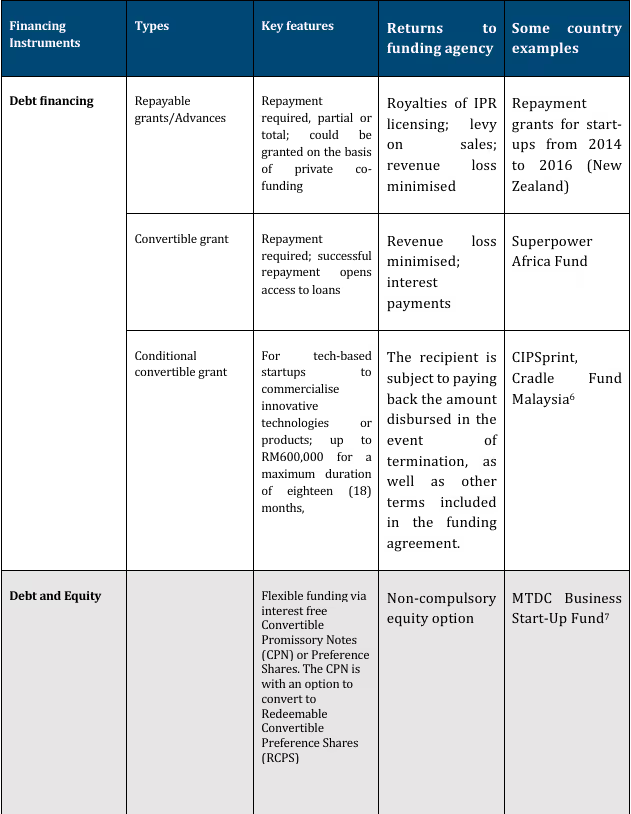
Repayable grants are one of several public financing mechanisms that can more equitably distribute risks and rewards between the public and private sectors. They can be fiscally neutral or offer ways for the state to become an investor, as well as complement private finance (as a form of blended finance)1. A number of related instruments are already in use in Malaysia (see Table 1).
Tax incentives v Repayable grants
A tax incentive aims to stimulate investment or targeted business activities by foregoing tax revenue. Tax incentives are not guaranteed to generate positive outcomes for the economy or alignment with government industrial policy goals (R&D activities can be gamed or lowballed). However, they carry low perception risk compared to guaranteed loans to private ventures that fail.
A repayable grant obliges the grantee to repay (partially or fully) the grant when a certain level of profit and/or revenue and/or investment leveraged are reached as specified in the grant agreement2. A convertible grant is another name for this type of conditional repayable loan. At its most basic level this tool minimises revenue losses to government where successful firms repay the grant. Losses will be incurred with unsuccessful ventures.
Repayable/convertible grants are often used to support startups or social enterprises who often lack savings or the ability to raise capital. Mature private firms could raise capital on public markets via an initial offering, for example, or seek loan finance. Convertible grants are also used to finance early-stage renewable energy (RE) investment by reducing risks3.
The Superpower Africa Fund’s convertible grant for RE has a provision where grantees who fully repay their grant qualify for a larger loan (5x). At successive stages due diligence costs are lowered as risks are mitigated4.
Laplane and Mazzucato (2020) describe repayable grants with a profit-sharing mechanism whereby the grant is repaid with profit-sharing via royalties on sales or equity stakes.
Grants offer a means for public agencies to control the course of a project, however they carry the risk of rent seeking, misallocation and abuse5. As with all grants, risk assessment and due diligence measures are required to minimise grantee failure.
Table 1: International Examples and Existing Malaysian Uses of Grant Mechanisms
Conclusion
From a revenue perspective, repayable grants offer a way to reduce investment risks for business grantees while reducing revenue outlays for federal government. The balance of long-term returns to the state or to business can be adjusted. The New Zealand and MTDC models give government a stake in a successful business. The Superpower Africa Fund and CIPSprint do not seek direct returns for government and follow traditional neoclassical approach favouring business subsidy and uncertain spillovers.
Repayable grants conditionally convertible to equity would be easier to execute in the case of small or fledgling companies with less bargaining power vis-à-vis government. Larger firms are typically perceived to be reluctant to bargain equity. However, Malaysia possesses institutions such as the Government-Linked Investment Companies (GLICs) who are able to acquire equity of publicly-listed firms.
The reigning fiscal philosophy in Malaysia is towards consolidation meaning that grand industrial policy goals for technological upgrading need to be achieved on the cheap. Recuperating traditional grant expenditure through one of the above models, or a variant, allows limited fiscal resources to stimulate greater upgrading and innovation.