






Introduction
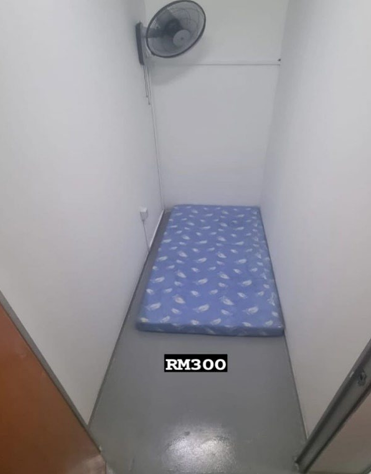
A little while back, social media was rife with anger regarding the deplorable living conditions of those who rent rooms in Klang Valley. The photograph uploaded depicted a room with a width that could only fit a single mattress, and with a length hardly exceeding half of the length of the said mattress. This tiny room cost RM 300 per month.
Amidst the clamour, a number of salient questions were raised. How are rents determined? How could a landlord charge RM300 for a room not much larger than a coffin? Why do tenants accept such deplorable living arrangements? And in the end - Why can’t we be ‘more-like-Germany’? - a common phrase often heard within think-tanks, academia and policy-research circles when referring to an efficient renting market.
How are rents determined? – It must be contextualized within the characteristics of the housing market
Area boundaries for housing markets ideally follow Origin-Destination employment data (travel distances from home-to-work), a detailed spatial distribution of workers’ employment and residential locations. Once the area boundaries are determined, then the nature and structure of housing supply for rent can be analyzed.
Broadly, the supply of rental accommodation has 3 main categories of landlords:
- institutional holdings e.g. government, cooperative or large corporations/private equity funds
- cottage industry i.e. private property owners who have 1 or 2 vacant dwellings with
- completed mortgage repayments
- uncompleted (still paying for) mortgage repayments
- speculative holdings i.e. speculators who buy to flip the property.
For the government’s institutional holdings, the rent is predetermined and meant to serve the poor and economically vulnerable; for example, in the case of our public housing programme, namely Projek Perumahan Rakyat (PPR). Meanwhile, cottage industry owners can be further categorized into two sub-categories. The first category (2a) is those who have completed paying their mortgages; and in this case, the rent setting mechanism would typically follow the ‘hedonic rent-pricing’ model1 or the ‘market price’.
The second category (2b) are those who require rents to cover their mortgage repayments. Rental prices characterized by off-setting mortgage repayments normally leads to higher rent prices as compared to Category 1 and 2a. Similar upward trends are generally found in the rents collected by landlords in Category 3 - the speculative buyers. This category not only seek to off-set mortgage repayments but are also actively pursuing extra profits.
The problem arises when the structure of the rental market consists of more landlords from Category 2b and Category 3. These players determine the rental prices to satisfy their own internal cost and profit structure; and by the sheer coalescing of large numbers will induce rent prices at the aggregate level to increase. Evidently, the rental market is skewed to landlords dictating rent prices based on the financial demands of their house mortgages (plus added profit) and not through competitive market prices. This answers partly the question that corresponds to
why landlords can determine obscenely expensive rental rates. But an exorbitant price for a sub-standard product? This brings us to the next question:
How could a landlord charge RM 300 for a ‘coffin’ room?
Adequate housing standards for shelter would suggest such rooms should not be in the market in the first place, but is it possible to regulate opportunistic behaviour by landlords? Government regulation plays a role but there are also questions from the ‘market’ on what ‘acceptable standards’ are. What is perceived to be ‘good standards’ or ‘acceptable standards’ by landlords vis-à-vis the ‘objective standards’ determined by the state (or building professionals) are a contentious issue for less established markets such as ours.
The subjectivity of standards, however, is not a problem in developed countries where there are continuous processes to improve and reconcile housing standards for both new-built and existing homes. As a result, good quality standards are explicit in the rental tenancy agreement between landlords and tenants. The local council or the agency in charge regulates and monitors both the rents and quality of houses in order to commensurate rent prices with the quality of homes provided.
Why do tenants accept such deplorable living conditions?
The main concerns in cities where housing standards and supply are generally inadequate would be the lack of amenities and overcrowding. It is often a case of where options are extremely limited for tenants.
Keynes once said, “the worse the situation, the less laissez-faire works2”. RM300 ‘coffin’ rooms will persist unless stricter and more effective regulation is instilled to ensure good standards are met and maintained as well as having sufficient rental options to choose from. Our ‘baseline situation’ in rental markets does not imply a market that works, and simply- as the old adage says-‘leaving it to the market’; will entail more abuse to tenants.
Why can’t we be ‘more-like-Germany’- where the rental market actually works?
In contrast to many other European countries, the rental housing and homeownership markets in Germany co-exist on equal footing. This has its antecedents from the state constructing social housing stock on a massive scale due to the severe shortage of houses after the Second World War. The First Housing Law (1950) was to promote the construction of homes which “in terms of their fittings, size and rent are intended suitable for the broad population”3. To date, these social and rented housing units are in the millions and are intended for both lower and higher income groups.
Rental contracts are governed by the German Civil Code, with renter protection as a priority. Since the key elements of the rental markets are stability and security, leases are open-ended rather than on a yearly basis. Landlords must ensure the units are in good condition (which renders ‘coffin’ rooms unlikely to emerge in their context). Formal complaints by the renter must be addressed by the landlord to remedy these deficiencies quickly, otherwise the renter can achieve rent reduction or in severe cases, termination without notice. Landlords cannot raise the rent arbitrarily. In very tight markets (where supply is inadequate), new rents for some homes cannot exceed the local average rent by more than 10% or are even capped temporarily4.
Conclusion
It might be tempting to look at the outcome of a market such as Germany for instance, and to imagine that we can emulate that which took many decades to ‘work’ within the backdrop of the carnages of WW2, the failed Morgenthau Plan and the structural transformation of the Marshall Plan. There were several strong planned interventions by the government. The socio-economic and political culture is also vastly different. We must also be privy to the fact that the comparatively low homeownership in Germany to its counterparts in Europe is often referred to as the weakness of the German housing market, not a strength.
But even if we want to learn from a rental market that works, we should start with simple basic questions, what is the purpose of our rental market in Malaysia? Is it to supplant homeownership? Do we want to encourage renting on an equal footing to homeownership? Do we want to promote decent housing standards for both tenures- renting and ownership? Currently, to the best of my estimation, the answer for the last question would be a resounding ‘yes’, and therefore policies on objective standard-setting mechanisms should be included into the proposed Rental Tenancy Act (RTA) for Malaysia. Otherwise, the RTA might just ratify RM300 ‘coffin’ rooms because the legal framework supports what the ‘market’ dictates, however distorted the market is.