








Discussion Papers
Jul 31, 2023
6
Minutes read

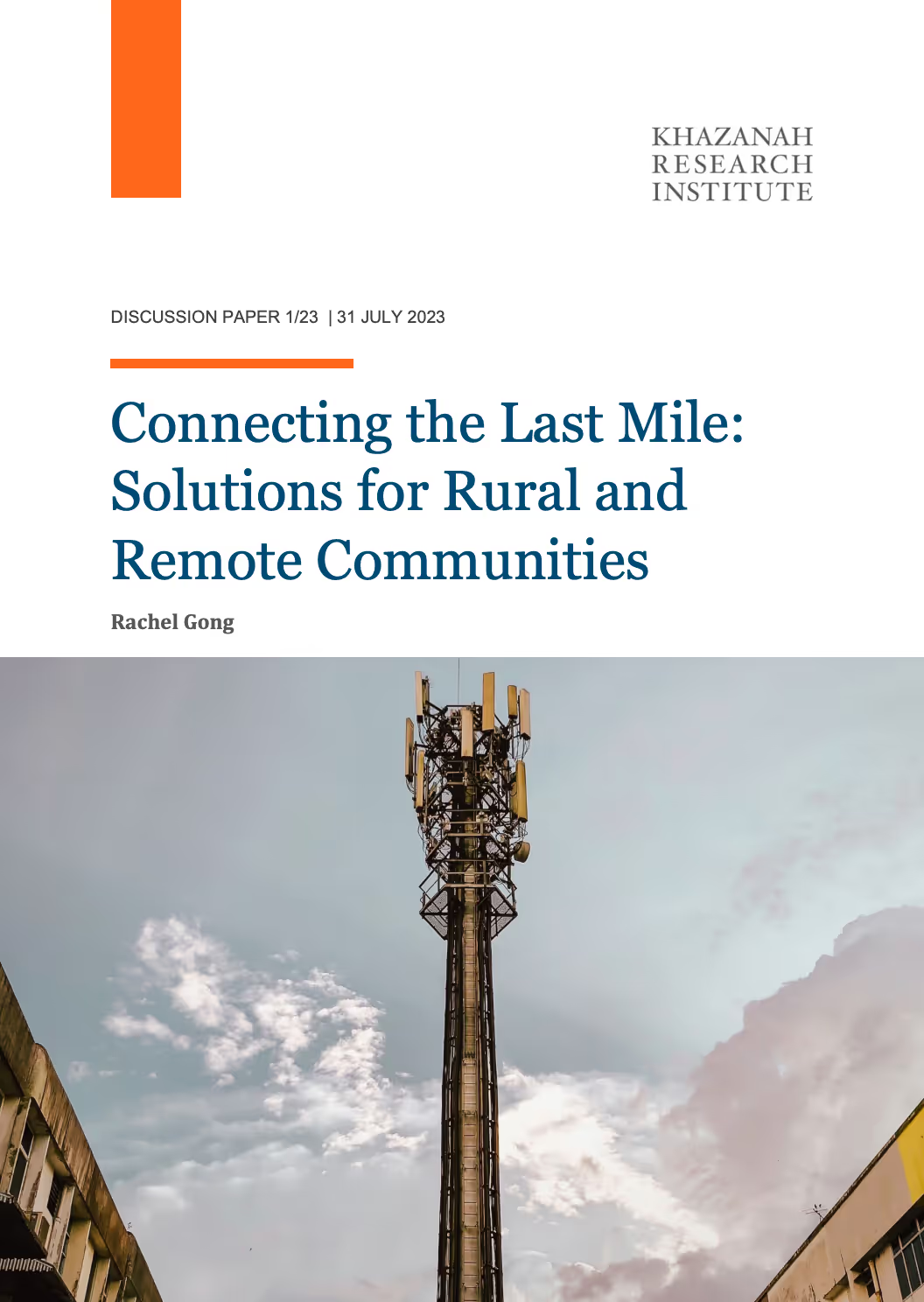
Connecting the Last Mile: Solutions for Rural and Remote Communities

Authors
Rachel Gong
No items found.
Key Takeaways
Data Sets Overview
- Malaysia has achieved 96% 4G broadband coverage of its populated areas as at 2022. Over 90% of households have internet access, and there are more mobile internet subscriptions than there are people.
- Nonetheless, user experience in many areas is poor and rural and remote communities face challenges obtaining internet access in their homes, even when they have an internet-ready device such as a smartphone.
- Rural and remote areas with uneven terrain and low population density are a challenge for connective infrastructure, from roads to electricity wires to data cables. Simply put, it is expensive to lay fibre optics cables through hills and jungle to reach the interior.
- Efforts to provide last mile connectivity in rural and remote areas include shared internet facilities in the form of community internet centres, shared signal receivers to enable wireless public internet access, broadband data being sent via power lines, fixed wireless broadband, satellite internet, and self-installed and self-managed community networks.
- Each of these models has advantages and disadvantages. Technology has evolved but constraints caused by geography, costs and market incentives remain.
- Given the different needs and locations of communities with limited internet access, there is no one solution that can bridge the digital divide. What is needed is a variety of policy options, and an agile regulatory framework to support them.
- Three policy considerations are proposed towards achieving the goal of bridging the digital divide. The first is to expand access to the Universal Service Provision (USP) Fund, for example, to allow non-profit organisations working with rural and remote communities to fund last mile connectivity programmes. The second is to facilitate the development of community networks by interested rural and remote communities as a last-mile connectivity option. The third is to incorporate user-generated network assessments into USP strategy.

connecting-the-last-mile-solutions-for-rural-and-remote-communities
Discussion Papers
Peer-reviewed publications designed to share emerging research or early analysis on key issues. Discussion Papers aim to invite feedback, encourage dialogue, and inspire further study or collaboration.
Disclaimer
As we transition to a digital-first communication and continue building our knowledge hub, publications released before October 2025 are preserved in their original format. Publications released from October 2025 onward adopt a new, digitally friendly format for easier online reading. The official versions of earlier publications, including their original language and formatting, remain available in the downloadable PDF.
- Malaysia has achieved 96% 4G broadband coverage of its populated areas as at 2022. Over 90% of households have internet access, and there are more mobile internet subscriptions than there are people. - Nonetheless, user experience in many areas is poor and rural and remote communities face challenges obtaining internet access in their homes, even when they have an internet-ready device such as a smartphone. - Rural and remote areas with uneven terrain and low population density are a challenge for connective infrastructure, from roads to electricity wires to data cables. Simply put, it is expensive to lay fibre optics cables through hills and jungle to reach the interior. - Efforts to provide last mile connectivity in rural and remote areas include shared internet facilities in the form of community internet centres, shared signal receivers to enable wireless public internet access, broadband data being sent via power lines, fixed wireless broadband, satellite internet, and self-installed and self-managed community networks. - Each of these models has advantages and disadvantages. Technology has evolved but constraints caused by geography, costs and market incentives remain. - Given the different needs and locations of communities with limited internet access, there is no one solution that can bridge the digital divide. What is needed is a variety of policy options, and an agile regulatory framework to support them. - Three policy considerations are proposed towards achieving the goal of bridging the digital divide. The first is to expand access to the Universal Service Provision (USP) Fund, for example, to allow non-profit organisations working with rural and remote communities to fund last mile connectivity programmes. The second is to facilitate the development of community networks by interested rural and remote communities as a last-mile connectivity option. The third is to incorporate user-generated network assessments into USP strategy.

Read Full Publication

Article highlight

featured report

Conclusion

Download Resources
Files
Datasets
Attributes
Footnotes
References
Photography Credit

Related to this Publication

No results found for this selection
You can  try another search to see more

Related to

Technology, Digitalisation & Future Proofing

Discussion Papers
Jan 28, 2026

Assessing and Optimising MyDigital ID

Launched in 2023, MyDigital ID enables Malaysians to access multiple government and selected private digital services using a single verified login. As a Single Sign On (SSO) platform, it simplifies access, reduces repeated verification and supports more efficient delivery of digital services. These practical benefits make authentication a sensible and appropriate starting point for a national digital identity initiative. International experience shows that many digital identity systems begin with authentication and develop gradually over time. In several countries, SSO has served as a foundation on which additional capabilities were introduced after governance arrangements, safeguards and public confidence were well established. In this respect, MyDigital ID’s current focus does not limit future options. Rather, it provides immediate value while preserving flexibility for future policy choices that align with national priorities. This research finds that MyDigital ID is progressing positively as a secure and reliable authentication platform within Malaysia’s broader digitalisation agenda. Its technical design aligns with recognised security standards, while its role as a verification layer that relies on authoritative government databases supports both system integrity and privacy protection. As adoption increases and integration expands, continued attention to governance clarity, accessibility and long-term planning can further strengthen public understanding and confidence in the system. Viewed in this way, MyDigital ID can be understood as a public digital asset that delivers immediate service improvements while remaining adaptable to future needs. A measured and phased approach allows benefits to be realised today, while ensuring that policy choices remain aligned with institutional readiness and public expectations.

Want more stories like these in your inbox?

Stay ahead with KRI, sign up for research updates, events, and more

Thanks for subscribing. Your first KRI newsletter will arrive soon—filled with fresh insights and research you can trust.

Oops! Something went wrong while submitting the form.
Follow Us On Our Socials