







The Hormuz crisis is driving prices up
Around a quarter of the world’s seaborne oil passes through the Strait of Hormuz1. The crisis in this shipping route following hostilities in West Asia has greatly disrupted global energy shipments and broader commercial shipping and supply chains. The immediate consequence has been a large and sustained rise in global crude oil prices, exceeding USD100 per barrel at its peak, in comparison to the USD65 per barrel projections underpinning Malaysia’s Budget 20262. Malaysian citizens have thus far been largely insulated from this shock through the BUDI95 fuel subsidy. Under the subsidy scheme, eligible Malaysian citizens pay RM1.99 per litre for RON95 petrol. The unsubsidised market rate rose 58% from RM2.54 per litre in mid-February to RM4.02 per litre by mid-April3. The difference in price, absorbed by the government, has risen from RM0.55 to RM2.03 per litre, more than tripling in nine weeks.
However, this subsidy is not a permanent solution as it puts a lot of pressure on government spending. In this article, we assess the consequences of the rise in global oil prices for Malaysians, in light of the government’s petrol subsidy programme and limited fiscal space. In particular, we consider the potential impacts on e-hailing drivers and propose long-term strategies to reduce the country’s risk to spikes in oil prices.
Malaysia’s petrol subsidies cushion the blow…
Across Southeast Asia, prices at the pump have increased. The Philippines, Viet Nam and Thailand are extremely dependent on oil from the Gulf and face both higher petrol prices and shortages in their supply as they lack oil reserves4. News reports of long queues at petrol stations that are running out of petrol paint a dire picture of the crisis around the region5.
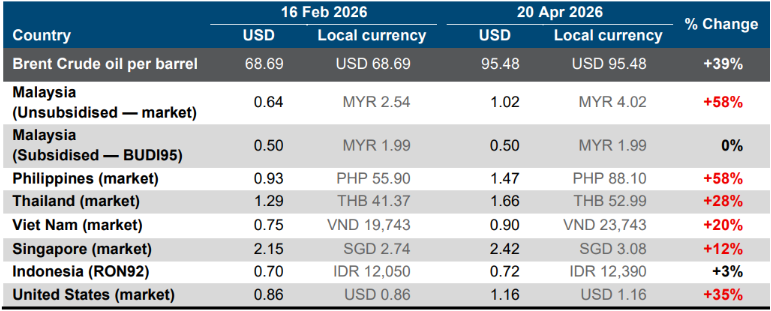
Figure 1 shows how petrol prices in six ASEAN countries have increased following the Hormuz Crisis. In mid-February 2026, pump prices ranged from USD0.75 per litre in Viet Nam to USD2.15 per litre in Singapore. By late April 2026, petrol prices in the Philippines had increased by 58%, Thailand by 28%, Viet Nam by 20%, and Singapore by 12%. Consumers in each of these countries pay the market price, while Malaysia’s subsidised price allows consumers to still pay RM1.99 per litre or USD0.50 for RON95 petrol.
The situation is slightly more complicated in Indonesia where the government subsidises a lower grade of petrol. While the price of higher grades of petrol have increased in line with market rates, Indonesia’s state-owned oil and gas corporation, Pertamina, is currently maintaining the prices of mid-range petrol grades such as RON92 to prevent customers shifting to the cheaper subsidised petrol, which could overstrain government finances6.
Figure 1: Percentage change of petrol prices in selected ASEAN countries between February–April 2026, RON95 unless stated
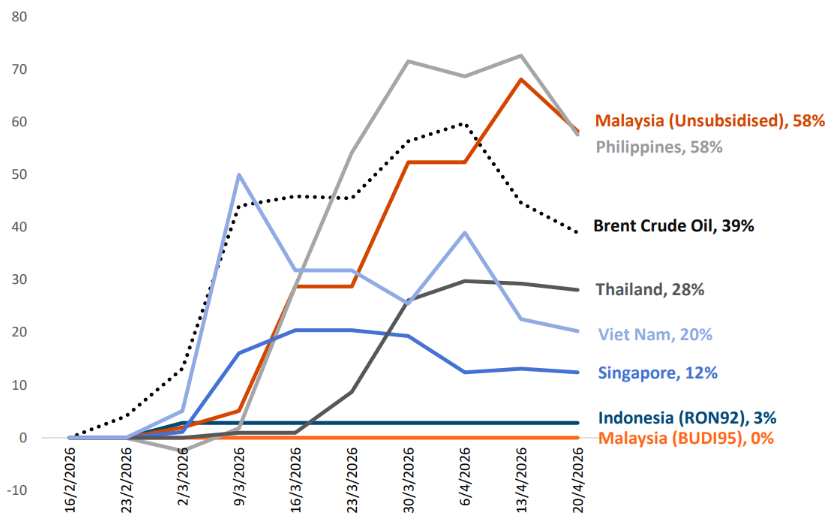
Table 1: Selected petrol prices between February–April 2026, per litre RON95 unless stated
Source: GlobalPetrolPrices.com (n.d.), Trading Economics (n.d.)
…but petrol subsidies are not a long-term solution
For Malaysia, the key takeaway from Table 1 is that the government is subsidising approximately 50% of the market price of petrol. Since consumers don’t yet feel the pinch, they are largely unincentivised to reduce demand and continue to consume petrol as usual. That puts significant fiscal pressure on the government and supply pressure on petrol suppliers.
Government subsidies related to petrol and diesel stood at RM0.7 billion per month in January 2026. As crude oil prices exceed USD100 per barrel, the subsidy was estimated as at March 2026 to be around RM4 billion per month7. If prices stay at this elevated level, fuel subsidies will cost around RM48 billion per year. For comparison, the total Budget 2026 allocation was approximately RM419.2 billion and the amount allocated for all subsidies and social assistance was RM49 billion8. At this trajectory, the BUDI95 scheme may consume the entire amount allocated for all subsidies and crowd out other spending, making the current rate increasingly difficult to sustain.
The Prime Minister has committed to maintaining the RM1.99 price through May 2026, while continuing to explore all options beyond that period9. To reduce the burden of BUDI95 on expenditure, the government has also reduced the subsidy quota from 300 litres to 200 litres, effective from 1 April 202610. At the time of writing, the Ministry of Finance has proposed cutting government operating expenditure to make more fiscal room for subsidies11.
To relieve the fiscal pressure on the government while not completely eliminating subsidies, one possible option is to raise the price of subsidised petrol. The World Bank has suggested raising the BUDI95 price from RM1.99 to RM2.05 per litre12.
Another alternative proposed by economists is a proportional pricing model where a percentage discount is applied to the price of petrol instead of setting a fixed price13. This means that the subsidy would be a pre-determined share of the market price instead of the government covering whatever price difference is needed to maintain a fixed consumer price.
Subsidising a percentage of the market rate would allow the government to reduce some of the consumer burden without itself being overburdened. Additionally, consumers would be more aware of market fluctuations, which could lead them to adjust their demand accordingly.
Another strategy, as this crisis is fundamentally a supply constraint, is to implement policies that prioritise managing existing supplies so they last longer14. This could include measures to reduce consumption, such as work-from-home policies and incentives to use less energy. However, such measures could have immediate impacts on the livelihoods of workers, such as e-hailing drivers.
E-hailing drivers are sandwiched between higher costs and lower demand
E-hailing is a significant cog in Malaysia’s urban transport infrastructure, serving as a complement to taxis or filling the last-mile connectivity gap for public transport users. As e-hailing drivers are not employees in the traditional sense nor do they necessarily work regularly or full-time, it is difficult to estimate how many drivers are active in Malaysia.
According to the Ministry of Human Resources, there are approximately 1.6 million gig workers in Malaysia in 2025, some of whom are e-hailing drivers15. For comparison, as of December 2025, there were 17.7 million people in Malaysia’s labour force16. In 2019, over 90,000 e-hailing drivers were reported to have obtained their public service vehicle license17. It seems likely that this number would have increased since then, but no official statistics are publicly available.
Although comprising a relatively small proportion of Malaysian workers, e-hailing drivers are a good example of workers whose livelihoods are directly impacted by the rise in oil and petrol prices.
Fuel is an occupational necessity for e-hailing drivers. An increase in the price of petrol translates into additional costs that eat into net earnings. The government’s petrol subsidies are an important mechanism to offset driver costs and protect their livelihoods. Recognising this, the government has maintained a tiered subsidised fuel quota for eligible e-hailing drivers of up to 800 litres per month contingent on distance driven18.
To illustrate the impact of rising fuel costs on e-hailing drivers, consider that in 2025 e-hailing drivers were estimated to need at least 700-800 litres of petrol per month to keep up with work requirements19. At the current subsidised rate of RM1.99 per litre, a driver consuming 700 litres per month would spend approximately RM1,393 on fuel. Without the government subsidy, this monthly cost of fuel jumps to RM2,814 at a market rate of RM4.02 per litre. A 2026 estimate corroborates this calculation, suggesting that e-hailing drivers can earn RM4,000 to RM7,000 per month and about RM1,200 to RM1,600 of those earnings is spent on fuel.20.
On one hand, e-hailing drivers face the threat of increasing costs due to the rise of petrol prices. On the other hand, they also face the threat of decreasing demand as people minimise traveling. Drivers who rely on long-distance airport transfers to boost their income have seen demand fall as international travel declines in the wake of the crisis, reporting weekly earnings falling by 15–20% as a result. To compensate, they work extra hours, focusing on shorter trips in the Klang Valley, which are more fuel-intensive because of traffic21.
In the short-term, the government’s tiered petrol subsidy system offers some relief to e-hailing drivers, but long-term solutions are needed to reduce Malaysia’s risk and exposure to spikes in oil prices.
Long-term resilience includes reducing fossil fuel dependence
Government subsidy programmes are currently holding the rising costs of living in check for Malaysians. However, large subsidies, particularly in times of crisis, add fiscal pressure to the national budget and are not sustainable. In the long-term, alternative solutions that mitigate the risks of global supply chain shocks should be developed. We propose two strategies for reducing our fuel dependencies and shifting to more sustainable energy sources and use.
First, in the Klang Valley and other urban areas, accelerate the process of reducing private car dependency in favour of public transport. Besides expanding light rail networks and last-mile connectivity, public transport could be improved by increasing bus services in terms of routes and frequency and reintroducing dedicated bus lanes, this time with stricter traffic enforcement.
KRI's research on mobility in Greater Kuala Lumpur finds that bus reliability remains uneven, reducing public confidence in buses as a mode of transport22. Nonetheless, near-term improvements in reliability can be achieved with operational improvements such as real-time schedule updates23.
Second, consider alternative sustainable energy sources for vehicles, such as electricity. The government is already providing tax incentives for the use of electric vehicles (EVs). These include exemptions on excise duty and sales tax as well as full import duty exemptions on components for locally assembled EVs until end of 202724. Individual taxpayers may also claim income tax relief of up to RM2,500 on expenses related to EV charging facilities25.
High upfront vehicle costs and uneven charging infrastructure could be barriers to EV take-up, especially for e-hailing drivers26. Targeted EV incentives could include dedicated purchase subsidies, rent-to-own programmes and cheaper access to charging infrastructure, easing the transition to EVs for e-hailing drivers.
To properly assess the feasibility and benefits of both proposals requires critical analysis of the costs of introducing, maintaining and upgrading new infrastructure as well as the existing and potential public appetite for such alternatives. Implementing lasting solutions requires strong commitment, thorough planning and high investment but the lesson of this crisis should be that short-term relief needs to be accompanied by long-term resilience.