




ACKNOWLEDGEMENTS
The authors would like to express their sincerest gratitude to Mr Koh Ah Kau for the visit to his farm in Raub and the subsequent interview. The authors would also like to thank Dr Ng Keng Yap from University Putra Malaysia for introducing the authors to Mr Koh and his assistance in verbal translation during the interview, and Professor Datin Paduka Dr Fatimah Arshad for joining the visit and contributing questions and information. Lastly, the authors would like to thank Junaidi Mansor, Director of Research for overseeing this initiative and providing his guidance and support.
2. Industry Performance
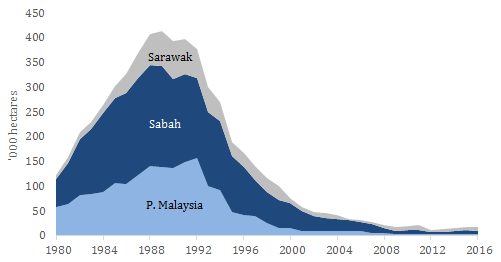
The cocoa industry in Malaysia has had a rather flavourful history over the past several decades. The industry performed spectacularly in the 1980s and early 1990s, only to suffer a reversal of fortune post-1990s, from which the cocoa industry had not recovered until today. As illustrated in Figure 1. the Malaysian cocoa industry’s collapse was almost as rapid as its meteoric rise – reflecting a typical “boom and bust” behaviour in which expansion in the growth of an industry is followed by contraction.
This section discusses the Malaysian cocoa industry’s evolution over time with a focus on production and trade.
2.1. Cocoa Production: From Boom …
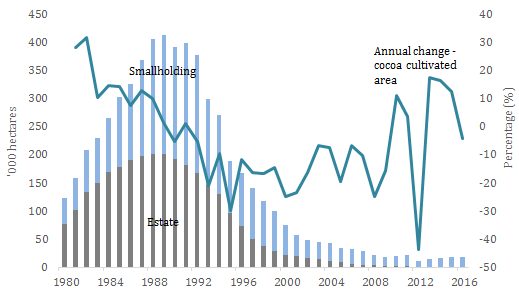
In the 1970s and 1980s, the cocoa industry underwent rapid development, with the area under cultivation expanding significantly from 123,855 hectares in 1980 to a peak of 414,236 hectares in 1989 – a three-fold increase in less than 10 years3. This translated into an average annual growth rate of about 15% in cocoa cultivated area.
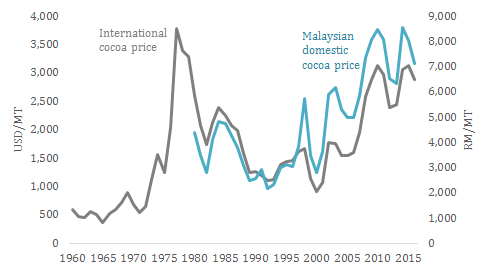
The rapid expansion in cocoa cultivation was spurred by the surge in international cocoa prices to unprecedented heights in the 1970s, which saw prices increasing almost six-fold from USD675/MT in 1970 to about USD3,800/MT in 1977 (Figure 2). In Malaysia, export price of dry cocoa beans (FOB) increased from RM3,010/MT in 1975 to RM4,310/MT in 1976 before doubling to RM8,320/MT a year later4. Given such strong cocoa prices coupled with low production costs in Malaysia, the estate5 sector was soon attracted to invest in cocoa plantations6.
At the height of cocoa cultivation in 1989, the estate sector accounted for almost half, or 48.7% of total cultivated area at 201,615 hectares, while the smallholders constituted the remaining 51.3%, or 212,621 hectares (Figure 3). Sabah’s cocoa industry, in particular, was dominated by the estate sector which accounted for more than 70% of the state’s total cultivated area. Conversely, in Sarawak, cocoa farming remained largely the domain of smallholders who accounted for more than 90% of the cultivated area.
During the peak (1980s), Sabah led in terms of cultivated area, accounting for almost half at 205,260 hectares, followed by Peninsular Malaysia, 33.5% (138,773 hectares) and Sarawak, 16.9% (70,12345 hectares) (Figure 4).
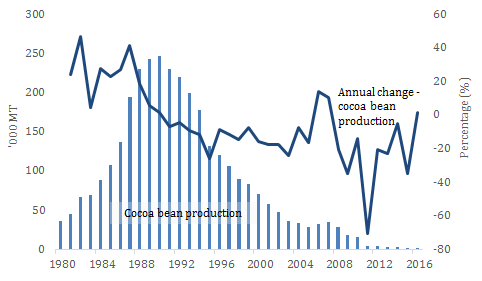
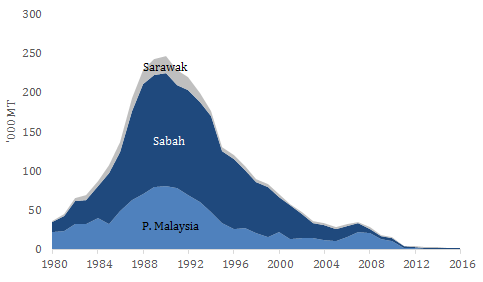
In tandem with the rapid expansion of cultivated area, Malaysia’s cocoa bean production rose to new heights. Between 1980 and 1990, production expanded at an average rate of about 22% per annum (Figure 4). This was almost four times the country’s economic growth during the same period7. In 1990, Malaysia produced 247,000 MT of cocoa beans, of which Sabah accounted for almost 60%, or 145,000 MT (Figure 5). The industry’s robust production also placed Malaysia as the world’s largest exporter of cocoa beans for the year.
2.2 … To Bust
Post-1990s, however, saw fortunes reversed for the local cocoa industry due to a combination of factors.One of the factors that led to the local cocoa industry’s decline was the slump in cocoa prices. Following a strong performance in the 1970s, international cocoa prices began to tumble in the 1980s and fell by more than 50% in five years to USD1,736/MT in 1982 (Figure 2). In Malaysia, cocoa prices began to decline in the mid-1980s, falling by 10.3% Y-o-Y from RM4,750/MT in 2005 to RM4,260/MT 1986. Domestic cocoa prices continued to tumble in the following years before hitting a low of RM2,184/MT in 1992 (Figure 2).
Nevertheless, it was the widespread infestation of the Cocoa Pod Borer Disease (CPB)8 in the early 1990s that sealed the course of the industry’s history9. The CPB infestation was first detected in an estate in Tawau, Sabah in 198010. Due to the failure of early detection and poor control of the disease, CPB spread rapidly to Peninsular Malaysia by 1985, and subsequently, throughout Malaysia due to the continued dispersion of planting materials from Sabah to the peninsula until the late 1980s11.
Adding to these “push” factors were other “pull” factors, particularly, the more profitable lure of oil palm and other non-cocoa ventures12. Collectively, these factors contributed to the exit of cocoa producers from the industry, especially the estate sector. As Figure 6 illustrates, cocoa cultivated area fell from 378,540 hectares in 1992 to just below 100,000 hectares in eight years. In stark contrast, the oil palm planted area in Malaysia has expanded unabatedly over the past 30 years or so. Although domestic cocoa prices subsequently rebounded to more than RM8,000/MT, this was not enough to revive the local cocoa industry as Malaysia’s agricultural focus had predominantly shifted to oil palm.
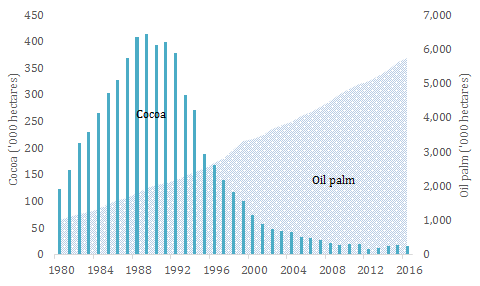
In 2016, the area under cultivation has dwindled to 17,368 hectares in 2016, or about 4% of peak cultivation in 1989 and smallholders now comprise more than 90% of the total planted area13. In terms of cocoa bean production, Malaysia produced merely 1,757 MT in 2016; at 1% of 1990’s peak production, this is a far cry from the industry’s heydeys when Malaysia was once a major player in the global cocoa bean market.
In summary, Malaysia’s cocoa industry collapsed in the 1990s due to the combination of both economic and environmental factors, namely, the producers’ inability to cope with cocoa price shocks, the debilitating effects of the CPD and the lure of more attractive returns from other ventures, particularly, oil palm cultivation.
2.3. Grinding Sector Continued to Flourish
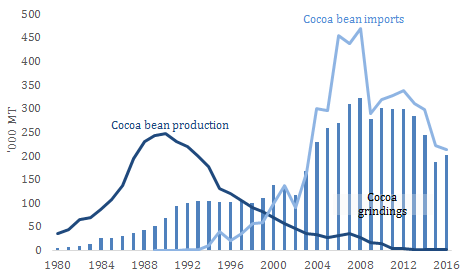
While cocoa bean production collapsed in the 1990s, the grinding sector took on a different trajectory. The cocoa grinding sector in Malaysia was established in 197314 and expanded significantly in the subsequent years, supported by robust cocoa bean production. From a fledgling annual grinding totalling 6,000MT in 1980, the grinding sector grew exponentially, averaging an annual growth rate of 18.7% between 1980 and 2000. The sector continued to expand further, peaking at an annual grinding of 323,653MT in 2008, which placed Malaysia as the fifth largest grinder in the world.
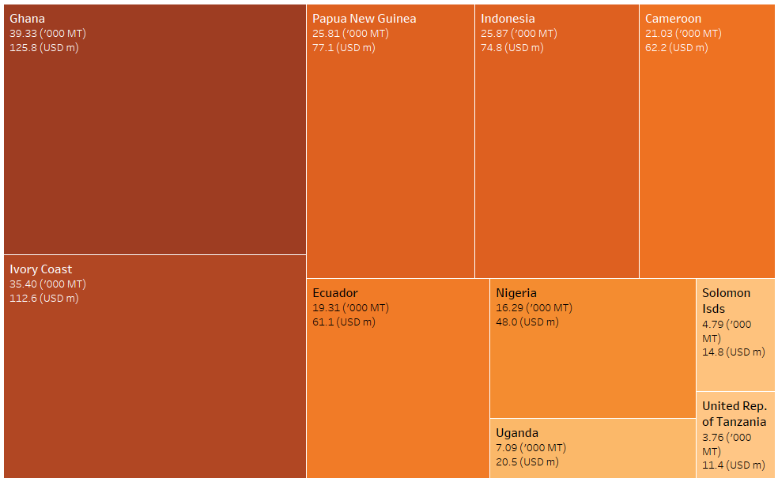
Following the decline in local cocoa bean production, however, the grinding sector had to resort to imported cocoa beans as the local industry was no longer able to meet the grinders’ demand. As illustrated in Figure 8, Malaysia imported cocoa beans from various countries in different regions in 2016. These include Ghana and Ivory Coast in Africa, Ecuador in South America, and Papua New Guinea in Oceania. The implication of this is that Malaysia has lost its “single origin cocoa” (SOC) edge – that is, cocoa beans that originate from a single source, which may refer to a single plantation, a small region within a country or a single country15. This is a trait that is favoured by artisan or connoisseur chocolate makers due to the uniqueness regarding flavour and character that SOC provides16. This could pose as possible marketing or pricing issues for Malaysia’s cocoa bean producers, as discussed further in Part 2 of the paper.
Today, five major cocoa grinders are operating in Malaysia, including Barry Callebaut, Guan Chong Cocoa Manufacturer Pte Ltd, and JB Cocoa Pte Ltd, amongst others. In 2016, total grindings in Malaysia stood at 203,093 MT, or 56.4% of the total grinding capacity (360,000 MT)17. In other words, there was an excess grinding capacity of about 40%. Currently, Malaysia ranks as the eighth largest cocoa grinder in the world and the largest in Asia and Oceania18.
2.4. Trade
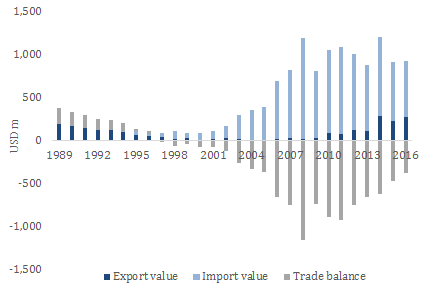
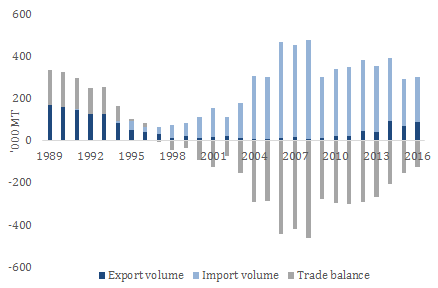
In the past, Malaysia played a significant role in the global cocoa trade. Export of cocoa beans from Malaysia increased from 30,640 MT in 198019 to a peak of 162,617 MT valued at USD165.8m in 1990. Consequently, Malaysia was ranked as the world’s largest cocoa bean exporter ahead of Brazil and Indonesia. However, Malaysia’s cocoa bean exports started to progressively decrease in the 1990s, reflecting the decline in cocoa cultivation and production.
Concurrently, Malaysia’s imports of cocoa beans rose exponentially from about 2,000 MT in the early 1990s to 100,707 MT in 2000, before peaking at 470,885 MT in 200820. In 2016, Malaysia imported a total of 213,841 MT of cocoa beans valued at USD653.9m, ranking it as the world’s fourth-largest importer of cocoa beans21.
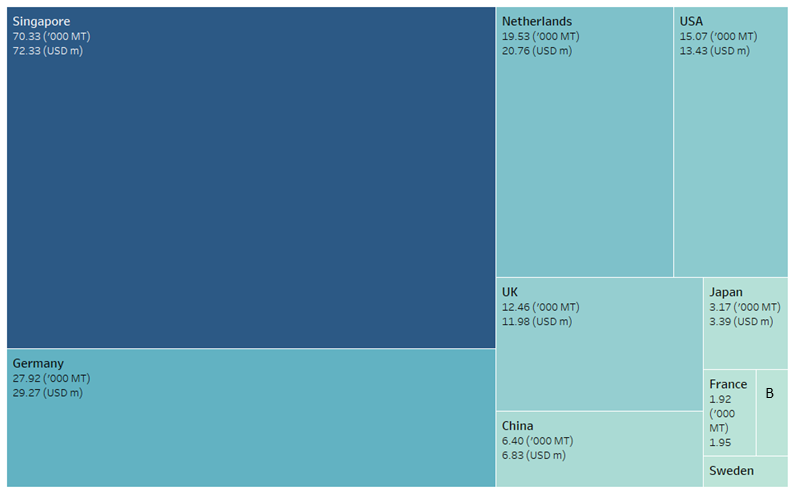
Figures 8 and 9 illustrate the contrasting positions of Malaysia’s trade in cocoa beans in 1990 and 2016 respectively. While the country’s cocoa beans were once destined for export markets such as Singapore, the United States and Germany when Malaysia was the world’s leading cocoa bean exporter (Figure 8), the country now depends heavily on cocoa bean imports (Figure 9). Although Malaysia still exports cocoa beans to Singapore and the US, its trade balance has transposed from surplus to deficit, both regarding value and volume as shown in Figures 10 and 11 respectively.
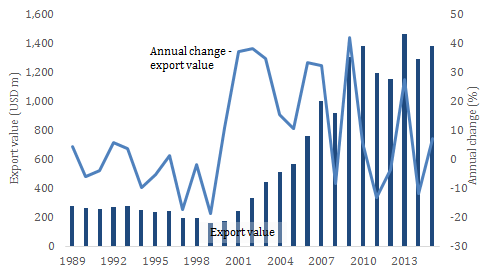
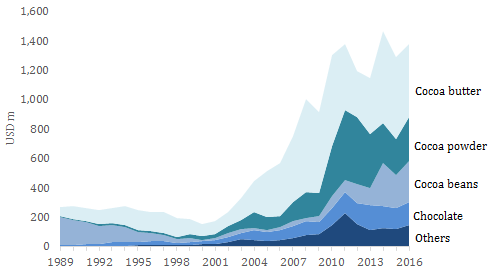
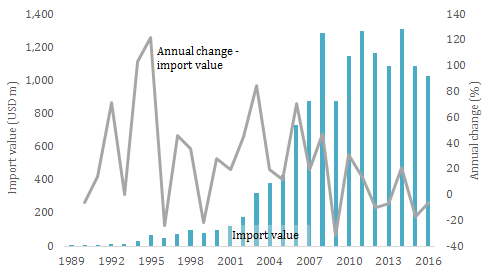
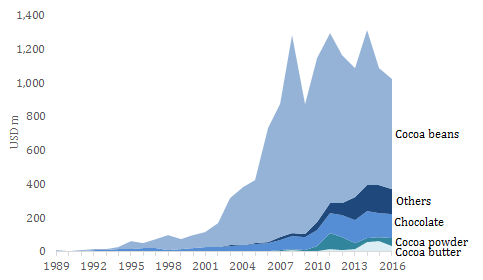
As for, cocoa products, both export and import values have grown steadily over the past few decades. In 2016, the total export value of cocoa and cocoa products stood at USD1.4b (Figure 12), while total import value amounted to USD1.0b (Figure 14), translating into a trade surplus of about USD400m. Cocoa butter accounted for the largest proportion of export value at USD500.4m or 36.2% (Figure 13), while cocoa beans constituted the highest proportion of import value at USD653.9m or 63.8% (Figure 15).
2.5. Conclusion
In this section, the Malaysian cocoa industry’s performance was discussed, in particular, the degeneration of the upstream segment, from one that was once robust enough to position Malaysia as a key global market player to one that is almost extinct now. Nevertheless, Malaysia’s cocoa grinding sector has continued to perform well, placing the country as the world’s eighth largest cocoa grinder22.
In the next section, the paper explores the challenges faced by cocoa smallholders who are now the mainstay of the Malaysian cocoa industry, with the exit of the estate sector following the industry’s collapse in the 1990s.
3. CHALLENGES FACING COCOA SMALLHOLDERS IN MALAYSIA
Following the ‘bust’ of cocoa production in the late 1990s, smallholders have been gaining prominence as the main mode of cocoa production in Malaysia. Considering that the future of Malaysian cocoa production might hinge on the smallholders, this section seeks to explore some of the major challenges facing the local growers. Note, however, that given the scant literature available on this subject, this section aims to be introductory and is, therefore, non-exhaustive.
The discussion on challenges faced by cocoa smallholders starts with challenges faced by cocoa smallholders globally, before focussing on the challenges within the local context. According to the World Cocoa Foundation (WCP)23, small cocoa-growing communities across the globe share the following key challenges:
- • Pest and disease management The threats from pests and diseases loom large in the minds of smallholders as they are often not financially fit to recuperate from a sharp decrease in output. WCP estimates that 30 to 40% of cocoa production losses in major cocoa growing countries is caused by pest and disease infestation
- • Marketing challengesWhile the factors vary from place to place, cash-strapped smallholders are usually price takers due to the lack of market information, poor knowledge in cocoa quality and low volume production.
- • Productivity improvement Without expansive knowledge on effective agricultural practices, many smallholders struggle to meet expected yield and cover production costs. Most small farmers also lack the financial resources to purchase superior planting materials and efficient machinery that could boost crop productivity and reduce reliance on labour-intensive practices.
Having looked at the general challenges, the following paragraphs elaborate on the above-mentioned points for the Malaysian context.
3.1. Pest and Disease Management: Limited Agricultural Extension Support
While the drop in large-scale cocoa plantations has provided an avenue to explore the many advantages of growing cocoa trees in a small-scale and eco-friendly setting25, a lack of hands-on and technical knowledge, as well as resources, continue to cripple farmers’ confidence in preventing and controlling pests and diseases26.
Threats from pests and diseases are a matter of great concern for Malaysian small growers. Admittedly, the drastic decline of cocoa cultivation area from 393, 465 ha in 1990 to 190, 127 ha in 1995 has been attributed to intermingled factors like the drop in global cocoa prices and the growth of the Malaysian oil palm sector27. Nevertheless, the CPB infestation has been singled out as the main factor driving the reduction in area cultivated, showing the severity of pest and disease-related damage28. In fact, the aftermath of the CPB infestation was so drastic that even the eventual increase in cocoa bean prices could not entice cocoa farmers and large estate owners to revive the cocoa industry to its former heydays29.
Acknowledging the importance of pest and disease management in sustaining cocoa production and as part of the agricultural extension support, the Malaysian Cocoa Board (MCB) has taken the initiative to set up an online ‘info-structure’ that outlines preventive and curative measures for key cocoa diseases and insect pests. However, less tech-savvy growers with low socioeconomic status living in inland areas may not be able to take full advantage of such a platform.
Studies have shown that face-to-face interactions could be the most effective medium for knowledge transfer. According to Hislop (2005)30, face-to-face communication is a superior communication medium especially when there is a need to transmit tacit knowledge that cannot be effectively expressed in writing. This might be especially true for cocoa farming in Malaysia given that its curative and preventive strategies are highly contextual, depending on the farm’s environmental conditions, the types of cocoa trees planted, and the infected diseases31. While there might be other cost-effective ways to address these local factors, the physical presence of the relevant officers could provide the much-needed assurance of continuous government support and viability of cocoa production32. Such physical engagements could also allow for two-way communication to take place, where the farmers can directly air their concerns and grievances as well as share their best practices. Notwithstanding the expected benefits, anecdotal evidence gathered from the trip to Mr Koh Ah Kau’s cocoa farm revealed that improvements in the frequency of such extension activities could prove invaluable for the industry.
3.2. Marketing: Inconsistent Quantity and Quality
Due to the small size of production, smallholders’ yields are often inconsistent in both quality and quantity. To some extent, this lack of consistency makes it difficult for small growers to market their crop to large processors33.
In terms of volume, most Malaysian small cocoa producers struggle to meet the demand of high-volume grinders and processors. As illustrated in Figure 7 and 10, the inability of local cocoa producers to satiate the demands of larger grinders along with the easy access to imported beans has transposed Malaysia from a net cocoa bean exporter to a net cocoa bean importer34. The decreasing reliance on local cocoa production implies that smallholders are more likely to be price takers, further exacerbating their income insecurities and vulnerabilities to the fluctuating commodity prices.
Another factor that impedes the profitability of small growers is the inconsistency in the quality of cocoa beans. As the farm-gate price is driven mainly by volume and not governed by robust quality control, small farmers are incentivised to neglect the quality of their beans. Accordingly, many farmers choose to skip time-consuming fermentation and drying techniques35 that can enrich the quality of their beans. While this may make economic sense, it limits the opportunities for small farmers to sell their beans at a premium price. As such, these external structural factors continue to weigh on the smallholders’ profitability and income security.
3.3. Productivity: Competition for Labour and Lack of Credit Facilities
Production Cost: Competition for Labour
The profit of small-scale production can be maximised through increasing its productivity and/or improving the quality of the beans. Apart from good farm management and conducive agro-climatic conditions, labour is another key factor influencing farm productivity and product quality. Many of the recommended good agricultural techniques such as pruning, tree spacing, shade system or grafting are technical and laborious36. Unfortunately, most hired-labourers are short-term migrants, thereby discouraging monetary investments in their training. At the same time, cocoa farmers especially those who rely on hired workers, are finding it increasingly difficult to hire workers due to competition from alternatives estates that require low-maintenance and low-skills such as oil palm37. This is not surprising considering that in 2012 at RM 4,794/ha, the total estimated earnings for oil palm doubled the expected earnings from planting cocoa)38.
In summary, the attractiveness of oil palm planting and other non-cocoa ventures continue to exert a downward pressure on the supply of labour, thus raising production costs and making it increasingly difficult for owners to manage and improve its productivity level of their farms as well as to stay profitable.
Credit Facilities
Other than the labour-intensive practices employed by small farmers, a lack of access to credit facilities might also hinder small farmers from investing in automating their cocoa production activities. While monetary incentive packages are provided by MCB, most of them exclude the adoption of machinery39. Financing programmes offered by Agrobank Malaysia40 come with specific eligibility criteria and are only open to certain agricultural products, making it hard for cocoa smallholders to qualify. This paper will not delve deeper into the issue of credit facilities but acknowledges its importance.
3.4. National Commodities Policy: Challenges in Meeting the Targets for the Cocoa Industry
The government is cognisant of the challenges facing the cocoa industry, particularly regarding improving productivity and increasing cocoa cultivation area in the upstream segment. Under the National Commodities Policy (NCP) 2011–2020, the government outlined several strategies to develop the cocoa industry that will focus on expanding new areas and conserving existing cocoa cultivated area. Some of the broad strategies include:
• Improving productivity in cocoa bean and cocoa-based products.
• Increasing research and development (R&D) activities.
• Involving more Small and Medium Enterprises (SMEs) in the downstream segment.
• Enhancing institutional support through stronger cooperation among the implementing agencies.
The NCP 2011–2020 targets cocoa cultivated area to increase to 40,000 hectares by 2020 through existing and new planting area. Additionally, cocoa production is expected to rise to 60,000 MT by 2020 through improving extension services in new planting areas as well as rehabilitating unproductive cocoa areas (Table 1).
However, these targets are unlikely to be achieved as cocoa cultivated area fell from about 20,000 hectares in 2010 to 13,826 hectares in 2013 after the policy was formulated, before increasing to 17,368 hectares in 2016. As for cocoa beans, production stood at 1,757 MT in 2016, significantly below the targeted 60,000 MT by 2020. On a positive note, with regards to the export revenue of cocoa-based products, the 2020 target of RM6b is likely to be exceeded as exports in 2016 had already reached RM5.7b. Nevertheless, given the smallholders’ limited involvement in secondary production and the processors’ heavy reliance on imported beans, it is difficult to see how the latter trend could be of benefit to the small producers.
Table 1: Cocoa industry prospects, 2011–2020
3.5. Conclusion
In this segment, we have outlined major challenges faced by cocoa smallholders in Malaysia. Some of these challenges involve productivity, pests and diseases and marketing challenges.
The following section illustrates two things: first, how the challenges as described in the literature manifest themselves, and secondly but perhaps more importantly, how Mr Koh Ah Kau has addressed these challenges. The practical insights gained from this case study show that there is hope for small cocoa farmers in Malaysia and existing stumbling blocks can, in fact, be turned into stepping stones.
4. SMALLHOLDER: THE STORY OF MR KOH AH KAU
4.1 Background
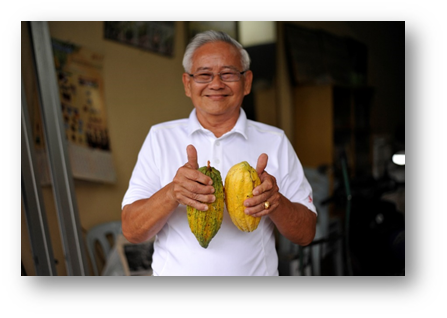
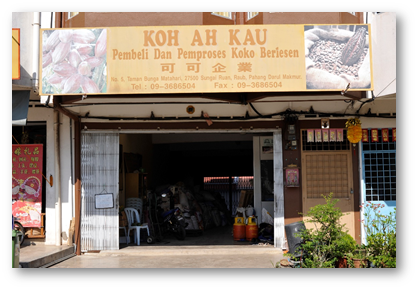
Born in 1949, Mr Koh Ah Kau is a cocoa farmer and owner of Koh Cocoa Enterprise Pte Ltd (Figure 17) located at Taman Bunga Matahari, Sungai Ruan, Pahang. He is both a cocoa farmer and a cocoa bean collector for downstream distribution. He is currently cultivating cocoa trees on 10 acres of land managed by two workers living on-site. It is located about six km off the main road of Jalan Sungai Klau in Pahang, flanked by previously existing cocoa farms, but now converted into oil palm estates. His cocoa farm is located towards the foothills with access to fresh river water.
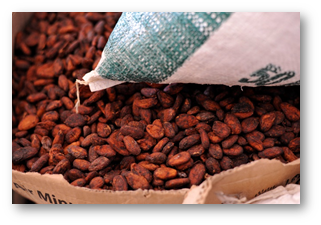
In addition to producing cocoa, Mr Koh also collects cocoa beans from other farmers to be sent in bulk (10 tonnes per delivery) to one of Malaysia’s largest grinder, Guan Chong Pt. Ltd. in Johor. This not only reduces the cost of transportation, but Mr Koh has a good reputation among the grinders in producing and delivering top quality beans. He achieves this by helping other producers in Pahang to cultivate and produce beans at an acceptably consistent quality.
Mr Koh grew up in Port Dickson with a father who worked in the rubber industry. He was first introduced to cocoa farming by the Ministry of Agriculture Malaysia in 1983 when he was in his 30s. A year later, Mr Koh planted his first nine acres of cocoa farm. From the initial size of nine acres, his cocoa farm gradually grew to 36 acres at the height of Malaysia’s boom in the cocoa industry (1990–2004). When the cocoa industry went bust in the 2000s, Mr Koh’s cocoa farm shrank to only 10 acres today.