












Introduction
On the 28th of February 2026, the United States and Israel launched airstrikes on Iran in efforts to effect regime change, to which Iran responded with a series of counter-strikes. Alongside counter-strikes, as a result of the conflict’s escalation, Iran severely restricted access to the Strait of Hormuz for passing ships to around 5% of its initial volume1. This article unpacks the effects, still faced months later, on Malaysian small-scale informal workers in the agri-food supply chain – from production through farmers, to retail and hawkers; the groups that did not ask for the conflict but pay a hefty price.
The restrictions increase risk, which increased insurance costs by 17 times their initial value, and therefore shipping costs2. Additionally, some Middle Eastern countries have decreased or halted oil production and exports for the foreseeable future under the effect of the conflict3. Meanwhile, for majority of the world for whom toll-free privileges are not extended, these effects are exponentially worse when concatenated with supply-side shocks, significantly increasing the cost of transporting oil, and the corresponding price of oil4. So, while Iran has exempted Malaysian ships from toll charges5, Malaysians still face direct effects of this geopolitical conflict through the price increases of oil and fertiliser shortages resulting in increased food prices6. Rising fuel prices, and the corresponding shortages of raw materials, increase raw material costs. This means the further tightening of profit margins7. This is especially the case when the ceasefire deal has been recently collapsed, oil and gas prices are not expected to stabilise immediately8.
This article builds on KRI’s paper on The Geoeconomics of Food Dependencies in Malaysia/Southeast Asia9. While that paper mapped Malaysia’s exposure at the macro level, this article argues that the impact flows disproportionately to small-scale informal workers at the two ends of the domestic food chain, namely small-scale farmers and street hawkers. The former would most likely be exposed to rising input costs, such as fertilisers and animal feed, which they absorb with thin margins and little market power. The latter face the dilemma of either absorbing higher ingredient costs or passing them on to price-sensitive consumers. Both groups tend to operate informally, where some are unregistered, uninsured, and under-covered by formal social protection. Hence, they absorb food-system shocks with minimal buffers, even as they constitute the critical infrastructure of national food security. Trade flows and market structure tell the story of Malaysia’s food dependencies, but further insight is needed to look at informal livelihoods through which those dependencies are experienced.
Cost escalation and its implications on business viability
One impact of the conflict is a price hike, which has placed greater economic pressure on businesses, particularly those operating at smaller scales. Producers already saw prices moving substantially higher on a year-on-year basis, from a 3.4% decline in February to a 1.1% increase in March, then rising further by 5.4% in April 2026 (Figure 1). The data breakdown revealed that this was mainly driven by double-digit price growth in crude fuel (51.8% in April vs. 26.3% in March). Although inflation was not as elevated as during the Covid-19 outbreak, statistics suggest that the effects of the conflict have begun to manifest through prices and are in line with previously projected price hikes after March, so long as the conflict persists10.
Figure 1: Year-on-year change in producer prices, 2020-2026

Among businesses that bear the brunt, microbusinesses are particularly hard hit by this shock, having not even fully recovered from the repercussions of the pandemic, especially amid a more challenging economic environment. To contextualise the brief analysis of this article, the impact of the hike in prices is examined through the following key sources: 1) the cost of fertilisers (input prices) and food production, and 2) the cost of transportation.
Rising fertiliser, falling margins and rising food production costs
Because of the ongoing conflict that has caused trade disruptions, Malaysia’s agricultural sector is among those hit hardest, especially due to the rise in the cost of fertilisers. Worse, it was reported that Malaysia only produces 39% of its fertilisers domestically11, hence making the nation dependent on imports12. However, the reliance on external sources has also taken a toll on local farmers as imports are becoming more expensive following the conflict. This is particularly due to export tightening imposed by other countries such as China13, as well as the hike in the price of natural gas14,15. Figure 2 shows that global fertiliser prices, together with natural gas prices, have persistently risen since the conflict commenced in February.
Figure 2: Elevated prices for fertilisers and natural gas, global, 2020-2026

Going further, the increased fertiliser prices have shown effects on the cost of food production in Malaysia. For example, in March, the cost of producing feed and food rose further from 4.4% in February to 5.5% (Figure 3).
One of the producer groups that felt the pinch is vegetable farmers. The Kuala Lumpur Vegetable Wholesalers Association had stressed that higher costs of fuel and fertilisers have resulted in lower harvests and a rise in prices for several types of vegetables16. Furthermore, the Malaysian Padi Farmers Brotherhood Organization (Pesawah) highlighted that there has been an increase of 50 to 55% in the sector's costs. Given the anticipated rise in costs, farmers are becoming more cautious about their operating costs, leading to a reduction in planting work and shipments of vegetables17.
On the flip side, many farmers have also experienced price crashes due to tight competition with imported vegetables, affecting demand from buyers18. This condition is further exacerbated by planting delays caused by concerns about water shortages19.
Altogether, not only rising costs but also price fluctuations, low bargaining power among small-scale independent farmers, and tighter competition have forced small-scale farmers to squeeze their profit margins.
Figure 3: Year-on-year change in producer prices for foodstuff and feedstuff, Malaysia, 2020-2026

Figure 4: Year-on-year change in consumer prices of selected food items, Malaysia, 2020-2026

Additionally, hawkers who source their ingredients directly from producers could feel the pinch due to inflationary pressures worsened by the conflict. For example, in March, the Federation of Malaysian Hawkers and Traders Associations did not rule out a 50% price increase for the products they sell to consumers20.
However, the higher cost borne by producers is yet to be fully reflected in consumer prices as of April, except for fruits (Figure 4). This implies consumers are not experiencing the shock as immediately as the businesses, likely buffered by 1) the price control scheme during Hari Raya Aidilfitri that ran until the end of March21 and 2) businesses temporarily absorbing cost pressures. But at the point at which cost absorption becomes unsustainable, businesses would run out of options but to pass on the pricing pressures to consumers that may result in shifts in consumer demand.
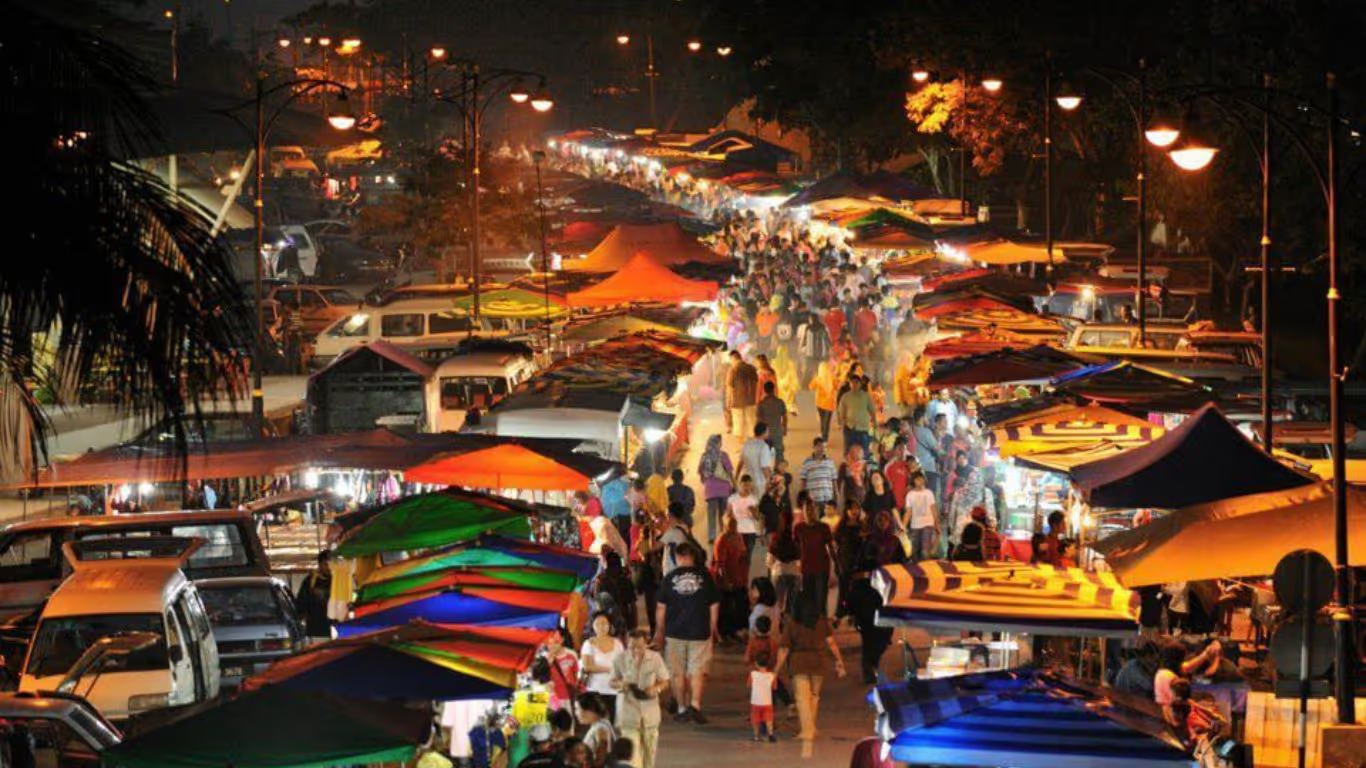
The upward price projection paints a dire picture for hawkers, especially those who have suffered from the impacts of the Covid-19 pandemic. As found from KRI survey of selected KL night markets, nearly seven in ten hawkers have reported poorer business performance compared to the pre-Covid period. Among other reasons, rising costs took a toll on their business, whereby over 70% of hawkers experienced mounting cost pressures of more than 10%, particularly due to the increased costs of raw materials and stocks (Figure 5 and Figure 6).
Figure 5: Proportion of hawkers by their perceived change in business performance compared to before Covid-19

Figure 6: Proportion of hawkers by perceived cost increase for raw materials and stocks over the past year

Breaking down the data further, Figure 7 shows that notable proportions of food & beverages, fruits and vegetables hawkers, as well as those selling fresh meat, poultry, fish & seafood experienced greater cost increases, of at least 30%. This finding indicates that workers involved in food production in the hawking scene are particularly vulnerable and sensitive to pricing pressures driven by the ongoing geopolitical conflict.
Figure 7: Perceived cost increase, by product group

Transportation costs and the uncertainty ahead
For small-scale informal workers such as farmers and hawkers, the transportation of raw materials and goods is key to their operations. The impacts from the conflict, as well as a substantial rise in global benchmark oil prices22 (Figure 8), have already been transmitted through to transportation inflation – moving up further from 1.6% in March 2026 to 4.1% in April (Figure 9). Among other inflation items, this uptick was particularly driven by a notable rise in diesel prices, remaining at double digit (48.5% in April vs. 16.6% in March) and petrol prices (4.3% in April vs. 0.5% in March), as seen in Figure 10.
Figure 8: Monthly oil prices, global, 2020-2026

Figure 9: Year-on-year change in transportation cost, Malaysia, 2020-2026

Figure 10: Year-on-year change in fuel prices, Malaysia, 2020-2026

While transportation subsidies are available for eligible businesses to cushion the cost pressures, including for farmers and hawkers23, the uptake remains contingent on recognition in the system, as the distribution will only take place if the transport is registered under a company or business entity, as well as classified as commercial vehicles under the Road Transport Department (JPJ).
Triple exposure: volatile income, rising costs, and near-zero safety nets
While the effects of the energy crisis outlined above will also be felt across the population, the more pressing question is who bears the heaviest burden. Small-scale farmers and street hawkers offer a microcosm of the agri-food supply chain under strain as they face a triple exposure of volatile incomes, rising costs, and little to no safety net.
Why small-scale farmers and street hawkers are disproportionately hit
According to DOSM, the majority of those working informally work overwhelmingly outside of the conventional business premises. Figure 11 shows that home-based, agricultural and street stalls or markets account for about 66% of employment in the informal sector. Income of informal workers can fluctuate and since individual earnings are not officially tracked, household income bands would be the closest available proxy for how informal workers such as street vendors are faring. The recent hawker study shows that 63.7% of night-market hawkers earn RM4,000 per month or below (Figure 12). Since informal workers are generally concentrated in these lower deciles, the crisis reaches them through both their earnings and their spending.
Figure 11: Employment in the informal sector, including agriculture (‘000)

Figure 12: Distribution of night-market hawker respondents by self-reported average gross monthly income

Lower-income groups devote a far larger share of their monthly budgets to precisely the categories the crisis inflates such as food, utilities and transport. The composition of monthly household consumption expenditure by quintile shows this skew clearly where households in the bottom deciles (D1–D2) direct 59.9% of expenditure to food and beverages, transportation, utilities and fuel, compared with 48.2% among higher-income households in D7-D824,25. The same price increase therefore erodes far more of a low-income household's real income.
Figure 13: Composition of monthly household expenditure for D1-D2 and D7-D8 income decile

The buffer they have, or the lack of it
If volatile income and rising costs describe the pressure, the thinness of the buffer describes the danger. For informal workers, the safety nets that cushion lifecycle risks are largely absent, voluntary, or only now being made mandatory and even where they exist, take-up remains relatively low. With that said, precarity is not confined to workers in the informal economy alone. The ILO's worker-centric definition of informality makes this explicit as informality is defined by the absence of a secure employment contract, social protection, or standard employment benefits. This means that even workers in formal employment can be informally employed and equally under-protected by some form of social protection.
The picture for employment protection among the self-employed is mixed. The Self-Employment Social Security Scheme, also known as Lindung Kendiri under SOCSO was, for most of its existence voluntary. From 2025, it is being made mandatory across some 20 informal sectors, ranging from agriculture, fisheries and livestock to street vending, construction and online retail. Mandating coverage and achieving it are two different stories. Despite sustained efforts to extend Lindung Kendiri for the self-employed, only 325,008 self-employed individuals (orang berkerja sendiri) are actively contributing as of February 202626. Low participation, perhaps, is less a matter of choice than circumstance. The irregular and unpredictable income defines the everyday lives of this population, making a fixed monthly commitment hard to keep, even when a protection scheme is within reach.
Social protection systems exist to prevent and protect people from poverty, vulnerability, and social exclusion. The EPF's flexible account (Akaun Fleksibel) appears to be serving exactly this function by allowing members to draw on part of their retirement savings to absorb lifecycle or economic shocks. Since the introduction of the Akaun Fleksibel in 2024, about 5.0 million EPF members under the age of 55 have made at least one withdrawal, with cumulative withdrawals amounting to RM16.6 billion (as of October 2025)27.
The reasons behind these withdrawals are themselves a testament to how challenging the current economic climate has become. According to EPF, among those who withdrew, 93% used their savings to sustain daily necessities, and 81.7% withdrew specifically to cover shocks and emergencies. This signal rising living costs that are pushing even households with formal retirement savings to draw down that buffer just to get by. This trend is not unique to small-scale farmers or street hawkers, but it is revealing precisely because it is not. These are EPF members who have retirement savings to withdraw from in the first place. It raises a harder question for those this article is centered on, namely small-scale farmers and street hawkers who might not have the capacity to build that buffer at all. What happens to those with no formal savings pot when the same shock hits?
Then there is the most immediate buffer of all, which is household savings. The RinggitPlus Malaysian Financial Literacy Survey 2025 found that about 73% could not survive more than six months on savings28. Bank Negara’s findings echo this, as close to 61% of Malaysians have difficulty raising RM1,000 as emergency funds on occasions where there is a loss of income29. For lower-income households who are most likely to be disproportionately represented in the informal economy, this thin buffer or safety net means a single exogenous shock, such as an illness, a lost week of trade, or even a rise in their household expenses, can push a family from coping into hardship.
Conclusion
From the small-scale informal worker’s perspective, these shocks are exogenous and inevitable. Employees in the formal sector, who face lower income volatility through a fixed income and have larger coverage from a wider range of social protection schemes, remain less affected than the informal worker. A more thoughtful system is needed to mitigate the effects of these shocks on small-scale informal workers, specifically regarding safeguarding income security and sustaining business continuity.
The government has policies in place to offset higher energy prices through substantial subsidies across the board, but it is worth noting the opportunity cost of such measures. This may strain the fiscal space available for other capacity-building priorities, including social protection and wider social policy. Malaysia, therefore, needs a more shock-resistant and adaptive social protection system, one capable of absorbing not only lifecycle risks but also the exogenous geopolitical crises seen in recent months. Equally important is effective outreach to informal workers, ensuring individuals are aware of the existence and details of these schemes. Building a resilient system is not just prudent but an investment worth paying to ensure that Malaysia's most vulnerable are not the first to fall when the next shock arrives.



.avif)