







Introduction
According to international human rights law, there are seven key elements that make housing “adequate” for its occupants. Security of tenure is one of them. Housing is considered not adequate if its occupants lack a degree of tenure security that guarantees legal protection against forced evictions, harassment, and other threats1.
In Malaysia, social housing appears to offer its occupants a greater degree of security of tenure than private rental housing, where tenants may face precarious living arrangements and a higher risk of forced eviction2. Besides providing access to shelter and reducing housing costs for lower-income households, social housing can also provide residential stability and a degree of protection against housing insecurity.
Hence, this article highlights that the role of social housing should be extended beyond providing access to basic or temporary shelter. Rather, it should be recognised as a form of social protection and an essential safety net for low-income and vulnerable households.
Social housing as a safety net for the urban poor
Social housing represents direct government intervention to address the housing needs of low-income households, who often have limited viable options in the private housing market. Beyond providing access to basic or temporary shelter, it also serves as a tool for poverty alleviation. While it does not eradicate poverty on its own, social housing helps ease affordability constraints of lower-income households by offering subsidised rents and access to basic services such as water, sanitation and utilities3.
Although Malaysia’s social housing program was initially designed to resettle urban squatters displaced under the Zero Squatter Policy4, it also provided these households with access to formal housing. By bringing urban squatters/low-income households into formal housing system, the government not only addressed immediate shelter needs but also potentially helped break the cycle of intergenerational poverty associated with urban slums5, giving these groups greater security and a foundation for upward mobility.
Beyond poverty alleviation, social housing should also be recognised as a form of social protection and an essential safety net for low-income and vulnerable households. Generally, social protection can be understood as a set of public policies or collective measures that intend to achieve three key objectives: (1) ensuring basic income security for all; (2) ensuring universal access to basic needs; and (3) enhancing people’s capability to be productive and resilient to vulnerabilities6.
It includes a wide range of policy interventions, including labour market measures, social insurance, income support and targeted benefits. International organisations such as International Labour Organisation, World Bank and Asian Development Bank share the view that social protection helps individuals, households and communities manage livelihood shocks, mitigate economic risks, and cope with declining living standards while strengthening resilience and human development7.
Within this broader framework, housing should be seen as integral to both the coverage and adequacy of social protection. For homeowners, housing is not merely a place to live; it can also serve as an appreciating asset, a potential source of rental income and collateral for accessing credit to meet business or other financial needs8. In the context of social housing, provision functions as a safety net against housing insecurity and the risk of homelessness by offering more affordable shelter and greater residential stability.
Social housing provides a higher degree of secure tenancy
A secure and decent home is fundamental to individual and societal well-being. It provides stability and enables people to participate in economic, social, and cultural activities, thereby enhancing self-efficacy. This aligns with Maslow’s Hierarchy of Needs9, where adequate shelter forms a prerequisite for individuals to pursue higher aspirations. Without a stable home, individuals may struggle to maintain their quality of life and productivity, with wider implications for economic growth and social mobility.
Thus, social housing should go beyond meeting basic housing needs; it should function as an instrument to empower beneficiaries, restore their dignity and foster social cohesion10. At the household level, social housing can empower beneficiaries by creating an environment that supports their focus on long-term goals. With reduced financial stress from high rental costs, families are better positioned to redirect resources toward education for their children, pursue skills development, or seek more stable forms of employment11. This sets the foundation for upward mobility.
At the community level, social housing can foster social cohesion by integrating vulnerable households into formal housing systems and the wider community. This can strengthen residents’ sense of belonging and encourage their participation in community activities12. In safe and stable environments, residents may be better positioned to develop social networks, engage in collective activities and contribute to local development.
Most importantly, social housing can provide a degree of security of tenure13, whether through ownership or rental arrangements. Affordable rental rates give low-income households greater certainty over their living conditions, allowing them to prioritize other financial responsibilities and exercise greater autonomy in shaping their quality of life. Even where tenancy is conditional or time-limited, social housing programs guarantee households the right to remain in their properties until they are no longer eligible, providing stability and reducing the risk of sudden displacement14.
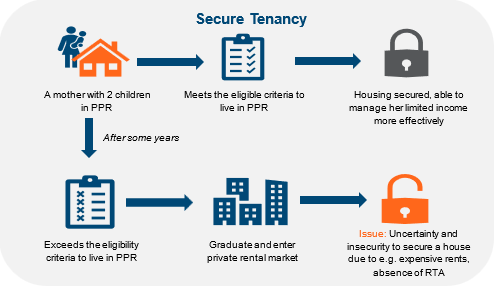
To put this into perspective, imagine a single mother of two young children living in a PPR unit in Kuala Lumpur. With access to subsidised rent of RM124, she knows that as long as she meets the eligibility criteria, her housing is secure. This assurance allows her to manage her limited income more effectively, saving for her children’s education, covering healthcare needs and planning for future housing options once she exceeds the threshold. Until then, the security of tenure provides her with the peace of mind and the opportunity to build a more stable foundation for her family’s future.
Security of tenure and exit policies in social housing must work together
Consider the same single mother after ten years, with her improved financial circumstances, which means that she no longer meets the program’s eligibility criteria. She is expected to graduate from the social housing program and transition to the private rental market. At this stage, she faces challenges in finding affordable options in the private sector and finding a suitable grace period to prepare for the transition. This leaves her with uncertainty and insecurity about how to maintain stability for her family while also securing housing within her financial means.
Figure 1: Scenario on the importance of secure tenancy in social housing
Hence, it is important to ensure that clear exit policies, including adequate notice periods and transitional assistance, are available to support households' transition into the market sector. Without such measures, the transition out of social housing could undermine the very stability the programme was intended to provide, disrupt family life and expose households to renewed socio-economic vulnerabilities.
The absence of a clear exit or graduation framework remains a structural weakness in social housing programs. Without viable and affordable alternative housing pathways, households may remain in social housing longer than they should, limiting turnover and reducing access for newly eligible households. Earlier research by KRI (2023) found that approximately 26% of households in its PPR case studies were potentially eligible to exit from social housing if viable options were available. However, the lack of a clear exit framework and a viable exit policy, coupled with unaffordable private rental options, has left many households trapped in the social sector.
Government policy should therefore distinguish between two complementary roles: a duty to house and a duty to help15. The former involves providing housing for households unable to secure adequate shelter on their own, while the latter focuses on enabling households with improved financial capacity to transition into the private housing market through targeted financial assistance, incentives and advisory support16. Achieving this balance requires an inclusive and well-functioning housing ecosystem capable of absorbing households ready to move out of social housing. The aim is to view social housing as a form of social protection for lower-income households. Ultimately, social housing should be recognised as an integral part of the social protection system for lower-income households, with clear pathways to suitable and affordable housing that enable residents to transition into the private market without falling back into housing insecurity.