









Introduction
The concept of the “middle-income trap” entered Malaysia’s development discourse through the New Economic Model (NEM) in 2010, informed by the World Bank’s report.1 The NEM ambitiously aimed to more than double Malaysia’s per capita income and achieve high-income status by 2020 through export-led industrialisation. It also sought to empower the private sector and reduce income disparity between the wealthiest and poorest Malaysians. The NEM’s long-term vision was subsequently carried through into the 10th and the 11th Malaysia Plans, as the 10th Malaysia Plan put it:
“We are now at a critical juncture, either to remain trapped in a middle-income group or advance to a high-income economy. We were successful in the past in transforming the economy from agriculture to industrial-based. The next phase of transformation, from a middle‑income to high‑income nation, we now have to shift to a new economic model based on higher value‑add and knowledge intensive activities.”2
Sixteen years after the NEM, Malaysia’s economy is larger, its infrastructure has expanded, and foreign investment continues to flow into the country at a remarkable scale. The mega-infrastructure and private-sector-led growth have largely materialised, namely the Klang Valley Mass Rapid Transit (MRT) under the Economic Transformation Programme (ETP). Malaysia is now 7.1% below the World Bank high-income threshold and is predicted to achieve high-income status by 2028.3
Philip Schellekens, Chief Economist at UNDP, recently argued that Malaysia is not caught in a middle-income trap.4 Instead, he suggests that the “trap” is a flawed concept and the wrong frame: it is a common growth trajectory rather than an income-level barrier. Hence, he argues that we should retire the idea of a “trap” and focus instead on the policy challenge of sustaining growth. However, my concern is that retiring the label does not necessarily mean we have retired the growth model that shaped Malaysia’s response to the so-called “trap” - one that continues to evaluate development primarily through aggregate income and economic growth.
That being said, I agree that Malaysia should move beyond the middle-income trap narrative. The more fundamental question, therefore, is, if Malaysia is getting richer, are the benefits generated from the growth model in the pursuit of high-income economy status - one that combines clustered growth with revitalised investment through FDI - can translate national income into broadly shared socio-economic prosperity that eventually reaches households.
Characteristic 1: Clustered Growth Through Agglomeration
One important feature of Malaysia’s growth model since the 10th Malaysia Plan has been its reliance on agglomeration. Malaysia’s pursuit of regional development is not new. Since the 1970s, the government have attempted to spread economic opportunities beyond the major urban centres from redistribution programmes such as the Federal Land Development Authority (FELDA) to promote rural development under the New Economic Policy (NEP), and the Southeast Johor Development Authority (KEJORA) to reduce regional economic imbalances and create job opportunities. The major strategic shift happened when the 10th Malaysia Plan and the NEM subsequently placed greater emphasis on agglomeration, recognising that, given limited resources, focusing on a few high-value-added sectors with strong potential, while concentrating infrastructure, firms and talent in strategic clusters, could generate stronger economies of scale and network effects.5 A good example here is Silicon Valley, which shows how clustering can create dynamic economic ecosystems.
The Korean experience similarly demonstrates that clustering - building of density in the capital region around Seoul - indeed successfully boosts economic growth, which could not have been achieved through ‘balanced growth’ within the same time frame. As a result, Korea evolved from a low-income economy into a high-income economy in less than 50 years. Yet their regional disparities narrowed since the implementation of the agglomeration in 1980: according to a World Bank study, the spatial disparity gap, in gross regional domestic production per capita, between the capital region and the southwest region, dropped from about 40% in 1985 to about 10% by the late 1990s.6 The important distinction is that Korea did not pursue FDI-led growth but emphasized local industrial upgrading and strong backward and forward linkages with the rest of the local economy, allowing economic activity to spill beyond the capital region. Clustering can therefore narrow spatial disparities when growth centres generate strong domestic linkages and spillovers, rather than merely concentrating investment.7
Malaysia’s case is different. In practice, Malaysia’s clustered growth has increasingly been reinforced by FDI-led development since 2010, with multinational corporations and export-oriented investment logically agglomerating in locations where infrastructure, ports, and existing skilled-labour pools are strongest, such as the Klang Valley, Johor, and Penang. This reinforces the advantages of already-developed economic centres and corridors, while regions outside these clusters may receive fewer opportunities to participate in higher-value activities. In 2024, 110 out of 166 districts, particularly in the east coast and northern regions of Peninsular Malaysia as well as Sabah and Sarawak, had below-national labour force participation rates, leaving the other less-developed regions outside these clusters to concentrate in informal, low-productivity self-employment and reliant on transfers to support household income.8 Put another way, the clustered growth strategy essentially allowed for unbalanced regional growth as a trade-off in the pursuit of economic results to achieve the high-income threshold.
Characteristic 2: Revitalise Investment Through FDI
Another characteristic of growth, starting from the 10th Malaysia Plan, is that Malaysia has sought to revitalise private investment as a source of growth. Private investment was once a major engine of the Malaysian economy, accounting for the bulk of total investment. Between 1987 and 1997, private investment rose to more than 30% of gross domestic production (GDP).9 However, it plummeted following the 1998 Asian financial crisis and has remained depressed ever since. By 2005, it had recovered only to around 10% of GDP. Another economic crisis in 2008 raised concerns that Malaysia’s growth trajectory would further flatten. This prolonged weakness of private investment subsequently became an important policy concern, increasing the importance of attracting new sources of investment, including foreign direct investment (FDI), to sustain economic activity and integrate Malaysia into shifting global and regional production networks.10
Malaysia’s increasing reliance on FDI also differs from that of North-East Asian economies, like Korea, Taiwan and Japan. In Korea’s context, FDI has never been as important. The ratio of FDI flows to gross fixed capital formation (GFCF) in non-residential capital peaked in 1973 at about 6% but declined to less than 2% in the 1980s, when Korea’s domestic investment boomed.11 Malaysia, by contrast, has remained relatively reliant on FDI as a major source of investment and participation in global production, but has not stimulated significant nationally-owned export industries.12 As GFCF was largely sustained by major infrastructure projects, the government has increasingly encouraged and welcomed foreign capital through a widening range of investment incentives, including the New Industrial Master Plan 2030's targeting of semiconductors, data centres, and renewable energy, as well as the establishment of Special Economic Zones.13
The problem arises when the success of attracting foreign capital becomes an end in itself. Malaysia's ability to attract foreign investment is a success. But attracting capital does not guarantee inclusive domestic benefits. Foreign investors naturally seek locations where they can operate competitively. Malaysia’s relatively well-established infrastructure, connectivity, and labour market can therefore contribute to the country’s attractiveness as an investment destination. Yet the spillovers remain questionable, and these advantages are not costless.
Data Centres: Where Agglomeration and FDI Meet
Malaysia’s data centre boom is a useful contemporary case to examine the relationship between Malaysia’s economic performance and distributional issues because it combines both characteristics of the country’s growth model: agglomeration and large-scale FDI, while simultaneously revealing the limits of the prevailing growth model contributing to domestic prosperity.
Between 2021 and mid-2025, 143 data centre projects worth RM144.4 billion of investment were recorded, making the technology sector one of the country’s biggest recipients of FDI.14 Malaysia has also continued to lead Southeast Asia’s data centre rankings, positioning itself to become the regional data centre hub. The National AI Roadmap 2021–2025 laid out an ambitious vision of building sovereign AI capacity rather than simply hosting foreign infrastructure.15 Yet, much of the AI infrastructure ecosystem arrived through foreign private capital, such as Google, Microsoft, AWS, Oracle and Nvidia, operating at a scale thousands of times larger than the government-funded infrastructure and ring-fenced research and development (R&D).
Due to several strategic factors, the growing network of data centres is primarily concentrated in Johor, Selangor and Cyberjaya. However, the domestic spillovers may be far more limited than the headline investment numbers suggest. RM144.4 billion of investment generated very few direct jobs, and the job opportunities are unlikely to spill beyond the hub regions. Despite economic gains, a hyperscale data centre can span the size of a football pitch and consume enough energy to power a small city, reflecting the fact that data centres are land- and power-intensive rather than labour-intensive.16 Establishing more energy-hungry data centres poses challenges to the country’s environmental goals and will inevitably crowd out other possible uses of freshwater supplies and reduce local groundwater aquifers.17
At the same time, foreign capital is leveraging Malaysia’s localised cost advantages in energy and resources. Compared to other countries in the region, Malaysia is attractive for two reasons: stable electricity costs and network infrastructure. We have relatively affordable electricity prices, supported by a single-buyer market and subsidisation, along with a mature power system. On the other hand, our transportation networks, power grids, water supplies, and labour markets are adequate.18 As a result, a large amount of the country’s economic resources is being leveraged, principally by Global North countries, while our economy remains reliant on revenues generated from hosting foreign-owned infrastructure.
This dependence and the transfer of resources are a major impediment to our country’s development. Foreign firms may bring production and investment while retaining much of the intellectual property, high-value R&D and high-wage jobs at home. Much of the revenue generated by data centres is repatriated to Global North countries via transnational corporations, leaving our natural resources exploited and the economy concentrated at the lower end of the production chain, such as labour-intensive assembly-line jobs. Eventually, the burden of this unequal exchange falls disproportionately on the labour force and their households in our country.
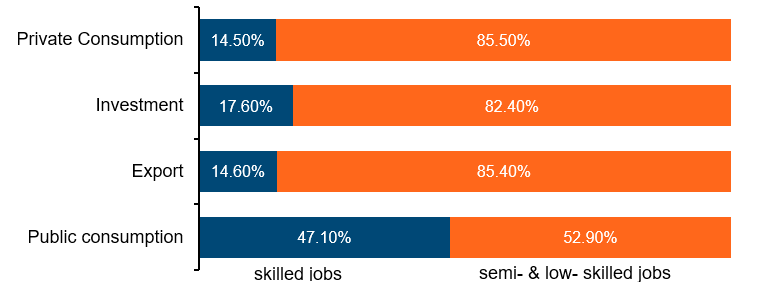
According to a study from the Centre for Future Labour Studies in Malaysia, the real growth engines - investment, exports and private consumption in nationwide generate roughly three semi- or low-skilled jobs for every skilled job, validating that our economy is structurally oriented toward lower-value-added production.19
Figure 1: Contribution of private consumption, investment and export to employment generation by skills
The Missing Question: Household Prosperity
Looking back in reality, have we really achieved a resilient economy, social well-being and equitable wealth distribution among our people? Based on KRI’s upcoming report, The State of Households 2026, which draws from the Houshold Income Survey Report 2024 by DOSM, median household incomes continued to recover following COVID-19, growing at a annual rate of 5.1% between 2022 and 2024 in nominal terms, faster than in previous periods. On the surface, this suggests that the benefits of economic recovery are reaching households.20 Yet the national average tells an incomplete story.
Figure 2: Median household income, by district, 2024
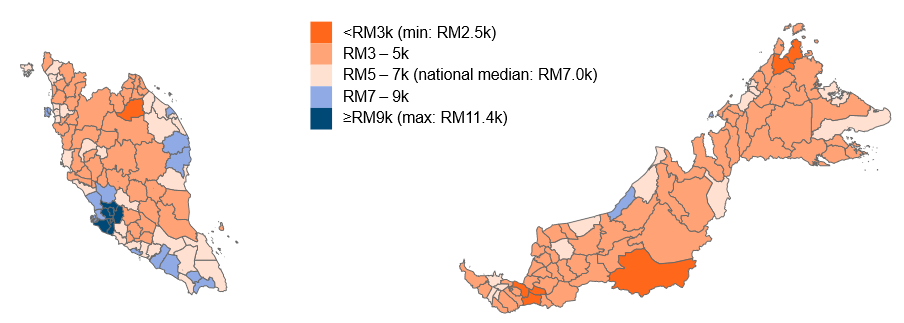
Figure 3: Real mean residual household income (2024 prices), by income decile, 2019 – 2024
A. Gross income minus expenditure (RM)
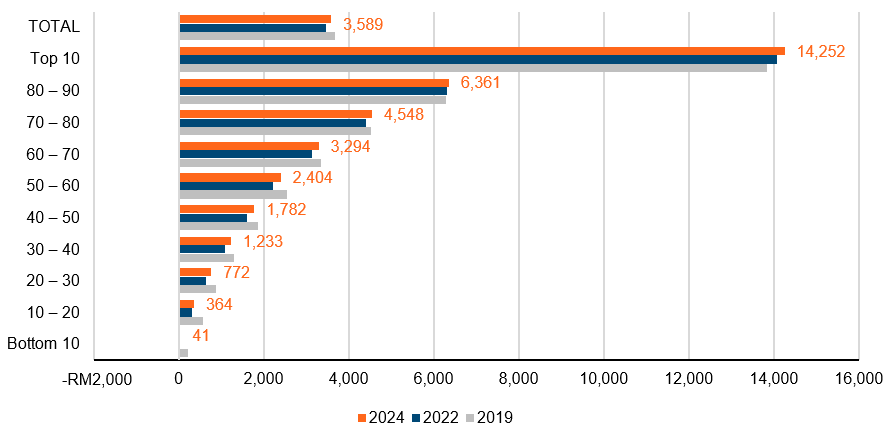
A closer look reveals substantial distributional disparities. Out of the total 166 districts in Malaysia, 22 reported median household incomes above the national median of RM7,017 in 2024. The figures are similar for previous years and almost half (46.2%) of Malaysian households live in these 22 districts. This indicates how economic activities and the population remain highly concentrated among a relatively small number of districts.21 The T20 income group holds around eight times the income share of the B20, while T20 households are mainly concentrated in the urban area, accounting for more than 88% of the group.22 What is even concerning is the residual income left for B10 households after expenditures fell from RM219 in 2019 to just RM41 in 2024, an 81% decline in five years.23
About two-thirds of Malaysian household income is highly reliant on paid employment, but our labour demand remains concentrated in semi-skilled jobs, which account for more than half of employment.24 Hence, even as GDP rises, demand for high-skilled, high-wage labour does not keep pace. This constrains wage growth, worsens brain drain and skill mismatches, and erodes the utilisation of Malaysia’s human capital. In this sense, the growth model designed to attain high-income status has consequences that eventually reach the socioeconomic dimesion.
Conclusion: Rethinking the Relationship Between Growth and Distribution
The prevailing growth model aimed at achieving a high-income economy has indeed delivered visible economic successes since we are now closer than ever to crossing the high-income threshold. However, the way we conceptualise growth itself determines what we notice as a success and what we treat as an externality. The data centre boom illustrates this tension particularly well: billions of ringgit in investment can be attracted into the country, while the benefits and costs of that investment may be distributed very differently across firms, regions and households.
Since the 10th Malaysia Plan, Malaysia has spent decades trying to reconcile two objectives: spreading development geographically while exploiting the efficiency gains of agglomeration and FDI-led growth. Our government have continuously coped with the distributional disparities by implementing several redistribution initiatives — from targeted cash transfers to the B40 under Bantuan Rakyat 1 Malaysia (BR1M), later Bantuan Sara Hidup and Sumbangan Tunai Rahmah, to digital-infrastructure equity programmes like Jalinan Digital Negara. Yet, distribution issues are often treated as a downstream consequence or an afterthought of growth — something to be addressed only after economic gains have been generated in the pursuit of escaping the middle-income trap. The challenge, therefore, is not simply to ensure that Malaysia grows faster or reaches the high-income threshold sooner. It is time to rethink how distribution is built into the way we think about economic growth and development.
As we are moving towards the next stage of development, if the gains from the current growth model remain unevenly distributed across places and households, have we really moved beyond the middle-income trap? Or have we simply changed the notion while keeping the same way of thinking about development?