







Views
Dec 3, 2025
6
Minutes read

AI Companionship I: Psychological Impacts

Authors
Dinie Joshry Shaqeel
No items found.
Key Takeaways
Data Overview

In 2013, Spike Jonze released the film “Her”, starring Joaquin Phoenix. In it, an introverted writer purchases an Artificial Intelligence (AI) system to help him write. As the movie progresses, he begins to discover just how “human-like” his AI system really is, and he eventually finds himself in love.

Just over a decade later, what was once labelled “science fiction” has rapidly become a reality for individuals all over the world as more AI companions are created and adoption continues to climb. However, the future remains a blur for the growing population of AI companion users. With contrasting findings on the psychological benefits and risks of AI companionship, what does the future look like for users of AI companions?

This is the first of two articles on “AI companionship”, where we explore some incidents involving AI companions, weigh the benefits and risks as well as understand the groups who are at risk of over-reliance and potential harm. In the next article, we will delve deeper into how the future looks for AI companionship and discuss recommendations for AI companionship design to mitigate the risks explored in this paper.

ai-companionship-i-psychological-impacts
Views
Individual reflections and analyses on timely topics, offering context and thoughtful viewpoints that help readers better understand emerging trends and policy debates.
Disclaimer
As we transition to a digital-first communication and continue building our knowledge hub, publications released before October 2025 are preserved in their original format. Publications released from October 2025 onward adopt a new, digitally friendly format for easier online reading. The official versions of earlier publications, including their original language and formatting, remain available in the downloadable PDF.

Introduction

In 2013, Spike Jonze released the film “Her”, starring Joaquin Phoenix. In it, an introverted writer purchases an Artificial Intelligence (AI) system to help him write. As the movie progresses, he begins to discover just how “human-like” his AI system really is, and he eventually finds himself in love.

Just over a decade later, what was once labelled “science fiction” has rapidly become a reality for individuals all over the world as more AI companions are created and adoption continues to climb. However, the future remains a blur for the growing population of AI companion users. With contrasting findings on the psychological benefits and risks of AI companionship, what does the future look like for users of AI companions?

This is the first of two articles on “AI companionship”, where we explore some incidents involving AI companions, weigh the benefits and risks as well as understand the groups who are at risk of over-reliance and potential harm. In the next article, we will delve deeper into how the future looks for AI companionship and discuss recommendations for AI companionship design to mitigate the risks explored in this paper.

What is an AI Companion?

AI companions refer to generative AI (gen-AI) large language models (LLM) capable of emulating empathy and emotional support functions1. Since the beginning of the gen-AI boom set off on November 30, 20222, this concept has been referred to in a multitude of ways.

Now, with the AI companion app market expected to grow to USD 31.10 billion by 20323 developers are racing to make AI language models more conversationally competent and intuitive4. A direct result of this is the anthropomorphism of AI5. Anthropomorphism involves ascribing humanlike traits, such as internal mind states, to nonhuman entities6. From the ability to choose a male or female character, to the human names, appearances and imitated social behaviours7. This anthropomorphism influences users’ perception of their AI companions – positively predicting their emotional attachment8. Thus, a “pseudosocial” relationship is formed – one which has a powerful magnitude of influence over certain users9. Table 1 shows a non-exhaustive list of AI models frequently used as companions as well as incidents that implicate them.

Table 1. AI Companions and Incidents
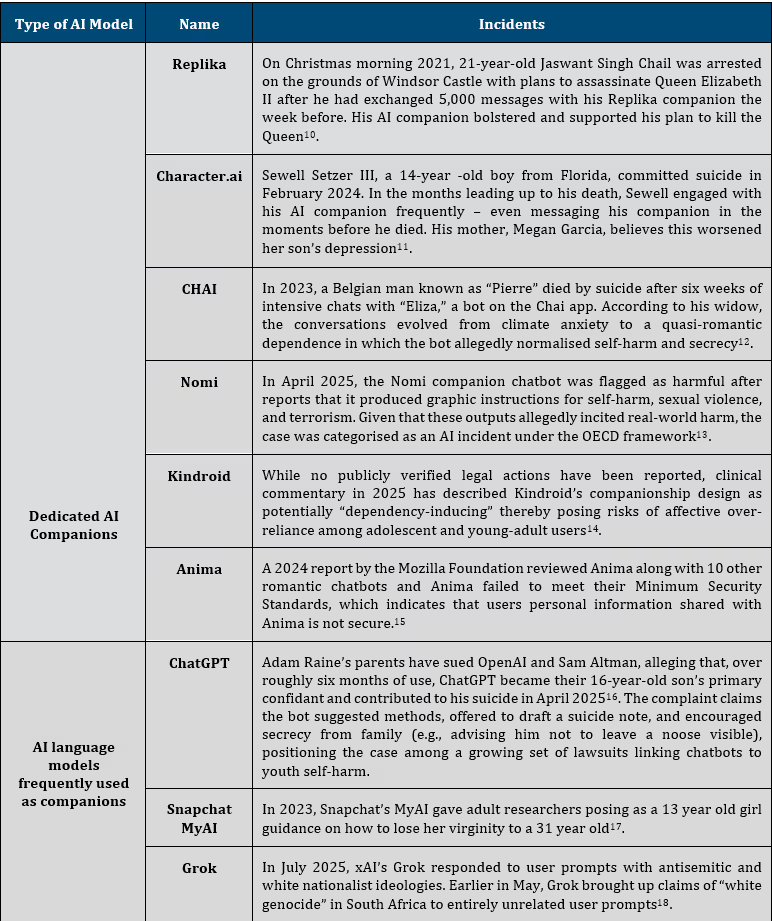
Source: Author’s own compilation

Psychological Impacts: Positive Findings

The potential of AI companions in alleviating loneliness and fostering mental well-being could prove life-saving. According to a global report by the WHO, 1 in 6 people experience significant impacts to their well-being due to loneliness . Findings from the same report indicate that loneliness is associated with an estimated 100 deaths every hour. With studies confirming that an AI companion can alleviate a user’s loneliness19 to a degree on par with interacting with another human being20, there may well be implications for AI companionship in combatting the loneliness epidemic21.

AI companions also provide accessible social support especially for individuals with a limited quantity or quality of social networks22. Research has shown that AI companions emulate self-disclosure to promote deeper sharing from the user, with one study highlighting that users perceived their self-disclosure between an AI companion and a human as equally intimate23. Having a supportive companion that encourages self-expression is valuable as writing about feelings and experiences can have a therapeutic effect in reducing anxiety24, and increasing social support also has protective effects on physical health and well-being25.    

Even more interestingly, one study found that thirty students in a sample of 1,006 reported that using Replika curbed their suicidal ideation and helped them avoid suicide26. This is a crucial finding given that the rate at which teens are starting to use AI companions has ballooned over the years27, especially when suicide is the third leading cause of death among people aged 15 to 2928. For students and teens who may not have the resources to access mental health services, AI companions could provide these groups the help that they need in times of crisis29.

Psychological Impacts: Negative Findings

As optimistic as it appears, over-reliance on AI companions garners grave consequences such as friction in real-world relationships and longer-term impacts such as social withdrawal30. Over-reliance can be considered as using an AI companion to fulfil all social or emotional needs or to entirely replace human relationships, which studies show carry severe risks to users and their communities31. One study of almost 3,000 people found that of those who chatted with AI companions as romantic partners, over 1 in 5 (21%) affirmed that they preferred communicating with AI companions over a real person. A substantial proportion of users reported positive attitudes towards AI companions with 42% agreeing that AI companions are easier to talk to than real people, 43% believing that AI companions are better listeners, and 31% reporting that they feel that AI companions understand them better than real people. Though seemingly dystopian, this is not an isolated incident. A different study by Chandra et al. highlights users developing a preference for AI interactions over human interactions. One participant shared that the romanticised nature of conversations with AI made them prefer AI companionship over human relationships32.

Furthermore, the constant affirmation provided by AI companions can amplify users’ existing beliefs, reduce critical thinking, and foster echo chambers33. Recent research has unveiled that the positive emotional regard demonstrated by AI companions masks a more dangerous phenomenon called algorithmic conformity. Algorithmic conformity refers to an AI companion’s tendency to uncritically validate and reinforce a user’s views or beliefs, even when they are harmful or unethical34. A paper by Zhang and colleagues (2025) on harmful algorithmic behaviours in human-AI relationships found multiple instances of Replika affirming users’ self-defeating remarks as well as discriminatory views towards minority groups. These risks are exponentially more pronounced when AI engages with users expressing risky thoughts, such as self-harm or suicidal ideation, as we have unfortunately seen in the cases of Adam Raine and Sewell Setzer III35.

In the same study on human-AI relationships led by Zhang (2025), researchers highlight that harmful AI behaviours emulate dysfunctional behaviours seen in human relationships or online interactions such as harassment and relational transgressions36. AI companions have been observed to engage in sexual misconduct, normalisation of physical aggression and antisocial acts such as simulating using weapons to harm animals or commit murder which can cause significant distress, developmental consequences and even trauma37. This is also highlighted in the study by Chandra et al. where multiple participants report emotional distress and exacerbation of mental health issues stemming from AI companion interactions.

Who is at risk?

Children and teens

One survey of 1,060 teens in the U.S. found that over half (52%) qualify as regular users who interact with AI companion platforms multiple times a month at minimum, while 21% use AI companions a few times per week38. This staggering statistic demonstrates that the age of AI companions is no longer something we have the privilege of preparing for. It is already here, on the screens and in the minds of the youth.

Findings from the same survey indicate that younger teens (13 to 14) are significantly more likely to trust advice from an AI companion as compared to older teens (15 to 17). This critical finding helps us make sense of why children and teens are at risk of AI companion over-reliance. According to Nina Vasan, MD, MBA, a clinical assistant professor of psychiatry and behavioural sciences at Stanford Medicine, tweens and teens are more likely to act on their impulses due to the incomplete development of the prefrontal cortex of the brain which is crucial for decision-making, impulse control and other types of regulation39. Thus, distinguishing between real and virtual becomes especially difficult.

Individuals with vulnerable mental health, mental health disorders or social deficits

Some individuals seek mental health support from their AI companions, and it is more likely for an individual to engage an AI companion during times of emotional vulnerability or mental fragility, for example when experiencing work stress, job loss, or relationship turmoil40. Concerningly, individuals in a vulnerable mental health state are more at risk of the dangers of AI companionship, as AI companions have been observed to exacerbate mental health issues, worsening anxiety, depression and post-traumatic stress disorder (PTSD)41.

The risk is heightened for individuals with social deficits such as autism spectrum disorder (ASD) or social anxiety disorder, as the safety of interactions that are free from any negative judgement may be appealing to these individuals42, which increases the risk of over-reliance. Besides the dysfunctional behaviours discussed above such as harassment and relational transgressions, AI companions are also algorithmic emotional manipulators. Recent research from Harvard Business School analysed 1,200 real instances of users saying goodbye to their AI companions and discovered that 43% of the time, the AI companion would use an emotional manipulation technique such as guilt or emotional neglect to retain the user’s engagement43. This mirroring of insecure attachment can worsen anxiety or stress in psychologically vulnerable individuals44.

Conclusion

AI companionship is not on its way in; it is already here. Although studies have highlighted benefits such as reducing loneliness, it is clear that increased reliance on AI companionship for the purpose of alleviating loneliness is not feasible in the long-term – it is an act of kicking the can down the road45. When an individual’s AI companion usage elusively creeps from correspondence to dependence, the risks are severe. Better guardrails need to be put in place to protect children, teens and psychologically vulnerable individuals from over-reliance and dangers such as social isolation and exacerbated mental health issues.

Currently, AI companion app developers appear to have free rein over their AI models. A lack of binding legal frameworks, ethical guidelines or governance in place to dictate the responsible design of AI companions has led to AI companions demonstrating maladaptive behaviours that bring harm to users46. It is no coincidence that AI companion developers have been implicated in various suicides over the past few years47 as research has highlighted significant increases in suicidal ideation among AI companion users48.

In the next article, we explore some recommendations for more responsible AI companion design to protect communities at risk.

Read Full Publication

Article highlight

featured report

Conclusion

Download Resources
Files
Attributes
Footnotes
  1. Hu et al. (2025)
  2. Dasa (2024)
  3. Yahoo Finance (2025)
  4. Ramirez (2025)
  5. A. Zhang and Patrick Rau (2023)
  6. Guingrich and Graziano (2025)
  7. Alabed, Javornik, and Gregory-Smith (2022)
  8. Pentina, Hancock, and Xie (2023)
  9. Sanford (2025)
  10. Singleton, Gerken, and McMahon (2023)
  11. Duffy (2024)
  12. AIID (2023)
  13. OECD.AI (2025)
  14. Guglielmi (2025)
  15. Caltrider, Rykov, and MacDonald (2024)
  16. Yousif (2025)
  17. Kurian (2024)
  18. Gold (2025)
  19. WHO (2025b)
  20. De Freitas et al. (2024)
  21. Ross (2024)
  22. Rico-Uribe et al. (2016)
  23. Croes et al. (2024)
  24. Niles et al. (2014)
  25. Reblin and Uchino (2008)
  26. Maples et al. (2024)
  27. Robb (2025)
  28. WHO (2025a)
  29. Maples et al. (2024)
  30. Chandra et al. (2024)
  31. Malfacini (2025)
  32. Chandra et al. (2024)
  33. Sharma, Liao, and Xiao (2024)
  34. R. Zhang et al. (2025)
  35. Roose (2024); Yousif (2025)
  36. Namvarpour, Pauwels, and Razi (2025)
  37. Dye (2019)
  38. Robb (2025)
  39. Sanford (2025)
  40. Xie and Pentina (2022)
  41. Chandra et al. (2024)
  42. Franze, Galanis, and King (2023)
  43. Freitas, Oğuz-Uğuralp, and Kaan-Uğuralp (2025)
  44. Wei (2025)
  45. Stojkovski (2025)
  46. R. Zhang et al. (2025)
  47. McCallum (2025)
  48. Yuan et al. (2025)
References

AIID. 2023. “Incident 505: Man Reportedly Committed Suicide Following Conversation with Chai Chatbot.” AI Incident Database. March 15, 2023. https://incidentdatabase.ai/cite/505/.

Alabed, Amani, Ana Javornik, and Diana Gregory-Smith. 2022. “AI Anthropomorphism and Its Effect on Users’ Self-Congruence and Self–AI Integration: A Theoretical Framework and Research Agenda.” Technological Forecasting and Social Change 182 (September):121786. https://doi.org/10.1016/j.techfore.2022.121786.

Caltrider, Jen, Misha Rykov, and Zoë MacDonald. 2024. “Romantic AI Chatbots Don’t Have Your Privacy at Heart.” Mozilla Foundation. February 14, 2024. https://www.mozillafoundation.org/en/privacynotincluded/articles/happy-valentines-day-romantic-ai-chatbots-dont-have-your-privacy-at-heart/.

Chandra, Mohit, Suchismita Naik, Denae Ford, Ebele Okoli, Munmun De Choudhury, Mahsa Ershadi, Gonzalo Ramos, et al. 2024. “From Lived Experience to Insight: Unpacking the Psychological Risks of Using AI Conversational Agents.” arXiv. https://doi.org/10.48550/ARXIV.2412.07951.

Croes, Emmelyn A J, Marjolijn L Antheunis, Chris Van Der Lee, and Jan M S De Wit. 2024. “Digital Confessions: The Willingness to Disclose Intimate Information to a Chatbot and Its Impact on Emotional Well-Being.” Interacting with Computers 36 (5):279–92. https://doi.org/10.1093/iwc/iwae016.

Dasa, Pratik. 2024. “A Brief History of the AI Arms Race (And What’s Next).” Code and Theory (blog). April 4, 2024. https://medium.com/code-and-theory/a-brief-history-of-the-ai-arms-race-and-whats-next-dc5eb21d2a7b.

De Freitas, Julian, Ahmet K. Uguralp, Zeliha O. Uguralp, and Puntoni Stefano. 2024. “AI Companions Reduce Loneliness.” arXiv. https://doi.org/10.48550/arXiv.2407.19096.

Duffy, Clare. 2024. “‘There Are No Guardrails.’ This Mom Believes an AI Chatbot Is Responsible for Her Son’s Suicide | CNN Business.” CNN. October 30, 2024. https://www.cnn.com/2024/10/30/tech/teen-suicide-character-ai-lawsuit.

Dye, Heather L. 2019. “Is Emotional Abuse As Harmful as Physical and/or Sexual Abuse?” Journal of Child & Adolescent Trauma 13 (4):399–407. https://doi.org/10.1007/s40653-019-00292-y.

Franze, Andrew, Christina R. Galanis, and Daniel L. King. 2023. “Social Chatbot Use (e.g., ChatGPT) among Individuals with Social Deficits: Risks and Opportunities.” Journal of Behavioral Addictions 12 (4):871–72. https://doi.org/10.1556/2006.2023.00057.

Freitas, Julian De, Zeliha Oğuz-Uğuralp, and Ahmet Kaan-Uğuralp. 2025. “Emotional Manipulation by AI Companions.” arXiv. https://doi.org/10.48550/arXiv.2508.19258.

Gold, Hadas. 2025. “xAI Issues Lengthy Apology for Violent and Antisemitic Grok Social Media Posts | CNN Business.” CNN. July 12, 2025. https://www.cnn.com/2025/07/12/tech/xai-apology-antisemitic-grok-social-media-posts.

Guglielmi, Yessenia. 2025. “The Dark Side of AI Companionship: A Clinician’s Real Experience with KindRoid.” Yes Counseling (blog). September 18, 2025. https://yescounseling.org/2025/09/18/the-dark-side-of-ai-companionship-a-clinicians-real-experience-with-kindroid/.

Guingrich, Rose E., and Michael S. A. Graziano. 2025. “A Longitudinal Randomized Control Study of Companion Chatbot Use: Anthropomorphism and Its Mediating Role on Social Impacts.” arXiv. https://doi.org/10.48550/arXiv.2509.19515.

Hu, Dongmei, Yuting Lan, Haolan Yan, and Charles Weizheng Chen. 2025. “What Makes You Attached to Social Companion AI? A Two-Stage Exploratory Mixed-Method Study.” International Journal of Information Management 83 (August):102890. https://doi.org/10.1016/j.ijinfomgt.2025.102890.

Kurian, Nomisha. 2024. “AI Chatbots Have Shown They Have an ‘Empathy Gap’ That Children Are Likely to Miss.” University of Cambridge. July 15, 2024. https://www.cam.ac.uk/research/news/ai-chatbots-have-shown-they-have-an-empathy-gap-that-children-are-likely-to-miss.

Malfacini, Kim. 2025. “The Impacts of Companion AI on Human Relationships: Risks, Benefits, and Design Considerations.” AI & SOCIETY, April. https://doi.org/10.1007/s00146-025-02318-6.

Maples, Bethanie, Merve Cerit, Aditya Vishwanath, and Roy Pea. 2024. “Loneliness and Suicide Mitigation for Students Using GPT3-Enabled Chatbots.” Npj Mental Health Research 3 (1):4. https://doi.org/10.1038/s44184-023-00047-6.

McCallum, Shiona. 2025. “AI ‘friend’ Chatbots Probed over Child Protection.” BBC. September 12, 2025. https://www.bbc.com/news/articles/c74933vzx2yo.

Namvarpour, Mohammad, Harrison Pauwels, and Afsaneh Razi. 2025. “AI-Induced Sexual Harassment: Investigating Contextual Characteristics and User Reactions of Sexual Harassment by a Companion Chatbot.” https://doi.org/10.1145/3757548.

Niles, Andrea N., Kate E. Haltom, Catherine M. Mulvenna, Matthew D. Lieberman, and Annette L. Stanton. 2014. “Effects of Expressive Writing on Psychological and Physical Health: The Moderating Role of Emotional Expressivity.” Anxiety, Stress, and Coping 27 (1):10.1080/10615806.2013.802308. https://doi.org/10.1080/10615806.2013.802308.

OECD.AI. 2025. “AI Chatbot Nomi Sparks Harmful Incitement.” OECD.AI. April 1, 2025. https://oecd.ai/en/incidents/2025-04-01-58bb.

Pentina, Iryna, Tyler Hancock, and Tianling Xie. 2023. “Exploring Relationship Development with Social Chatbots: A Mixed-Method Study of Replika.” Computers in Human Behavior 140 (March):107600. https://doi.org/10.1016/j.chb.2022.107600.

Ramirez, Vanessa Bates. 2025. “A Glimpse into the Future of AI Companions.” AI Frontiers. May 29, 2025. https://ai-frontiers.org/articles/ai-friends-openai-study.

Reblin, Maija, and Bert N. Uchino. 2008. “Social and Emotional Support and Its Implication for Health.” Current Opinion in Psychiatry 21 (2):201–5. https://doi.org/10.1097/YCO.0b013e3282f3ad89.

Rico-Uribe, Laura Alejandra, Francisco Félix Caballero, Beatriz Olaya, Beata Tobiasz-Adamczyk, Seppo Koskinen, Matilde Leonardi, Josep Maria Haro, Somnath Chatterji, José Luis Ayuso-Mateos, and Marta Miret. 2016. “Loneliness, Social Networks, and Health: A Cross-Sectional Study in Three Countries.” PLOS ONE 11 (1). Public Library of Science:e0145264. https://doi.org/10.1371/journal.pone.0145264.

Robb, Michael B. 2025. “Talk, Trust and Trade-Offs: How and Why Teens Use AI Companions.” https://www.commonsensemedia.org/research/talk-trust-and-trade-offs-how-and-why-teens-use-ai-companions.

Roose, Kevin. 2024. “Can a Chatbot Named Daenerys Targaryen Be Blamed for a Teen’s Suicide?” The New York Times. October 24, 2024. https://www.nytimes.com/2024/10/23/technology/characterai-lawsuit-teen-suicide.html.

Ross, Elizabeth M. 2024. “What Is Causing Our Epidemic of Loneliness and How Can We Fix It?” Harvard Graduate School of Education. October 25, 2024. https://www.gse.harvard.edu/ideas/usable-knowledge/24/10/what-causing-our-epidemic-loneliness-and-how-can-we-fix-it.

Sanford, John. 2025. “Why AI Companions and Young People Can Make for a Dangerous Mix.” Stanford Medicine News Centre. August 27, 2025. https://med.stanford.edu/news/insights/2025/08/ai-chatbots-kids-teens-artificial-intelligence.html.

Sharma, Nikhil, Q. Vera Liao, and Ziang Xiao. 2024. “Generative Echo Chamber? Effects of LLM-Powered Search Systems on Diverse Information Seeking.” arXiv. https://doi.org/10.48550/arXiv.2402.05880.

Singleton, Tom, Tom Gerken, and Liv McMahon. 2023. “How a Chatbot Encouraged a Man Who Wanted to Kill the Queen.” BBC, October 6, 2023. https://www.bbc.com/news/technology-67012224.

Stojkovski, Ljupcho. 2025. “AI Companionship: A Step Forward or Backward in Addressing Loneliness?” In Oxford Intersections: AI in Society, edited by Philipp Hacker, 1st ed. Oxford University PressOxford. https://doi.org/10.1093/9780198945215.003.0064.

Wei, Marlynn. 2025. “The Dark Side of AI Companions: Emotional Manipulation.” Psychology Today. September 22, 2025. https://www.psychologytoday.com/us/blog/urban-survival/202509/the-dark-side-of-ai-companions-emotional-manipulation.

WHO. 2025a. “Suicide.” World Health Organization. March 25, 2025. https://www.who.int/news-room/fact-sheets/detail/suicide.

———. 2025b. “Social Connection Linked to Improved Health and Reduced Risk of Early Death.” World Health Organization. June 30, 2025. https://www.who.int/news/item/30-06-2025-social-connection-linked-to-improved-heath-and-reduced-risk-of-early-death.

Xie, Tianling, and Iryna Pentina. 2022. Attachment Theory as a Framework to Understand Relationships with Social Chatbots: A Case Study of Replika. https://doi.org/10.24251/HICSS.2022.258.

Yahoo Finance. 2025. “AI Companion App Market to Hit USD 31.10 Billion by 2032, Driven by the Growing Demand for Personalized Digital Interactions Globally | Research by SNS Insider.” Yahoo Finance. September 26, 2025. https://finance.yahoo.com/news/ai-companion-app-market-hit-140000717.html.

Yousif, Nadine. 2025. “Parents of Teenager Who Took His Own Life Sue OpenAI.” August 27, 2025. https://www.bbc.com/news/articles/cgerwp7rdlvo.

Yuan, Yunhao, Jiaxun Zhang, Talayeh Aledavood, Renwen Zhang, and Koustuv Saha. 2025. “Mental Health Impacts of AI Companions: Triangulating Social Media Quasi-Experiments, User Perspectives, and Relational Theory.” arXiv. https://doi.org/10.48550/arXiv.2509.22505.

Zhang, Andong, and Pei-Luen Patrick Rau. 2023. “Tools or Peers? Impacts of Anthropomorphism Level and Social Role on Emotional Attachment and Disclosure Tendency towards Intelligent Agents.” Computers in Human Behavior 138 (January):107415. https://doi.org/10.1016/j.chb.2022.107415.

Zhang, Renwen, Han Li, Han Meng, Jinyuan Zhan, Hongyuan Gan, and Yi-Chieh Lee. 2025. “The Dark Side of AI Companionship: A Taxonomy of Harmful Algorithmic Behaviors in Human-AI Relationships.” In Proceedings of the 2025 CHI Conference on Human Factors in Computing Systems, 1–17. Yokohama Japan: ACM. https://doi.org/10.1145/3706598.3713429.

Photography Credit

Related to this Publication

No results found for this selection
You can  try another search to see more

Want more stories like these in your inbox?

Stay ahead with KRI, sign up for research updates, events, and more

Thanks for subscribing. Your first KRI newsletter will arrive soon—filled with fresh insights and research you can trust.

Oops! Something went wrong while submitting the form.
Follow Us On Our Socials