








Data Sets
Oct 3, 2019
6
Minutes read

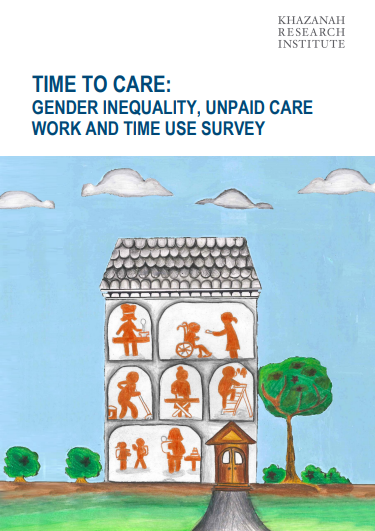
Time to Care: Gender Inequality, Unpaid Care Work and Time Use Survey

No items found.
Authors
Dr Christopher Choong Weng Wai
Adam Manaf Mohamed Firouz
Alyssa Farha Jasmin
Alyssa Farha Jasmin
Nazihah Muhamad Noor
Rachel Gong
Rachel Gong
Key Takeaways
Data Sets Overview

The Khazanah Research Institute 2018 Time Use Survey is a small-scale pilot project that explores the potential of time use survey as a methodology to understand how people of different demographic characteristics allocate their time across activities. Our report, Time to Care: Gender Inequality, Unpaid Care Work and Time Use Survey, showcases the strength of time use surveys in giving visibility to unpaid care work, and empirically linking it to gender inequality and the wider economy.

time-to-care-gender-inequality-unpaid-care-work-and-time-use-survey-dataset
Data Sets
Disclaimer
As we transition to a digital-first communication and continue building our knowledge hub, publications released before October 2025 are preserved in their original format. Publications released from October 2025 onward adopt a new, digitally friendly format for easier online reading. The official versions of earlier publications, including their original language and formatting, remain available in the downloadable PDF.

Introduction

Gender inequality and unpaid care work are inextricably intertwined. Despite improvements made by women in labour force participation, job advancement and remuneration, unpaid care work is limiting progress and slowing the pace of gender convergence in the economy. Anecdotal evidence abounds and data from labour force surveys further lend credence to this aspect of nonmarket activity having an impact on market outcomes. There is broad agreement on the problem statement, captured considerably in official development planning and policy documents.

However, the nature of unpaid care work taking place predominantly at home—where there is no market transaction—poses a non-trivial challenge to our ability to grapple with the intricacies of the issues and advance understanding that can lead to better and more effective policy solutions. Discourses on the economy, gender inequality and unpaid care work exist in parallel but may not intersect in a meaningful way. The lack of empirical data, or the ability to count unpaid care work, often lead to the magnitude of the problem being underestimated, shifting unpaid care work down the hierarchy of issues that warrant attention and redress.

This is where the time use survey comes in. It is a methodology that comes with a set of instruments that can be used to enumerate non-market activities. Its historical roots are inseparable from unpaid care and its gender implications, but the time use survey has since taken off into many other interesting research directions. While certainly imperfect, many countries across regions and development levels are turning to time use surveys as the tool to bridge the gap between market and non-market activities. International and regional organisations are harmonising standards, and research centres are experimenting with innovative ways to conduct time use studies using new technology.

Our report, Time to Care: Gender Inequality, Unpaid Care Work and Time Use Survey, builds on this rich and growing tradition. It is based on a pilot time use survey that we conducted in 2018 but our larger motivation stems from wanting to strengthen the empirical work linking the economy, gender inequality and unpaid care work. We want to demonstrate the usefulness and potential of time use surveys, albeit at a small scale, and the insights that can be derived alongside more representative datasets to spur policy thinking.  

For a detailed explanation of the survey design, data collection process, coding framework, and data processing procedures, please refer to the KRI Time Use Survey User Guide.

Caveats and Limitations

This dataset is subject to the following caveats as described in the KRI Time Use Survey User Guide :

  • This dataset is based on a small-scale pilot Time Use Survey involving 125 respondents.
  • The survey covers residents aged 20 - 64 in Kuala Lumpur only.
  • Time use data reflects one recalled weekday (Tuesday - Thursday) per respondent.
  • Information is self-reported and collected via retrospective interviews.
  • Imputation and proxy measures were applied for selected demographic and income variables.
  • Activities were coded using ICATUS 2016, with documented coding rules and decisions applied.

Metadata

Data Source(s) Face to face interview
Last Updated 4th March 2024
Frequency One-off
Format Excel Workbook

KRI Time Use Survey Data

Dataset Brief Description

This dataset contains data from the Khazanah Research Institute Time Use Survey, a small-scale pilot survey. The survey collected information on how respondents spent their time during the previous 24-hour weekday, recorded using a time-diary starting at 4am the previous day and ending at 4am on the interview day in 15-minute intervals. The survey was conducted through face-to-face interviews with respondents aged 20 to 64 residing in Kuala Lumpur.

This particular dataset reports the sum total minutes spent for each respondent per activity category (including main and secondary activities), per location category, per transportation type, and per social context category. It also contains each respondents' demographic, household, and employment-related information, as well as whether they perceive their time reported as being representative of their usual weekday and whether they are satifsfied with their time-use.

Activities are coded according to the International Classification of Activities for Time Use Statistics 2016 (ICATUS 2016), following the coding rules and procedures described in the User Guide. Selected variables were derived or imputed during data processing as documented in the User Guide.

Methodology

A full methodology is provided in the following document: KRI Time Use Survey User Guide

Download Dataset

Download Data
Dataset Preview
ID Gender Age Ethnic Marital Education Employment Status Household Income No. of Jobs Job Type Household Size Representative Weekday Satisfied A1_1 (Work) A1_31 (Domestic) A1_41 (Care) A1_81 (Leisure) T_1 (Transport) L_1 (Home) W1_1 (Social)
1 Male 50 Malay Married Certificate (>6 months) Working Full Time RM8,000–RM8,999 1 Full-time 6 No Yes 620.0 225.0 105.0 177.5 1140.0 572.5 30.0
3 Female 36 Malay Married Diploma Working Part Time > RM15,000 2 Part-time 7 Yes Yes 267.5 150.0 112.5 247.5 1255.0 1140.0 55.0
4 Male 33 Malay Married Bachelor’s degree Working Full Time RM10,000–RM10,999 1 Full-time 2 No No 135.0 300.0 195.0 217.5 1292.5 585.0 0.0
5 Male 27 Malay Married Bachelor’s degree Working Full Time > RM15,000 1 Full-time 4 No No 560.0 30.0 85.0 367.5 1247.5 720.0 0.0
6 Female 43 Malay Married Diploma Working Full Time RM10,000–RM10,999 1 Full-time 5 Yes No 493.0 72.5 70.0 390.0 1316.0 782.5 14.5
Note: This preview shows selected columns only. To access the complete set of variables, please download the full dataset.
Column Definitions
Note: Refer to User Guide for further interpretation of these activity and context codes.
Column Name Data Type Description Valid Values / Units Example Value
ID int Respondent unique identification number Positive integer 1
Gender string Gender of respondent Male, Female Male
Age int Age of respondent Years 50
Ethnic string Ethnicity of respondent Malay, Chinese, Indian, Others Malay
Marital string Marital status of respondent Single, Married, Widowed, Divorced Married
Nationality string Nationality of respondent Malaysian, Non-Malaysian Malaysian
Education string Educational attainment of respondent Certificate, Diploma, Bachelor’s degree, etc. Bachelor’s degree
Head string Whether the respondent is the head of household Yes, No Yes
Empl.stts string Employment status of the respondent Employed, Unemployed, Student, Retired Working Full Time
Dpndt string Whether the respondent is disabled or in need of special care Yes, No No
Chldrn.out string Whether the respondent has children living outside the household Yes, No No
Own.Vehcle string Whether the respondent’s household owns any vehicle Yes, No Yes
n.Car int Number of cars owned by household ≥ 0 1
n.Motor int Number of motorcycles owned by household ≥ 0 1
n.Van int Number of vans owned by household ≥ 0 0
n.Lorry int Number of lorries owned by household ≥ 0 0
Maid string Whether the household employs a live-in domestic worker Yes, No No
Nanny string Whether the household uses nanny/child-minder services Yes, No Yes
Cleaner string Whether the household uses cleaner services Yes, No No
Taska string Whether the household relies on care centres (child/elderly) Yes, No Yes
Hh.Inc string Total household income range Income bands (RM) RM8,000 – RM8,999
n.Jobs int Number of paid jobs held by respondent ≥ 1 1
Occ int Occupation category of primary job Coded categories 3
Hrs.pw string Weekly working hours (primary job) Hour ranges 30 to 48 hours
Job.ft string Full-time or part-time primary job Full-time, Part-time Full-time
Occ_2 int Occupation category of secondary job Coded categories / NA 2
Hrs.pw_2 string Weekly working hours (secondary job) Hour ranges / NA Less than 15 hours
Job.ft_2 string Full-time or part-time secondary job Full-time, Part-time, NA Part-time
Occ_3 int Occupation category of tertiary job Coded categories / NA NA
Hrs.pw_3 string Weekly working hours (tertiary job) Hour ranges / NA NA
Job.ft_3 string Full-time or part-time tertiary job Full-time, Part-time, NA NA
Indvl.Inc string Total personal income Income bands (RM) RM6,000 – RM6,999
Hse.Size int Household size ≥ 1 6
Yngest int Age of youngest household member Years 6
Oldest int Age of eldest household member Years 50
n.<1y int Household members under 1 year ≥ 0 0
n.<3y int Household members under 3 years ≥ 0 0
n.<15y int Household members under 15 years ≥ 0 2
n.<18y int Household members under 18 years ≥ 0 4
n.>18y int Household members over 18 years ≥ 0 4
n.>64y int Household members over 64 years ≥ 0 2
n.Resp children int Respondent’s children ≥ 0 2
Gender.hh string Gender of head of household Male, Female Male
Age.hh int Age of head of household Years 50
Emp.hh string Employment status of head Employed, Unemployed, Retired Employed
Dep.hh string Head disabled Yes, No No
Rel.hh string Relationship to head Self, Husband, Wife, Parent Self
Gender.Spse string Spouse gender Male, Female Female
Age.spse int Spouse age Years 44
Emp.spse string Spouse employment Employed, Unemployed Employed
Dep.spse string Spouse disabled Yes, No No
n.Working int Working household members ≥ 0 2
Rprsnt.UsualWkday string Usual weekday Yes, No Yes
Satisfied string Satisfaction Yes, No No
A1_[1-9] float Main activity major division Numeric (float) 180.0
A1_[11-95] float Main activity division Numeric (float) 15.0
A2_[1-9] float Secondary activity major Numeric (float) 0.0
A2_[11-93] float Secondary activity division Numeric (float) 1.0
T_1 float Total minutes in Transport mode 1 (Train) Numeric (float) 190.0
T_2 float Total minutes in Transport mode 2 (Bus) Numeric (float) 168.0
T_3 float Total minutes in Transport mode 3 (Taxi) Numeric (float) 1.0
T_4 float Total minutes in Transport mode 4 (Private e-hailing) Numeric (float) 22.5
T_5 float Total minutes in Transport mode 5 (Car driver) Numeric (float) 1.0
T_6 float Total minutes in Transport mode 6 (Car passenger) Numeric (float) 1.0
T_7 float Total minutes in Transport mode 7 (Motorbike driver) Numeric (float) 1.0
T_8 float Total minutes in Transport mode 8 (Motorbike passenger) Numeric (float) 178.0
T_9 float Total minutes in Transport mode 9 (Bicycle) Numeric (float) 1.0
T_10 float Total minutes in Transport mode 10 (Walking) Numeric (float) 199.0
T_97 float Total minutes in Transport mode 97 Numeric (float) 77.5
L_1 float Location type 1 (Own house) Numeric (float) 2.0
L_2 float Location type 2 (Friend house) Numeric (float) 207.0
L_3 float Location type 3 (Relative house) Numeric (float) 257.5
L_4 float Location type 4 (Other house) Numeric (float) 2.0
L_5 float Location type 5 (Workplace) Numeric (float) 2.0
L_6 float Location type 6 (Public area) Numeric (float) 2.0
L_7 float Location type 7 (Commercial) Numeric (float) 2.0
L_8 float Location type 8 (Leisure) Numeric (float) 2.0
L_9 float Location type 9 (Dining) Numeric (float) 2.0
L_10 float Location type 10 (Education) Numeric (float) 2.0
L_99 float Location type 99 (Other) Numeric (float) 2.0
W1_0 float Who with activity 1 (Unspecified) Numeric (float) 457.5
W1_1 float Who with activity 1 (Spouse) Numeric (float) 1.0
W1_2 float Who with activity 1 (Child) Numeric (float) 30.0
W1_3 float Who with activity 1 (Family) Numeric (float) 134.0
W1_4 float Who with activity 1 (External family) Numeric (float) 1.0
W1_5 float Who with activity 1 (Non-family) Numeric (float) 199.0
W2_0 float Who with activity 2 (Unspecified) Numeric (float) 134.0
W2_1 float Who with activity 2 (Spouse) Numeric (float) 0.0
W2_2 float Who with activity 2 (Child) Numeric (float) 199.0
W2_3 float Who with activity 2 (Family) Numeric (float) 457.5
W2_4 float Total minutes spent by respondent in Who with for activity 2 category 4 (Family and relative living outside household) Numeric (float) 0.0
W2_5 float Total minutes spent by respondent in Who with for activity 2 category 5 (Non-family household member) Numeric (float) 457.5
W2_6 float Total minutes spent by respondent in Who with for activity 2 category 6 (Friends/neighbours/acquaintances) Numeric (float) 199.0
W2_8 float Total minutes spent by respondent in Who with for activity 2 category 8 (Colleagues and clients) Numeric (float) 0.0
W2_9 float Total minutes spent by respondent in Who with for activity 2 category 9 (Shop personnel/service providers) Numeric (float) 134.0
W2_11 float Total minutes spent by respondent in Who with for activity 2 category 11 (Stranger) Numeric (float) 0.0
W2_12 float Total minutes spent by respondent in Who with for activity 2 category 12 (Alone) Numeric (float) 0.0
W2_97 float Total minutes spent by respondent in Who with for activity 2 category 97 (Not applicable (no activity 2)) Numeric (float) 0.0

Respondents Time Diary

Dataset Brief Description

This dataset contains data from the Khazanah Research Institute Time Use Survey, a small-scale pilot survey. The survey collected information on how respondents spent their time during the previous 24-hour weekday, recorded using a time-diary starting at 4am the previous day and ending at 4am on the interview day in 15-minute intervals. The survey was conducted through face-to-face interviews with respondents aged 20 to 64 residing in Kuala Lumpur.

This particular dataset, in a time-diary format, reports the main and secondary activities for each 15-minute interval, as well as the transport used (if applicable), the location, social context and further time duration in minutes (for 15-minute intervals where more than one activitity is report).

Activities are coded according to the International Classification of Activities for Time Use Statistics 2016 (ICATUS 2016), following the coding rules and procedures described in the User Guide. Selected variables were derived or imputed during data processing as documented in the User Guide.

Methodology

A full methodology is provided in the following document: KRI Time Use Survey User Guide

Download Dataset

Download Data
Dataset Preview
ID Time Activity 1 Activity 2 Transport Location With Who 1 With Who 2 Duration
1 4.00AM 141, 141 711, 843 97, 97 5, 5 8, 8 8, 8 7.5, 7.5
1 4.15AM 141, 141 711, 843 97, 97 5, 5 8, 8 8, 8 7.5, 7.5
1 4.30AM 141, 141 711, 843 97, 97 5, 5 8, 8 8, 8 7.5, 7.5
1 4.45AM 141, 141 711, 843 97, 97 5, 5 8, 8 8, 8 7.5, 7.5
1 5.00AM 141, 141 711, 843 97, 97 5, 5 8, 8 8, 8 7.5, 7.5
Note: This preview shows selected columns only. To access the complete set of variables, please download the full dataset.
Column Definitions
Note: Refer to User Guide for further interpretation of these activity and context codes.

Column Definitions

Column Name Data Type Description Example Value
ID int Respondent unique identification number 1
Time string 15-minute time interval 4.00AM
Activity 1 string Main activity performed (coded following ICATUS 2016) 141, 141
Activity 2 string Secondary (simultaneous) activity performed (coded following ICATUS 2016); "." signifies no Activity 2 711, 843
Transport string Transport used by respondent 97, 97
Location string Location of respondent 5, 5
With Who 1 string With whom Activity 1 is performed 8, 8
With Who 2 string With whom Activity 2 is performed 8, 8
Duration string Duration in minutes 7.5, 7.5

Location Codes

Code Description
0 Undescribed / not specified
1 Own house
2 Someone else's house: friend
3 Someone else's house: relative/family
4 Someone else's house: other
5 Workplace if outside home (includes farm)
6 Public area (e.g., street, town hall, public gardens, church; excluding work surau, etc.)
7 Commercial and service area (e.g., bank, shop, office; other than 8 and 9)
8 Establishment for leisure, culture, sports activities
9 Eating and drinking locale (excluding work canteen, etc.)
10 Educational establishment
11 Country, bush, beach
99 Other

Transport Codes

Code Description
0 Transport used, not specified
1 Train
2 Bus
3 Taxi
4 Private e-hailing
5 Car, van, truck as driver
6 Car, van, truck as passenger
7 Motorbike, scooter as driver
8 Motorbike, scooter as passenger
9 Bicycle
10 Walking
11 Airplane
12 Boat / ferry
97 Not applicable
99 Other N.E.C.

Who with Codes

Code Description
0 Unspecified
1 Spouse
2 Child living in household
3 Other family member living in household (excluding spouse and child)
4 Family / relative living outside household
5 Non-family household member
6 Friends / neighbours / acquaintances
7 Children of friends / neighbours
8 Colleagues and clients
9 Shop personnel / service providers
10 Crowd
11 Stranger
12 Alone
97 Not applicable
99 Other

Related Data Files

1. Respondent Profile

Respondent-level demographic, employment, income, and household information.

Each row represents one respondent and can be linked to the time-diary dataset using the ID.

Download Data

2. Summary Tables on Time Use

Aggregated tables showing mean time spent on primary and secondary activities by selected demographic and contextual categories.

Download Data

Credits

Author(s): Christopher Choong Weng Wai, Adam Manaf Mohamed Firouz, Alyssa Farha Jasmin,Nazihah Muhamad Noor, Dr Rachel Gong

This landing page was prepared and maintained by the Knowledge, Innovation & Data Hub (KID) team at Khazanah Research Institute. The team is responsible for the structuring, documentation, and ongoing maintenance of the dataset.


Read Full Publication

Article highlight

featured report

Conclusion

Download Resources
Files
Datasets
Attributes
Footnotes
References
Photography Credit

Related to this Publication

No results found for this selection
You can  try another search to see more

Want more stories like these in your inbox?

Stay ahead with KRI, sign up for research updates, events, and more

Thanks for subscribing. Your first KRI newsletter will arrive soon—filled with fresh insights and research you can trust.

Oops! Something went wrong while submitting the form.
Follow Us On Our Socials