










Introduction
Some children may begin primary school at age 6 instead of 7 in 2027. This lowering of the age at school entry is contentious, as critics argue that exposure to academic and social pressures too early may undermine effective learning. Furthermore, the influx of students resulting from the lowering of the school entry age raises concerns about classroom size, teacher availability, and other resource constraints. On the other hand, it can be argued that delaying entry defers skills acquisition. This debate is aligned with research findings, which show age at school entry as a determinant not only of academic success but also of labour market outcomes.1 This is likely true for children in the Malaysian education system, yet the extent to which age at school entry determines human capital outcomes is unknown. To gauge this, this article estimates age-at-school-entry effects using Census data.
How institutional rules affect age at school entry
Before presenting the estimates, we briefly illustrate how institutional rules affect the age at school entry and, in turn, how this influences learning. In Malaysia, children begin compulsory primary schooling in January of the year they turn 7. This means a child born in January starts school at 7 years old, while a child born in December enters at about 6 years old, nearly a full year younger. This age difference persists throughout schooling and leads to meaningful differences in development and interactions with peers and educators. As the example shows, laws governing the start of compulsory schooling affect a student’s starting age, which reflects maturity and readiness, as well as the student's relative age in the classroom, which is tied to social interactions. Furthermore, the age at which students are assessed by standardized tests, such as the Sijil Pelajaran Malaysia, would also differ. A consistent finding is that older students tend to outperform younger students.2 We observe this pattern when analyzing the years of schooling of Malaysian adults in the 1991 Census: Malaysians born in January, on average, have longer years of schooling than those born later.3,4
Figure 1: Average years of schooling for persons born in 1954 - 1966 by birth month, 1991

Source: Ruggles et al. (2025), authors’ calculations
Estimating the possible human capital gains from enrolling later
While informative, Figure 1 only clarifies our understanding of the relationship between lower age at school entry and educational attainment, not the possible implications of lowering that age. Answering this is pertinent to the 2027 policy change.
To inform our discussions, we again use the 1991 Census and compare outcomes for persons born in December with those born in January of the following year. This research design is motivated by the regression discontinuity design (RDD), commonly used to study the effects of age at school entry.5 The assumption is that, given similar biological age between those born in December and in the following January, the outcomes of a person born just before the cutoff for Standard 1 enrolment (i.e., December) are comparable to those born immediately after the cutoff (i.e., January) had they entered school a year earlier. Figure 2 shows that a 1-month difference in birth date can be the deciding factor in Standard 1 enrolment. 94.1% of children born in December 1984 were enrolled in Standard 1 in 1991, whereas only 3.3% of children born in January 1985 were. Table 1 summarizes the differences in age at school entry between December- and January-borns, which may explain the differences in outcomes.
Figure 2: Share of children born in December 1984 and January 1985 enrolled in Standard 1, 1991

Table 1: Age at school entry for December (year t) and January (year t+1) babies

To estimate the difference in years of schooling between persons born in December and those born in January of the next year, we run the following ordinary least squares regression model:
(1) Years of schooling_i= β_1∙January+ β_2∙Cohort+β_3∙Birthplace+β_4∙Ethnicity+β_5∙Sex+ε_i
The January coefficient represents the advantage of being born in January compared to being born in the previous month. We designate cohorts for each December (year t)-January (year t+1) pairing, starting with cohort 1 for persons born in December 1954 and January 1955, 2 for December 1955 and January 1956, and so on, up to cohort 13 for December 1966 and January 1967. We control this so that the main estimate represents the average of within-cohort comparisons. We control for fixed effects on birthplace, ethnicity, and sex that may influence education. We run the same regression when investigating the probabilities of being employed and of holding a high-skilled job.
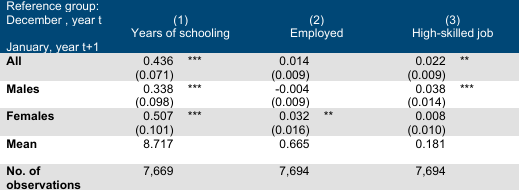
The results in Table 2 can be interpreted as follows: Adults with roughly the same biological age but likely different ages at school entry—due to institutional rules governing school enrolment—have significantly different educational and labour outcomes. January-born adults have longer years of schooling than adults born in the previous month. This extends to both males and females. Unsurprisingly, this pattern is reflected in labour outcomes too, albeit differently by gender. Females born in January are more likely to be employed relative to females born in the previous month. The null effect for males may be due to the high employment rate—89% of males in the sample were employed, compared with only 38% of females. Instead, noteworthy effects amongst males are observed in the likelihood of being employed in high-skilled jobs—managers, professionals, and technicians. Referring to column (3), January-born males are 3.8 percentage points more likely to work in high-skilled jobs relative to males born in the previous month.
Table 2: Effect of being born in January relative to the previous month on years of schooling, likelihood of being employed, and having a high-skilled job
Source: Ruglers et al. (2025), authors’ calculations
To translate the advantage into monetary terms, we calculate the difference in annual salaries and wages between January-borns and those born in the previous month, attributable to January-borns’ higher likelihood of holding high-skilled jobs. With the difference in median monthly wages between high- and low-skilled jobs being RM3,025 in 2024,6 this results in an annual difference of RM36,300 (= RM3,025 x 12 months). With 37,890 live births per month,7 and based on our estimate in Table 2 column (3) that January-borns are 2.2 percentage points more likely to have high-skilled jobs, we estimate a surplus of 851 high-skilled workers among January-borns (= 37,890 x 2.2%). The total annual advantage is estimated at a sizeable RM30,891,300 (= RM36,300 x 851).
While this advantage cannot be entirely attributed to later enrolment, the systematic difference in enrolment timing illustrated in Figure 2 suggests it is likely a contributing factor. Any changes to the timing of enrolment would also change the age at school entry. Table 3 highlights changes in starting and relative ages for January 2021 babies based on year of enrolment. Thus, we can link these findings to the policy discussion by viewing them as potential gains that could be lost should children enroll earlier. In simple terms, the advantage that January (year t+1) children experience relative to December (year t) children might not manifest if they enroll at the same time.
Table 3: Changes in age at school entry for January 2021 babies by year of enrolment

Children of lower socioeconomic status are most vulnerable to policy change
This is not to say that all younger children should delay enrollment. Development is not linear and varies from child to child. The decision to enroll is based on a long set of factors, including the child’s abilities and skills. Currently, the policy change leaves this decision to parents, as Standard 1 entry at age 6 is optional. While one might expect that only 6-year-olds deemed prepared for primary schooling will be enrolled, this decision is often tied to parents’ socioeconomic status, with better-off parents more likely to delay entry.8
Decisions related to the timing of enrolment are influenced by weighing the costs and benefits. These costs take many forms, such as the availability of kindergartens and household labour to bear the childcare burden. Better-off families have a greater ability to absorb the costs of delaying.9 These families, therefore, benefit from the resulting maturity advantage in learning. In contrast, families that are worse off are more constrained. These parents may not be able to afford childcare, and opt to send their kids to school as soon as possible. They may also view earlier entry into the job market as necessary to contribute to household income and reduce dependency. As a consequence, when presented with the option to delay, the benefits are likely to accrue disproportionately to children from more advantaged backgrounds, reinforcing educational and social inequalities.10
Conclusion
This article provides suggestive evidence of the implications of lowering the age at school entry using Malaysian data. Among adults of the same biological age, those likely enrolled later in primary school have longer years of schooling and higher chances of being employed in high-skilled jobs than those likely enrolled earlier. This advantage for children enrolled later may be tied to being older at the start of school and relative to their peers. By enrolling earlier, this advantage may disappear. Thus, decisions on the timing of enrolment must be carefully considered for the child’s current and future well-being.
The current policy change is voluntary, with the assumption that parents enroll only children who are developmentally ready for school. Unfortunately, international evidence suggests that this decision is often tied to social standing. Delaying entry is more common among well-off parents who have the resources for childcare and other preparations prior to enrolment. Without the appropriate interventions, human capital disparities may widen. Thus, remedial measures must be put in place to ensure those affected by the policy change are not left behind.
Our estimates are only suggestive and should be interpreted as intent-to-treat estimates, since the timing of school enrolment is unobserved. This article investigates an old cohort with little to no information on socioeconomic characteristics and schooling experience, precluding adequate control of confounders. For instance, the school they are enrolled in is likely an attenuating factor in educational attainment, as schools with more resources and smaller class sizes would produce better educational outcomes. More research is needed using contemporary administrative data, which would provide information on students’ characteristics and class and school descriptors. With better data (e.g., birthdays rather than birth month as a running variable), more advanced methodologies, such as regression discontinuity design, can be used to produce causal estimates.