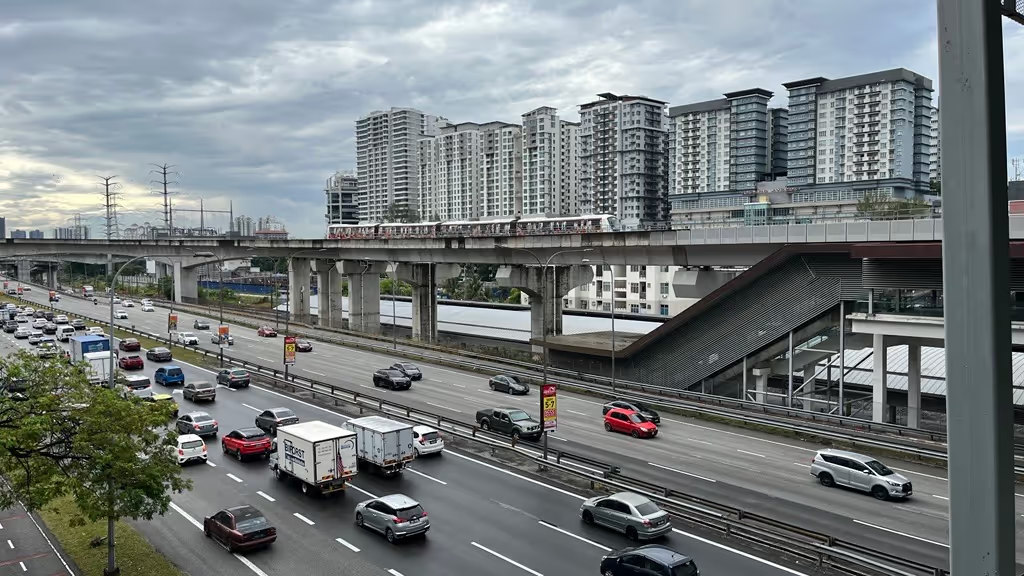










While there is nothing wrong in a city being attractive in that sense, overly focusing on liveability as defined by these rankings may lead to some negative repercussions, particularly in terms of gentrification and its effects.
Liveability rankings as city-marketing strategy
Cities that do well in these rankings are predominantly compact cities in developed countries, such as Melbourne, Vancouver, Copenhagen, Zurich and Munich. The indicators range from those exclusively targeted towards the expatriate community (eg Mercer’s rankings, which some global companies use to calculate settlement allowances for their expatriate employees), to Monocle’s “softer indicators” (eg “electric car charge points” and “ability to shop for groceries on a Sunday”). What is clear however, is that none of these rankings measure a city’s inclusivity, as none of them measure the cost of living (Mercer has a separate cost of living index, but again, this caters to expatriates). Small wonder then, that cities deemed most liveable are also some of the most expensive.
Obviously, all cities should aim for some of the indicators that these rankings measure: all cities should have sustainable, efficient and accessible public transportation and mobility, effective public services delivery, low crime rates, political stability and excellent health and education for its population. The question however, is that if our cities are supposed to climb up these rankings based on indicators clearly aimed at a particular segment of the population, what are the ramifications for other urban citizens, given that resources are finite, and all policy measures have opportunity costs? Do we develop “liveable cities” as defined by the rankings at all costs? None of the liveable city indicators for leisure and recreation for instance, look at whether or not these facilities are accessible to all segments of the population – a city can have a world-class opera house, art galleries and museums without them being affordable (or accessible) to the public, and still technically be rated highly. Neither do these rankings measure other aspects of inclusivity – the Economist ranking for instance, has a high weightage for private healthcare facilities, but none for public ones.
Conflicts between the creative class and the other inhabitants of the “liveable cities” they reside in is not just restricted to Malaysia. San Francisco for instance, is experiencing a pushback from its residents due to higher property prices resulting from the existence of companies such as Google, which also receive special treatment from the city government, eg special buses for their employees, which use public bus stops. In fact, Richard Florida recently stated that the most liveable cities in the US, ie the ones that attract the highest number of people from the “creative class”, are also the most divisive in terms of class and income.
“Liveability” therefore has to be considered beyond the question of the global competitiveness of cities. We need to first ask – who should our cities be liveable for? Do we want to limit Kuala Lumpur and our other cities to only members of the “creative class”, or those involved in what Saskia Sassen defines as “high-end services” (finance, technology, the creative industries) with the majority of the population providing them with “low-wage services”, working in the restaurants, cultural facilities and their households, but being unable to afford to live in these cities thanks to gentrification?
Moving beyond cities as growth engines
Globally and in Malaysia, the future of urban planning is moving away from the neoliberal idea of cities solely as growth engines, and by extension, that cities should compete with each other merely to become stronger production centres for the global economy. Arising from the 2008 Global Financial Crisis and the realisation that capitalism has to change its ethos and structure, cities and city governments are beginning to think beyond issues surrounding economic efficiency and embracing ideas surrounding inclusivity and sustainability. There are moves for instance, to make the planning process in Malaysia more inclusive, with some local authorities such as Majlis Bandaraya Petaling Jaya (MBPJ) taking public hearings more seriously before approving development plans. There is also an increasing recognition in the country that urban planning and policies need to be more holistic, and extend beyond the built environment to include considerations such as social inclusion and measures to tackle urban poverty. Therefore, perhaps one issue that should be considered is how our planning institutions and local government can – as the front-line agencies for urban planning and policy - be more empowered.
In terms of the economic importance of liveable cities, such measures are rooted in the concept of a hierarchy of cities that have emerged as global production centres due to globalisation. Based on work by Richard Florida amongst others, the idea is that mobile high-value human capital (“the creative class”), are attracted to the quality of life offered by “liveable cities”, and this in turn attracts the companies which hire such talent. The missing links here however are: (1) To what extent does the causality run in the other direction, ie talent is attracted by the presence of these companies; (2) Are there more fundamental factors that attract these companies?; and (3) How would the presence of these global companies contribute towards national economic growth, if for instance, they have little linkage with the domestic economy? Therefore it’s a bit difficult to quantify the ‘loss’ to Malaysia if we don’t have “world standard liveable cities”. The straw-man argument is that we can have a world class liveable city on par with Melbourne, or closer to home Singapore (no. 16 in Monocle’s 2014 list), and therefore attract the necessary high-value human capital and the companies that hire them, but how would the local population benefit, if for instance, these companies benefit from existing tax breaks and/or do not have a domestic vendor base or develop local spin-offs? We can have high GDP growth and still not have that growth trickle down towards the majority of the population.
In addition, there is no definite number for the GDP contribution that should come from cities. To the extent that cities are centres for agglomeration economies – ie economies of scale resulting from the proximity of human capital, markets and ideas – then the more urbanized the country, naturally the higher its cities’ contribution to GDP. Given that more than half of Malaysia’s GDP comes from services that are mostly provided from and in cities, such as finance, telecommunications and to a certain extent tourism, then it’s safe to say that most of Malaysia’s GDP, apart from the contribution via mining and agriculture, come from its cities, and is probably close to the global average. McKinsey for instance, has estimated that 60 percent of global GDP comes from the world’s urban centres. The key factor here is productivity, no matter the location of production, and this is related to an economy’s quality of education and institutions, the skills of its labour force and the efficiency of its markets, among other factors.
Conclusion
Returning to liveability rankings, Kuala Lumpur typically places between 70th – 85th place in the EIU and Mercer rankings (it is not included in the Monocle measure), with no other Malaysian cities being ranked. This would seem to indicate that we have a long way to go before we “catch-up” to the likes of Vancouver, Melbourne, etc. However, it is more important not to lose sight of the fact that beyond these rankings, our cities must be liveable for all their inhabitants, as well as economically and environmentally sustainable. In addition, we also need to ensure the same for our peri-urban and rural areas. There are more fundamental issues that are at stake, beyond the superficiality of liveable city rankings – does our education system produce citizens who can contribute towards developing a high-income nation that is both inclusive and sustainable? Are our firms sufficiently productive? Are our institutions strong and efficient enough to effectively provide public services and to protect our rights? Doing well in liveability rankings should be considered as a positive externality on the road to achieving these ends, rather than the end in itself.