








Introduction
Malaysia’s climate-related costs are an amalgamation of several estimates based on its mitigation, adaptation, and other climate-related policies and initiatives. Under mitigation, its net-zero emission goal by 2050 is estimated to require at least RM1.3 trillion in investments1. Nationwide adaptation against flood alone is estimated at RM392 billion2. For disaster preparedness and the development of an Early Warning System, RM460 million and RM210 million are allocated, respectively, in Malaysia’s 2026 national budget3.
Given the scope and price tag, accessing and mobilising climate funds under the United Nations Framework Convention on Climate Change (UNFCCC) may help advance some of Malaysia’s climate initiatives. An understanding of the available funds can directly inform and strengthen Malaysia’s climate and development strategies.
The United Nations and Climate Funds
Arguments over money resurface at every United Nations (UN) climate talk. As the leading platform for climate negotiations, the UN hosts annual conferences to address climate change issues and agreements, where financial provisions are negotiated. At the core of the finance discourse is the question of who pays and who receives, which reflects the opposing positions of developed and developing countries4.
The UN climate talks have acknowledged the gaps in climate finance and the urgent need for support5. This type of acknowledgment affects the climate funds, particularly those under the UNFCCC. The impacts include the funds’ operations and access, as well as the mobilisation of resources to achieve financial targets and funding allocation mandates. These impacts highlight the heart of the finance discourse, particularly regarding how developing countries receive the money and whether they can access it.
Leveraging the Climate Funds
The UNFCCC provides financial resources to developing country Parties for climate-related initiatives and efforts by way of its Financial Mechanism6. It houses several funds and their operating entities, providing financial support to developing countries for climate mitigation and adaptation. As a developing country, Malaysia has access to them.
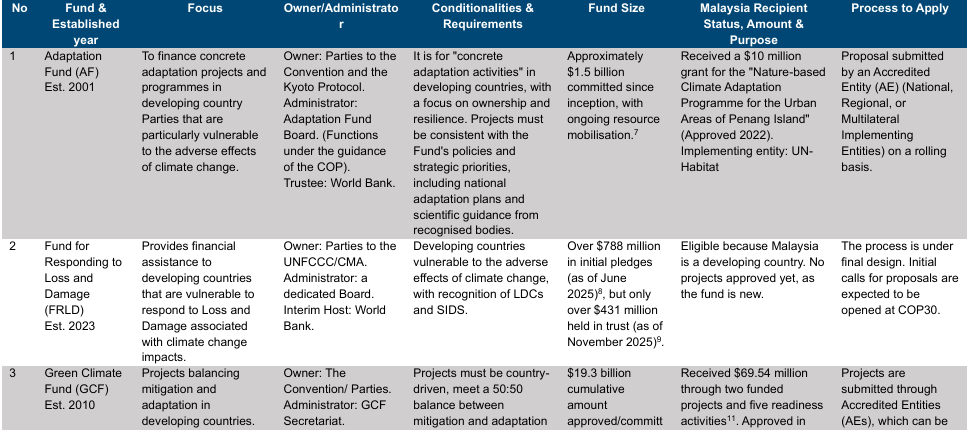
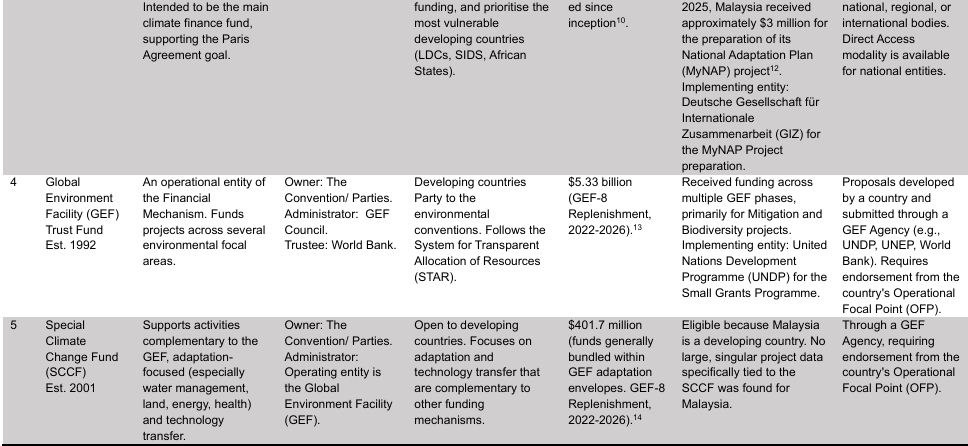
Table 1 below summarises the funds accessible to Malaysia under the UNFCCC.
Table 1: Details of climate funds according to the UNFCCC
Challenges to Efficient Fund Access
Despite pools of available funding for developing countries to support their climate ambitions, developing countries still face challenges in efficiently accessing the funds15. The lengthy processes for accreditation and funding applications are made more challenging when taking into account the technical capacities needed throughout. The complexity of the process and its requirements have affected developing countries’ access to the funds16.
The burden of process and complexity
To access the climate funds, developing countries must establish formal links with them. These formal links are known as accreditation procedures, which are termed differently depending on the funds - for instance, the AF utilises Accredited Institutions while the GCF coins the term Accredited Entities (AE), which can be recognised at multiple levels.
Generally, accreditation involves multiple steps and offers two access options: direct and indirect17. The type of access determines who handles the money and who oversees the project.
Direct access, facilitated through Direct Access Entities (DAEs)18, refer to a country nominating domestic institutions to receive funds directly and manage project execution internally. These institutions can range from government ministries to state-linked organisations. This process requires consultation with the country's national designated authority (NDA)19 to ensure country ownership and alignment.
Taking the GCF as an example, a few ASEAN countries have nominated DAEs, including Indonesia, the Philippines, and Cambodia. Indonesia has two accredited DAEs, namely PT Sarana Multi Infrastruktur and Kemitraan bagi Pembaruan Tata Pemerintahan (Partnership for Governance Reform). These entities coordinate with a department under the Ministry of Finance, which serves as Indonesia’s NDA20. The Philippines nominated the LandBank of the Philippines as its DAE, operating under the oversight of its Department of Finance, as the NDA21. Cambodia nominated the National Committee for Sub-National Democratic Development, with its Ministry of Environment acting as its NDA22.
Indirect access is facilitated through International Accredited Entities (IAEs)23, which include multinational and international organisations. This process provides an alternative for developing countries without direct access.
Regardless of whether an organisation is a DAE or an IAE, any AE must have the legal authority to enter into agreements and be able to manage international funds independently24. This accreditation is not limited to public bodies. Private sector firms or non-profit organisations that meet these criteria may also apply for accreditation at some funds25.
Based on Table 1, Malaysia has received funding from three out of the five funds listed in the form of grants26, proving it has some capability to access these funds. Malaysia received this funding through indirect access from implementing entities (IAEs), namely UN-Habitat, GIZ, and UNDP. There is no public information on whether Malaysia has direct access to the funds.
Project development and implementation capacity gaps
Another factor for receiving funding is proposing projects that meet the objectives of the respective funds. This requires thoughtful and technically sound project proposals, which highlight the much-needed capacities in project development and implementation27.
The project proposal process largely involves developing a project concept note, preparing a funding proposal that aligns with the fund’s objectives and criteria, and submitting the proposal through an AE, which will then go through a review process by the fund’s secretariat and technical advisory panel before seeking approval from the fund’s board28. All in all, this lengthy process is resource-consuming as it requires a combination of human, technical, and financial resources to produce a fully developed proposal. To meet these demands, international intermediaries offer developing countries their expertise and resources29.
Furthermore, project proposals must demonstrate a strong understanding of climate issues by showing how applicants plan to address climate change in their respective areas. Climate knowledge includes distinguishing between mitigation and adaptation projects because each fund has a specific requirement. For example, the Adaptation Fund emphasises adaptation initiatives in developing countries, while the GCF requires applicants to reach a balance between mitigation and adaptation (see Table 1). Likewise, identifying strategic partners to help implement the project is vital to ensure the project’s viability. Thus, multidisciplinary skills are necessary to both develop the projects and justify the funding needs.
For context on how appropriate capacity can help secure funding, consider the approved project by the Adaptation Fund (see Table 1). The Penang Nature-based Climate Adaptation Programme (PNBCAP) for the Urban Areas of Penang Island aims to address the environmental and social components of climate change at the state level30. On the environmental component, the Programme identified issues relating to the urban heat island effect, as well as increased rainfall and flooding, which are to be addressed through urban greening and stormwater management, respectively31. The social component aims to build community-based social resilience, particularly with vulnerable groups32.
The Programme’s strategic partners include Majlis Bandaraya Pulau Pinang (MBPP), Jabatan Pengairan Dan Saliran (JPS), Think City, Ministry of Environment and Water (KASA)33, emphasising its multi-disciplinary team and jurisdictional areas. The Programme demonstrates the application of climate knowledge and provides actionable approaches to address its identified climate issues by leveraging the strategic partners’ corresponding expertise.
The PNBCAP is designed as a pilot initiative to develop a state-level framework on climate adaptation with the potential to scale nationwide34. This intentional approach can help determine state-level capacity and capability to implement climate interventions and monitor its progress, particularly with the Programme‘s knowledge management platform, which is part of its design35.
The processes and procedures in accessing international climate funds are not linear, and the factors listed above are interdependent, requiring country coordination and collaboration.
A Strategic Approach to Fund Access
In order to translate the existing funds’ potential into tangible national outcomes, a two-pronged strategy should be considered. First, Malaysia should proactively pursue fund matching and diversification by identifying and securing funding sources based on project needs and funder priorities. It is also important to ensure that projects are spread equitably between mitigation and adaptation. This measured approach is needed due to the varied rules and procedures required to access the different UNFCCC-linked funds.
Second, Malaysia should consider establishing direct access via DAEs. Thus far, Malaysia has primarily accessed the funds through indirect access, relying on international intermediaries rather than receiving funding directly. The move towards direct access needs a balanced assessment of its advantages and disadvantages. Direct access would promote country ownership by keeping the project’s design, implementation, and decision-making in-house. The internal control helps ensure that projects are aligned with national priorities and local needs, reflecting on-the-ground political and social dynamics. This, in turn, leads to more targeted and relevant interventions.
Conversely, establishing direct access can be a complex and lengthy process, as it must meet the stringent accreditation requirements set by the respective funds (see Table 1). As previously noted, the accreditation process is time- and resource-consuming, further appealing the use of international intermediaries. However, this indirect pathway comes at a cost, as international intermediaries charge fees for their services36. These charges are drawn from the approved project funding, subject to percentages by the respective funds37.
Conclusion
The climate, climate finance, and geopolitical landscapes have changed drastically over the past three decades. Aside from the UN climate talks, these factors influence the resources raised and disbursed by the UNFCCC-linked funds. Thus, developing countries, including Malaysia, ought to be strategic in mobilising climate funds if they can successfully access and utilise these resources.
Malaysia’s success in meeting its climate goals is not solely contingent on receiving support from climate funds. Rather, a comprehensive financial plan is needed to finance Malaysia’s climate-related costs estimated at billions of Ringgit. Although the climate funds total in hundreds of millions of USD, they are distributed selectively among 155 developing countries. Nonetheless, Malaysia should proactively and strategically engage with them. Climate funds such as the AF, FRLD, GCF, GEF, and SCCF should be viewed as a catalytic layer rather than a sole funding source.