








- Over the years, the increased agglomeration of economic activities in major cities and the higher rate of migration of people to these economic centres have catalysed the formation of urban slums in developing countries worldwide.
- As each country faced the challenge to house their growing number of residents in rapidly growing cities, Malaysia has adopted a ‘Zero-Squatter Policy’ in the year 2000, whose goals was to be achieved via the provision and facilitation of low-cost housing in the 1970s as well as resettlement programs in the 1990s and 2000s.
- As a result, Malaysia has done reasonably well in providing shelter and curbing the formation of slums. Nevertheless, various problems emerged over the years concerning the management (or mismanagement) of low-cost housing.
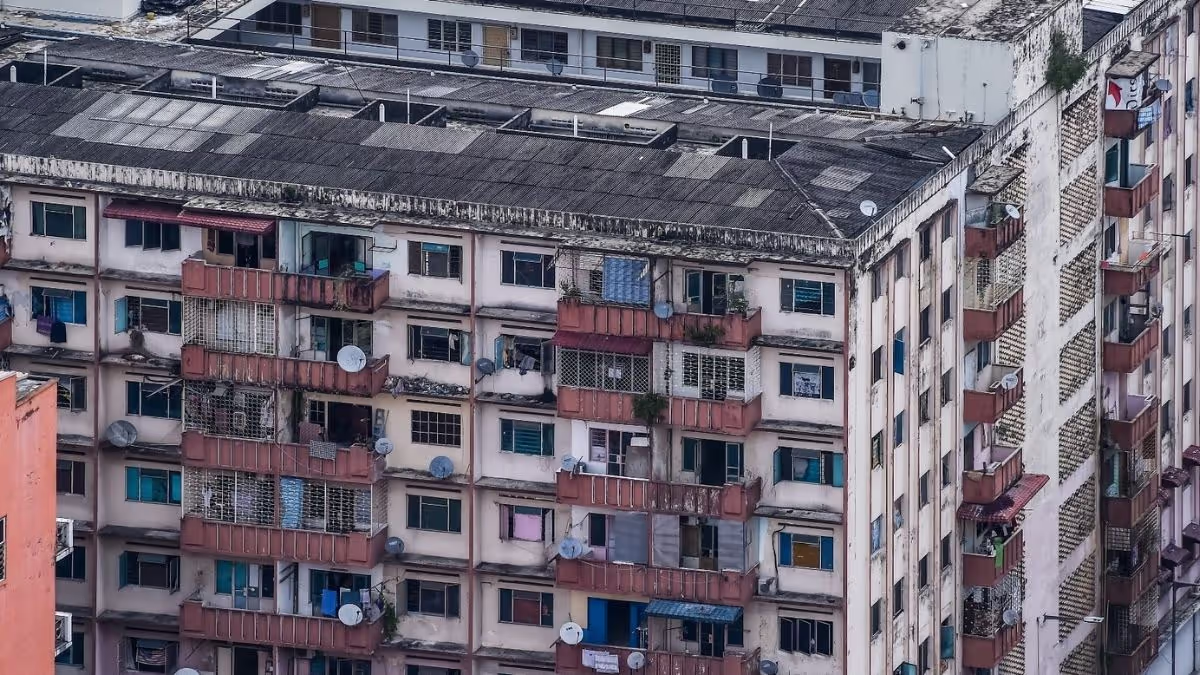
- As a diagnostic tool to detect the magnitude and extent of these problems, we seek to quantify the “Not-in-my-back-yard” (NIMBY) effects of living in close proximity to low-cost housing. This is done by geolocating transacted residential data for the entire Greater Kuala Lumpur (GKL) region over the 5-year period of 2015 to 2019.
- We were able to quantify the statistical association that living in close proximity to low-cost housing is correlated with lower house prices. This suggests the existence of a NIMBY effect, which remains persistent even under different model specifications of the Hedonic Price Model (HPM).
- Our findings point to different statistical regularities in the NIMBY effect for Landed housing vs Non-Landed housing, representing different aspects of NIMBY that is conditioned by the those who live in Landed properties vis-à-vis their Non-Landed counterparts.
- Our findings rekindled the need to reconsider several policy recommendations which we have formerly presented in the Rethinking Housing report[1], to ensure that GKL continues to be an inclusive city, that facilitates its citizens social mobility and aspirations.